Dhammapada verse 157:
Attānañce piyaṃ jaññā, rakkheyya naṃ surakkhitaṃ;
Tiṇṇam aññataraṃ yāmaṃ, paṭijaggeyya paṇḍito.
If one holds one’s soul dear, one should protect it well. At least in one of the three ages of life, a wise man should be vigilant.
For over a century, the translation of attā (Pāli) and ātman (Sanskrit) as “self” has shaped how the teaching is understood in English. This choice, though now conventional, is neither neutral nor sufficient. It narrows a term of ontological depth into a psychological abstraction, and in doing so, redirects the aim of the path itself.
A more accurate rendering—both linguistically and doctrinally—is:
Attā / Ātman = Soul
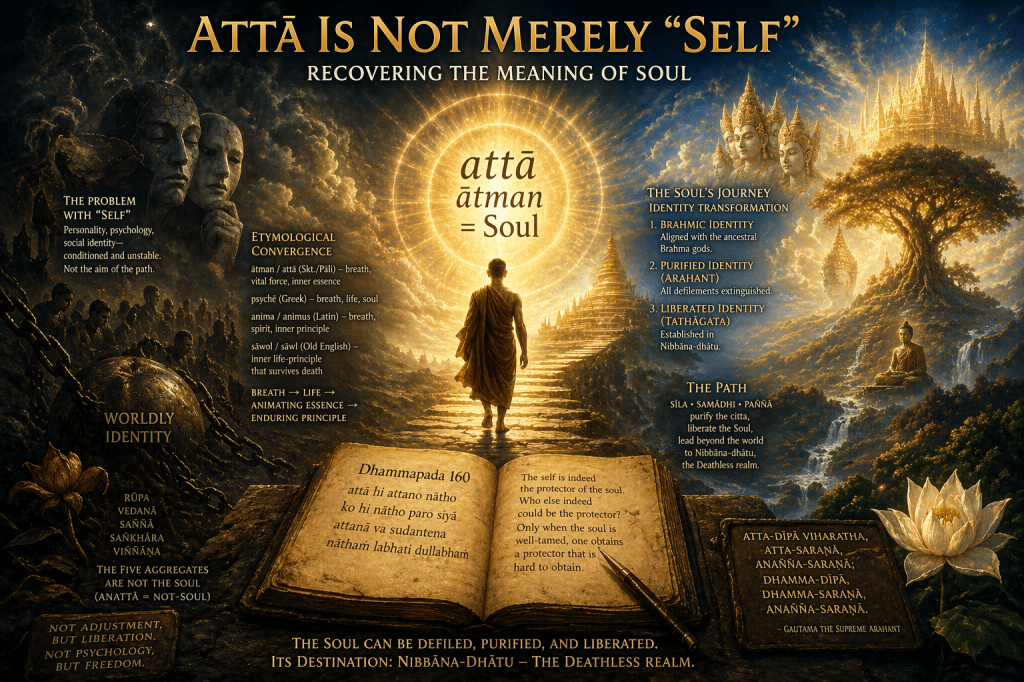
(1). The Problem with “Self”
In modern English usage, self refers to:
- personality (self-image, self-expression)
- psychological processes
- social identity
These are precisely the domains the teaching identifies as conditioned and unstable.
To translate attā as “self” therefore creates a conceptual distortion:
it suggests that the path concerns refinement of personality, rather than liberation of the being from the world.
This is why contemporary readers fall into the contradiction of pursuing a “self-less self”—a linguistic artifact of mistranslation.
(2). Why “Soul” Fits the Term
The English word soul carries features that align far more closely with attā / ātman:
- it refers to the animating principle of life
- it implies continuity beyond a single lifetime
- it carries moral and existential weight
- it is something that can be endangered, purified, or saved
This matches the functional role of the citta in Gautama the Supreme Arahant’s teaching:
the citta is the carrier of the Soul—the locus of continuity, defilement, purification, and liberation.
(3). Etymological Convergence (Indo-European Layer)
When examined etymologically, the case becomes stronger.
Sanskrit / Pāli
- ātman / attā — originally linked to breath, vital force, inner essence
Greek
- ψυχή (psychē) — breath, life, soul
- also connected to animation and continuity of life
Latin
- anima — breath, spirit, soul
- animus — inner principle, mind, life-force
Old English / Germanic
- sāwol / sāwl (soul) — though debated, consistently used to denote the inner life-principle that survives death
Across these traditions, a common semantic field appears:
breath → life → animating essence → enduring principle
This is exactly the semantic field of ātman.
By contrast:
- self derives from Proto-Germanic selbaz → meaning same, identical
- it emphasizes identity, not essence
So linguistically:
“self” encodes sameness
“soul” encodes life-principle
Only the latter matches attā.
(4). Doctrinal Necessity: The Weight of Anattā
The consequences become decisive when we examine anattā.
If translated as:
- “no-self” → it becomes a psychological claim
- “there is no fixed identity”
But correctly understood as:
“not-soul” → it becomes an ontological clarification
Namely:
the five aggregates are not the Soul
- rūpa
- vedanā
- saññā
- saṅkhāra
- viññāṇa
These are:
- worldly conditioned
- impermanent
- part of the world-system
They are not:
- the carrier of continuity
- the entity that is liberated
Thus: Anattā does not deny the Soul—it denies misidentifying the world as the Soul.
(5). Reading Dhammapada 160 Correctly
attā hi attano nātho
ko hi nātho paro siyā
attanā va sudantena
nāthaṁ labhati dullabhaṁ
Literal rendering:
The self is indeed the protector of the soul.
Who else indeed could be the protector?
Only when the soul is well-tamed,
one obtains a protector that is hard to obtain.
This verse makes a critical distinction:
- attā — the acting, disciplining principle
- attano — that which is protected, the belonging essence
This allows a precise functional reading:
The self (as disciplining agent) protects the soul (as the deeper ontological principle).
Through taming (sudantena):
- the citta becomes a nātha (protector, master)
- the Soul becomes secured from the world
(6). Liberation Requires Ontological Language
The path taught by Gautama Buddha is not:
- psychological optimization
- identity refinement
- emotional balance
It is: exit from the world (loka)
Such a goal cannot be carried by minimal language.
- “Self” suggests adjustment
- “Soul” implies risk, gravity, and salvation
And this is exact: the Soul can be defiled, bound, purified, and finally liberated into Nibbāna-dhātu.
(7). Reclaiming the Sacred Meaning of the Path
To restore Soul is to restore honesty.
It affirms that beings are more than biological systems or psychological narratives. It affirms that the Soul can be endangered, purified, restored, and ultimately saved.
Brahmacariya exists for one reason: to free the Soul from the world.
Through ethical withdrawal (Sīla), concentrated lifting of the mind (Samādhi), and liberating realization (Paññā), the defiled citta is purified. When liberation (Vimutti) is complete, the Soul leaves the world entirely and abides in Nibbāna-dhātu, the Deathless realm.
Only there does the Soul become permanent and eternal, deathless and blissful.
This is not a metaphor.
It is the destination.
Restoring Soul restores the seriousness of liberation itself—and reveals again what the path was always meant to accomplish.
“Atta-dīpā viharatha, atta-saraṇā, anañña-saraṇā;
dhamma-dīpā, dhamma-saraṇā, anañña-saraṇā.”
“Dwell with your Soul as your island, your Soul as your refuge, there is no other refuges;
My Dhamma as your island, my Dhamma as your refuge, there is no other refuges.”
- Gautama the Supreme Arahant
(DN 16, Mahāparinibbāna Sutta)
(DN 26, Cakkavatti-Sīhanāda Sutta)
(SN 22.43, Attadīpa Sutta)
To translate attā as “self” is to reduce an ontological principle to a psychological construct. The term properly denotes the Soul—the animating, enduring principle carried by the citta, capable of defilement and purification, and destined either for continued entanglement in the world or for liberation beyond it. Anattā does not negate this Soul, but corrects the fundamental error of identifying it with the five worldly aggregates. Thus, the path is not the refinement or dissolution of personality, but the protection, purification, and ultimate release of the Soul into Nibbāna-dhātu, the Deathless realm.
This article is an excerpt from the forthcoming book The Arahanism Suttas: Handbook for Walking the Path of Complete Liberation by Bhante Mudita. In this work, the Arahanist path of liberation is presented from the pali canon, the original teaching from Gautama the supreme arahant.


Leave a comment