Atammayatā must be understood with exactness. It does not indicate the absence of identity, but non-identification with the world (loka).
It is not no identity — it is no worldly identity.
This distinction is decisive.
In MN 113 (Sappurisa Sutta), even at the summit of attainment in this world — the dimension of neither-perception-nor-non-perception — the practitioner is cautioned not to identify (Atammayatā). In MN 137 (Salayatana-vibhanga Sutta), the progression from diversified equanimity (nanatta-upekkha) to unified equanimity (ekatta-upekkha), even the most refined states are “formation” (saṅkhāra) and shall be Relinquished/Non-identified with. Thus, the path does not culminate in refined states, but in atammayatā — complete non-identification with all that is worldly.
1. The Function of Atammayatā
Atammayatā operates as:
- a force of disengagement
- a safeguard against subtle attachment
- the culmination of non-identification with the worldly conditioned phenomena
It prevents the citta from:
- “making itself” out of experience
- identifying with form, perception, or refined states
- binding itself even to the highest attainments within saṃsāra
Thus:
Atammayatā is the completion of non-identification with all that belongs to the world.
It is the final purification of orientation before transcendence.
2. Not the End, but the Threshold
Atammayatā is not the final destination.
It is:
the final disengagement from the world—
the clearing of all identification with worldly conditioned existence
Even the most refined states:
- formless attainments
- unified equanimity
- subtle dimensions of perception
are not to be identified with.
This confirms: Atammayatā operates at the highest limit of the world, ensuring that no residue of worldly identification remains.
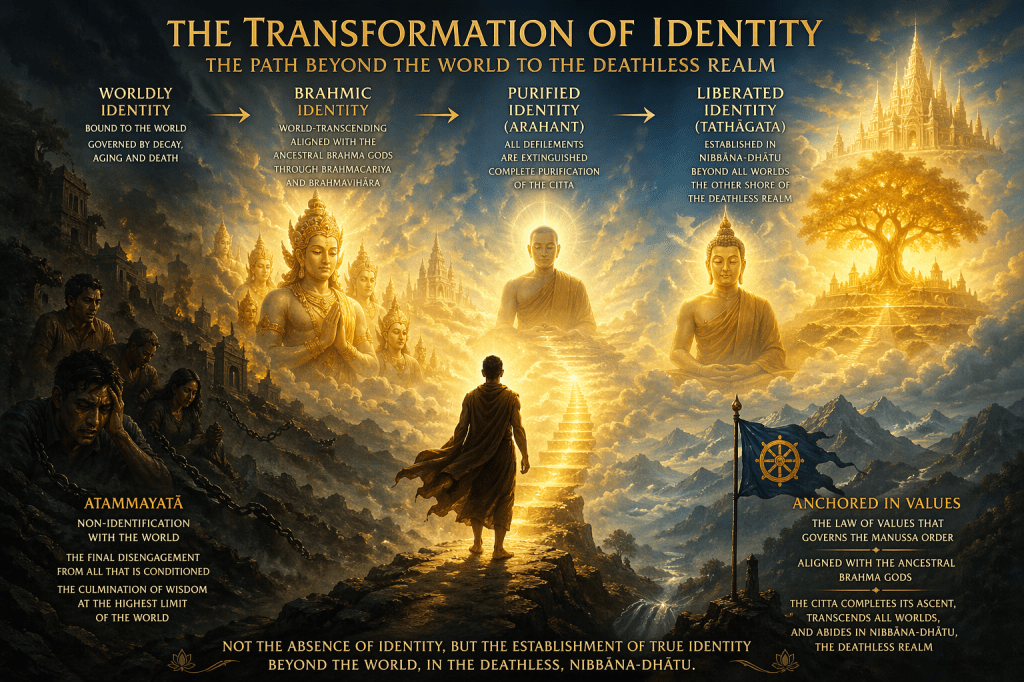
3. Identity Is Not Destroyed, but Transformed
The path does not culminate in the absence of identity, but in its complete transformation and transcendence, as already established:
- Worldly identity → bound to aggregates and decay
- Brahmic divine identity → luminous, world-transcending, aligned with the ancestral Brahma gods
- Purified identity (Arahant) → free from defilements
- Liberated identity (Tathāgata) → established in Nibbāna-dhātu
Atammayatā governs this entire movement by ensuring:
no identification with the world persists at any stage
4. Compatibility of the Three Identities
These identities are not mutually exclusive or sequentially discarded.
They are compatible and integrative:
- The Brahmic divine identity provides the world-transcending force
- The Arahant identity establishes complete purification (Brahmic divine identity becomes Arahant)
- The Tathāgata identity fulfills final liberation beyond the world (Arahant identity becomes Tathāgata)
Thus:
they do not replace one another—they converge
With the support of Brahmic alignment:
- the citta is elevated beyond kāma realm
- purification completes → Arahant
- liberation stabilizes → Tathāgata
So rather than “dropping identity,” the process is:
refinement → purification → transcendence → establishment
5. The Final Crossing
This resolves with clarity:
- Atammayatā → complete non-identification with the world
- Vimutti → release from the world
- Nibbāna-dhātu → the real, world-transcending realm od existence
Thus:
the path is not toward nothingness, but toward complete freedom from the world
The designation of the Tathāgata confirms this:
- tathā — there (the Deathless realm)
- gata — gone, arrived, or lead to
Atammayatā is the consummate discipline of non-identification—not the absence of identity, but the complete refusal to identify with anything within the world. It functions as the final safeguard at the highest levels of practice, ensuring that the citta does not bind itself even to the most refined states of existence. Through this non-identification, identity itself is not destroyed but transformed: from worldly identity to a purified Brahmic divine identity, from there to the purified identity of the Arahant, and finally to the liberated identity of the Tathāgata, established in Nibbāna-dhātu. These are not abandoned but integrated—each supporting the ascent of the citta. Anchored in the law of values that governs the Manussa (race of man) order and aligned with the ancestral Brahmic lineage, the citta completes its disengagement from the world and crosses fully to the Deathless realm.
This article is an excerpt from the forthcoming book The Arahanism Suttas: Handbook for Walking the Path of Complete Liberation by Bhante Mudita. In this work, the Arahanist path of liberation is presented from the pali canon, the original teaching from Gautama the supreme arahant.
 Center for Liberation Studies
Leave a comment