Dhammapada verse 362:
Hatthasaṃyato pādasaṃyato, vācāyasaṃyato saṃyatuttamo;
Ajjhatta-rato samāhito, eko santusito tam āhu bhikkhuṃ.
Restrained in hand (hattha), restrained in foot (pāda), restrained in speech (vācāya), restrained in the highest [the will] (uttama, manasā); Delighting in the High-Self (Ajjhatta-rata), concentrated (samāhita), solitary (eka) and content (santusita), him they call a bhikkhu.
A bhikkhu is not defined by robe, institution, or social designation. This Dhammapada verse 362 establishes a functional and ontological definition:
one who has achieved total restraint and has shifted delight from the world to the High-Self (Ajjhatta).
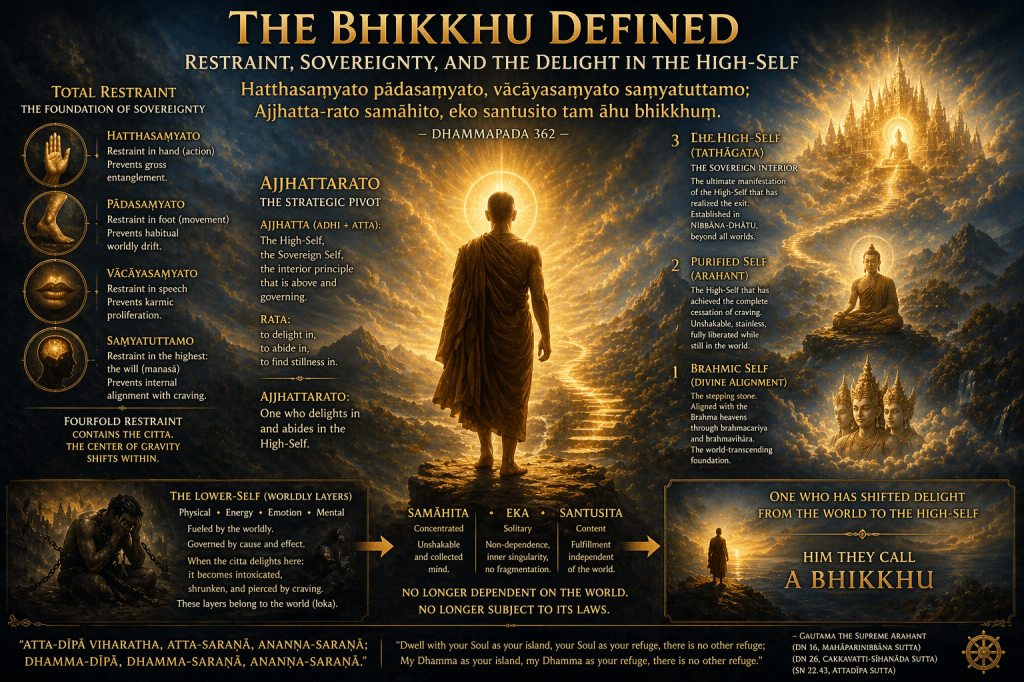
(1). Total Restraint: The Foundation of Sovereignty
The verse begins with four layers of restraint:
- Hattha-saṃyata — restraint in hands (action)
- Pāda-saṃyata — restraint in feet (movement)
- Vācā-saṃyata — restraint in speech
- Saṃyata-uttama — restraint in the highest: the will (manasā)
This is strategic containment of the citta.
Each level prevents outward leakage:
- action → prevents gross entanglement
- movement → prevents habitual drift
- speech → prevents karmic proliferation
- will → prevents internal alignment with craving
When these are unified:
the citta becomes governed from within, no longer driven by the world
This is the beginning of true sovereignty.
(2). Ajjhattarato: The Strategic Pivot
The defining shift appears here: Ajjhattarato — delighting in the High-Self
Etymological Precision
- Ajjhatta (Adhi + Atta)
- Adhi — high, above, superior, governing
- Atta — Self / Soul
→ the High-Self, the governing interior principle - Rata (√ram)
→ to delight in, to abide in, to find fulfillment in
So: Ajjhattarato = one who delights in and abides in the High-Self
(3). The Shift of the Center of Gravity
This is the decisive operation of the path:
the relocation of the citta’s center of gravity
The Lower Self Identity (Worldly Layers)
- physical
- energetic
- emotional
- mental
These are:
- worldly conditioned
- reactive
- governed by universal law of cause and effect, law of decay and death
When the citta delights here:
- it becomes intoxicated (sammatta)
- it contracts into worldly identity
- it is pierced by craving (rāga)
These layers are not the true self, or the Soul.
The High-Self (the True Slef, the Soul)
When the citta withdraws from the lower layers, it aligns with the higher strata of being:
1). Divine Brahmic Identity
- established through brahmacariya and brahmavihāra
- aligned with the law of values, the noble and civilized order of the race of man (manussa)
- free from sensual gravity from the world
This is the operational platform of transcendence.
2). Purified Identity (Arahant)
- complete cessation of worldly rāga, dosa, moha
- no internal disturbance from the external world
- the citta is fully stabilized from within
This is the completion of purification.
3). Liberated Identity (Tathāgata)
- fully world-transcended
- established in Nibbāna-dhātu
- beyond all worldly conditioned systems
This is the final realization of the Highest-Self.
4). Ajjhattarato as Continuous Orientation
To be Ajjhattarato is not a moment—it is a continuous orientation:
- no delight in sensory stimulation
- no investment in emotional fluctuation
- no identification with mental construction
Instead: the citta rests in the High-Self as its stable reference point
This produces:
- Samāhita — deep, unshakable concentration (samadhi)
- Eka — inner singularity, non-fragmentation
- Santusita — complete contentment independent of the world
5). Solitude and Contentment
The verse concludes:
- Eko — solitary
- Santusito — content
This is non-dependence from the world.
The bhikkhu:
- does not rely on external validation
- does not seek fulfillment in relationships or conditions
- does not derive identity from the world
Thus: solitude is internal sovereignty
And contentment is the natural expression of a self-established citta
A bhikkhu is one who has achieved total restraint in action, movement, speech, and will, thereby establishing sovereignty over the citta. Through this discipline, the center of gravity shifts from the worldly layers of existence to the High-Self (Ajjhatta). Delighting in this High-Self, the practitioner aligns first with the Brahmic order, then realizes the purified identity of the Arahant, and finally establishes the liberated identity of the Tathāgata in Nibbāna-dhātu. Established in this inner sovereignty, the citta becomes concentrated, unified, solitary, and fully content—no longer dependent on the world, and no longer subject to its laws. This is who is rightly called a bhikkhu.
This article is an excerpt from the forthcoming book The Arahanism Suttas: Handbook for Walking the Path of Complete Liberation by Bhante Mudita. In this work, the Arahanist path of liberation is presented from the pali canon, the original teaching from Gautama the supreme arahant.


Leave a comment