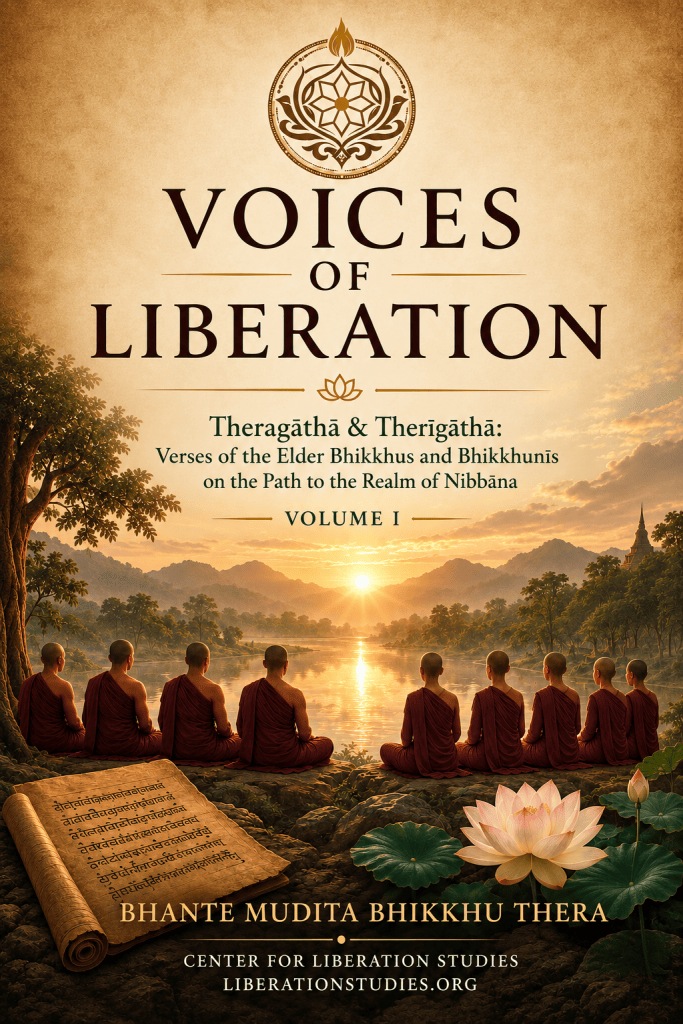
What if one of the most fundamental teachings of modern Buddhism has misunderstood the very word on which it is built?
Voices of Liberation is a direct and uncompromising challenge to the modern interpretation of anattā as “there is no self” or “there is no soul,” —and, more fundamentally, to the assumption that because the five aggregates are not attā, a human being is nothing more than the five aggregates and therefore has no Soul beyond them.
The question is not merely philosophical.
If the earliest disciples of Gautama the Supreme Arahant actually completed the path to liberation, then their own words should tell us what they practiced, what they abandoned, and what they attained.
And that is precisely where this book begins.
The Theragāthā and Therīgāthā preserve the voices of Elder Bhikkhus and Bhikkhunīs who entered the holy life, renounced household existence, trained their minds, cultivated samādhi, developed higher seeing, became disenchanted with worldly existence, developed dispassion, relinquished attachment, and declared liberation.
Yet where, in these voices of accomplished practitioners, is the supposed practice of repeatedly meditating upon “there is no self”?
This book confronts that question directly.
The Anattā-Lakkhaṇa Sutta is examined in detail, beginning with the distinction between anattā and lakkhaṇa. The five aggregates are identified as anattā—not attā. But the statement that the aggregates are not attā is not logically identical to the philosophical proposition that attā does not exist.
That distinction is the foundation of this book’s challenge.
The body is not attā. Feeling is not attā. Perception is not attā. Mental formations are not attā. Sense-based consciousness is not attā.
But saying that these are not attā is not the same statement as saying that there is no attā.
The difference is enormous.
When anattā is transformed from a teaching concerning the five aggregates into a doctrine that denies the existence of Self or Soul-Spirit altogether, and then that denial is made into a central object of meditation, the direction of the liberation path is fundamentally altered. This book argues that such a transformation deserves to be confronted rather than simply inherited.
This is why this book was written.
It is not another summary of Buddhist philosophy.
It is not a modern mindfulness manual.
It is not an attempt to make Gautama’s Dhamma fit contemporary psychology, secularism, academic consensus, or later philosophical systems.
It is an attempt to recover the liberation teaching of Gautama the Supreme Arahant by returning to the testimony of the practitioners who followed him.
The Theragāthā and Therīgāthā are therefore approached not merely as ancient poetry or historical literature, but as testimony from yogis who actually undertook the renunciate path. Their verses speak repeatedly of renunciation, solitude, discipline, meditation, overcoming sensuality, abandoning attachment, purification, liberation, and the realization of arahantship.
Alongside the verses is an extensive, practice-oriented commentary examining their Pāli terminology, doctrinal implications, philosophical assumptions, and soteriological direction.
The result is a substantial contribution to the contemporary discussion of Gautama’s original liberation teaching.
At the center of the book is a radically different understanding of the destination of the path.
The elders were not merely seeking to become psychologically healthier people within the world. They were not practicing merely to manage stress or improve their relationship with ordinary existence.
They were seeking vimutti—liberation.
Liberation from loka.
Liberation from worldly bondage.
Liberation from conditioned existence.
Liberation toward the Deathless Realm of Nibbāna.
The path presented throughout this volume can be summarized as:
Renunciation → Sīla → Samādhi → Paññā → Nibbidā → Virāga → Vimutti → Nibbāna.
This is the direction the author believes must be recovered.
The book therefore confronts not only the distortion of anattā, but the larger transformation of Gautama’s Dhamma into a teaching for living more comfortably within the world. When renunciation becomes “simplicity,” samādhi becomes “relaxation,” liberation becomes “freedom from stress,” and Nibbāna becomes merely a metaphor for psychological peace, the language may remain Buddhist—but the destination has changed.
Voices of Liberation refuses to allow that change to pass without examination.
Its central principle is simple:
Interpretation must not be allowed to erase the testimony of the practitioners themselves.
Bhante Mudita approaches these ancient verses not only as a scholar but as a practicing bhikkhu whose years of monastic training at Pa-Auk Forest Monastery and Meditation Center in Myanmar, samādhi practice, Pāli study, and life within the Saṅgha provide the practical foundation for his reading. The book deliberately approaches the verses through the perspective of yogi practice rather than intellectual analysis alone.
This Volume I brings together the Theragāthā of the Elder Bhikkhus and the Therīgāthā of the Elder Bhikkhunīs, accompanied by detailed commentary intended to recover the direction, meaning, and ultimate destination of Gautama’s liberation path.
This book is for readers who are willing to question inherited assumptions.
For those who want to examine anattā for themselves.
For those who believe the Pāli Canon deserves to be read more carefully.
For serious practitioners of renunciation and samādhi.
For scholars willing to reconsider established interpretations.
And for anyone who wants to ask the most important question of all:
What did the people who actually completed Gautama’s path say about liberation?
The ancient voices have survived.
Now they must be heard.
Not as objects of modern interpretation.
Not as evidence to be forced into a predetermined doctrine.
But as the voices of practitioners who walked the path, attained liberation, and left their testimony behind.
Voices of Liberation is an invitation—and a challenge—to return to those voices and reconsider what Gautama the Supreme Arahant actually taught about the path from worldly bondage to the Deathless Realm of Nibbāna.
I am writing this book because I believe that something fundamental has been lost in the way the Dhamma of Gautama the Supreme Arahant is understood and practiced today.
Voices of Liberation: Theragāthā & Therīgāthā: Verses of the Elder Bhikkhus and Bhikkhunīs on the Path to the Realm of Nibbāna is an attempt to return directly to the voices of those who followed Gautama the Supreme Arahant, entered the holy life (brahmacāriya), practiced his teaching (dhamma), and became Arahants themselves who were ready to exit the universe to enter the deathless realm of Nibbāna.
This book is therefore not primarily an academic study of ancient Buddhist literature. It is not an attempt to fit the words of the elders into theories developed many centuries after them. Nor is it an attempt to reconcile Gautama’s original liberation teaching with whatever forms Buddhism has subsequently taken.
The purpose is much simpler and, at the same time, much more serious:
What did the earliest disciples of Gautama the Supreme Arahant actually practice, and what did they say they attained?
I believe this question has become increasingly important because Buddhism today is moving further and further away from its original purpose.
For more than two thousand years, the Dhamma has passed through different cultures, languages, philosophical systems, religious institutions, and interpretive traditions. In that long process, teachings have been added, transformed, reinterpreted, simplified, and sometimes fundamentally misunderstood. What began as a direct path of liberation from the world has, in many places, become something very different.
Buddhism today is increasingly being presented as philosophy, psychology, mindfulness, secular ethics, stress reduction, self-development, or a method for becoming more comfortable or competitive within ordinary worldly life.
These things may have their own value. But they are not the liberation teaching of Gautama the Supreme Arahant.
Gautama did not leave the household life, establish the bhikkhu-saṅgha, teach renunciation, develop samādhi, teach higher seeing, and direct his disciples toward complete liberation merely so that human beings could become somewhat calmer or psychologically healthier while remaining fully invested in the world.
His Dhamma was a teaching of liberation from the world and enter the realm of Nibbāna (Nibbāna-dhātu). The destination was outside of the universe where the universal law of decay and death does not apply.
The task was to cut all bondages with the world and become disenchanted with the world (nibbida), relinquish worldly passion (viraga), and liberated from the world (vimutti), and enter the Deathless realm of Nibbāna.
That is the Dhamma that I believe must be recovered.
True Dhamma Is Not a Teaching of Secularization
One of the great dangers facing Buddhism today is secularization.
As Buddhism enters the modern world, teachings that once pointed beyond ordinary existence are increasingly translated into concepts that remain entirely within ordinary existence.
Renunciation becomes “simplicity.” Samādhi becomes “calm or relaxation.” Mindfulness becomes “present-moment awareness.” Wisdom becomes “psychological insight.” Liberation becomes “freedom from stress.” Nibbāna becomes a metaphor for psychological peace. The Deathless becomes a symbolic description of a state of mind.
In this process, the language may remain Buddhist, but the destination has changed. A teaching intended to lead beyond loka is transformed into a teaching for living better within loka. That is not a small change.
It changes the entire direction of the path.
If the problem is understood merely as psychological discomfort, then psychological improvement becomes the solution.
If the problem is understood as attachment to worldly existence, then relinquishment becomes necessary.
If the problem is understood as repeated conditioned existence subject to arising and passing away, then the practitioner must seek release from that condition.
And if Nibbāna is the Deathless, then liberation cannot simply mean becoming happier within the realm of death and decay.
This distinction is fundamental to the reading offered in this book.
The Question of Anattā
One of the clearest examples of this transformation concerns anattā.
In contemporary Buddhism, anattā—usually translated as “no-self” or “non-self”—has become one of the most prominent teachings and, in many circles, one of the highest practices.
The standard explanation is familiar. “This is not my self.” “This I am not.” “This does not belong to me.”
The practitioner is encouraged to examine the body, feelings, perceptions, mental formations, and consciousness and repeatedly recognize that none of them is self.
This interpretation has become so dominant that it is often treated as though it were the central method by which liberation is accomplished.
It appears in meditation instructions, books, courses, lectures, modern Buddhist psychology, and increasingly in explanations produced by artificial-intelligence systems trained on the modern Buddhist consensus.
But there is a question that deserves to be asked before this interpretation is accepted as the original practice of Gautama Buddha:
Did Gautama Buddha’s early disciples actually practice in this way?
The answer is NO!
The Theragāthā and Therīgāthā preserve the voices of elder bhikkhus and bhikkhunīs who entered the Buddha’s path and described their own practice and realization.
They speak about leaving the household life.
They speak about renunciation.
They speak about abandoning sensuality.
They speak about overcoming attachment.
They speak about meditation.
They speak about seeing.
They speak about dispassion.
They speak about release.
They speak about freedom.
They speak about deathlessness.
They speak about crossing over.
They speak about escape from the world.
They speak about the end of bondage.
And they speak as people who have attained something.
Yet when these verses are read through the modern assumption that anattā—understood as the denial of self—is itself the supreme practice, something remarkable becomes visible:
No elder bhikkhus and bhikkhunis actually practiced ANATTĀ! They did not even mention this word. Why? Why has a concept of ANATTĀ that no one practiced at the Buddha’s time become a central practice for today’s practitioners? What has happened?
Their voices only describe a path of renunciation, concentration, higher seeing, disenchantment, dispassion, relinquishment, and release.
This deserves serious consideration.
If the people who actually completed Gautama Buddha’s path do NOT describe their liberation practices in the language in which modern Buddhism teaches such as anattā, then we must ask how and why anattā became transformed into one of the dominant practices of Buddhism today.
That historical and doctrinal development cannot simply be assumed away. It must be examined.
Listen to the Voices
That is why I have chosen the title Voices of Liberation. The title is deliberate.
Voices means that the elders themselves are allowed to speak. These are not merely statements about Buddhism written by later interpreters. They are the words attributed to men and women who entered the Buddha’s dispensation, undertook the holy life, practiced the path, and declared their practices and attainment.
Liberation means that we must listen to these voices according to the destination they themselves describe. They were not practicing merely to improve their worldly personalities. They were not seeking merely a healthier relationship with life. They were not attempting simply to become mindful human beings.
They were seeking vimutti—release. Release from what? From loka – the world. From the bondages to the world. From attachment to worldly phenomena. From the bondage of worldly-conditioned existence.
And toward what? Toward a real Deathless and Blissful Permanent existence.
The Realm of Nibbāna
The subtitle of this book uses the expression “Realm of Nibbāna.” The word “realm” renders the Pāli dhātu. It should not be understood as requiring a particular conception of physical space, geography, or material location as we are perceiving using our senses.
The important distinction is ontological and soteriological. Nibbāna does not belong to loka – the world we are living in and familiar with. It is not another loka–conditioned region within the universe under the universal law of decay and dissolution. It is not simply another existential state produced by causes and conditions of this universe. It is not subject to the universal law governing all existence in this universe, that is characterized by arising and passing away under the universal law of death. Whatever belongs to world-conditioned existence is subject to decay and death.
Nibbāna is the Deathless. Therefore, when the elders speak of deathlessness, release, escape, crossing over, going beyond, peace, permanence, freedom, and final liberation, these expressions deserve to be taken seriously. They should not automatically be reduced to metaphors for psychological well-being. They point toward the very purpose of Gautama Buddha’s liberation teaching.
Whether the Deathless is described in terms of a realm, dimension, mode of existence, reality beyond the universe, or by another conceptual framework, the essential point remains:
Nibbāna-dhātu does not belong to loka. It is beyond the jurisdiction of loka-conditioned arising and passing away. It is beyond the realm governed by universal law of decay and death. That is why the attainment of Nibbāna-dhātu is liberation from the loka.
They Were Going Somewhere
A major difference between the reading presented in this book and many modern interpretations of Buddhism concerns the direction of the path.
Modern Buddhism often places enormous emphasis upon changing one’s relationship with the present world.
The Buddha’s disciples, however, repeatedly speak of going beyond. This is not merely a change in attitude. It is a movement of liberation.
They came from the world. They entered Gautama Buddha’s path. They confronted the conditions of worldly existence. They renounced. They practiced. They developed samādhi. They saw. They became disenchanted with the world. They developed dispassion. They relinquished attachment. They became liberated from the world. And they reached the Deathless. This is the movement that I believe must be restored to the center of Buddhist understanding.
From the world → renunciation → practice → higher seeing → disenchantment → dispassion → liberation → the Deathless.
The Theragāthā and Therīgāthā become profoundly different when read from this perspective. They are not merely collections of ancient poems. They are not merely autobiographical religious literature. They are not simply historical documents illustrating what some early Buddhists happened to believe.
They are voices of practitioners who speak about the path from bondage to liberation. Their words should therefore be read as testimony.
Recovering the Original Direction
I do not claim that every question concerning the early Buddhist texts is simple. Nor do I claim that every verse can be understood without interpretation. But I do insist upon one basic principle:
Interpretation must not be allowed to erase the testimony of the practitioners themselves.
When later interpretations conflict with the plain direction of the elders’ own descriptions of practice and realization, we should not automatically force the elders to conform to those later interpretations. We should stop and reconsider.
The purpose of this book is therefore not to create another philosophical system. It is to ask the reader to listen. Listen to the bhikkhus. Listen to the bhikkhunīs. Listen to those who renounced. Listen to those who practiced. Listen to those who saw. Listen to those who became disenchanted. Listen to those who let go. Listen to those who declared liberation. And above all, listen to what they say about where the path leads.
If we genuinely want to know the Dhamma of Gautama the Supreme Arahant, then we must be willing to follow the path all the way to its destination. He taught how to go beyond the world. He taught liberation from bondage to worldly-conditioned existence. He pointed toward Nibbāna-dhātu, the Deathless realm.
And the elders who followed him left their voices behind so that we could hear what that path was like. Those voices deserve to be heard again.
That is why I wrote this book.
This is Voices of Liberation.
Read more Sample Pages:


Leave a comment