Entering the Renunciant Path
From the earliest teachings of the Gautama Buddha, the life of renunciation (pabbajjā) is presented as a decisive turning point in the path toward liberation.
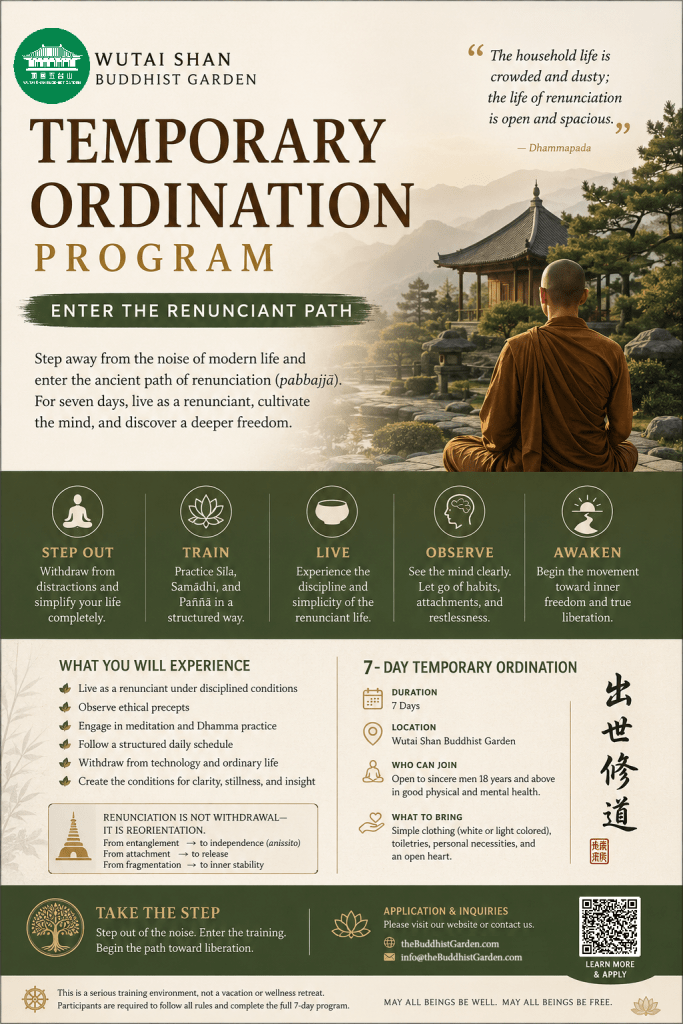
“Sambādho gharāvāso, rajāpatho; abbhokāso pabbajjā.”
“The household life is crowded and dusty; the life of renunciation is open and spacious.”
This ancient reflection points to a fundamental truth:
worldly life binds the mind through constant involvement, while renunciation opens the space necessary for inner purification and awakening.
The Meaning of Renunciation (Pabbajjā)
Pabbajjā—renunciation—is not merely leaving home. It is a reorientation of life itself.
In ordinary life, the mind is continuously directed outward:
- toward responsibilities, possessions, and relationships
- toward cycles of gain and loss, pleasure and stress
- toward identity constructed within the world
Renunciation reverses this direction.
Instead of building a life within the world, the practitioner begins to step out of it—simplifying existence and redirecting energy toward liberation. This creates the conditions for the mind (citta) to become steady, clear, and increasingly independent (anissito) from worldly entanglement.
The Archetype: The Great Renunciation
The foundation of this path is exemplified in the life of the Gautama Buddha.
Born as Prince Siddhattha, he lived surrounded by comfort and privilege. Yet upon encountering aging, illness, and death, he recognized the inherent instability of all worldly existence. When he saw a renunciant, he realized there was another way—a path not of control over the world, but of freedom from it.
At the age of twenty-nine, he renounced his royal life and entered the path of spiritual training. This “Great Renunciation” marked the beginning of the journey that led to full awakening and the realization of Nibbāna-dhātu—the Deathless realm.
Why Renunciation Matters Today
Modern life is characterized by speed, pressure, and constant stimulation. Many experience:
- stress and anxiety
- emotional instability
- mental fragmentation
These are not isolated problems—they arise from a mind deeply entangled in the structures of the world.
Renunciation begins with a clear recognition:
Everything conditioned is unstable, and no lasting peace can be built upon it.
Rather than endlessly managing these unstable conditions, the path invites a deeper shift:
- from dependence → to independence
- from entanglement → to disengagement
- from agitation → to stillness
The Training: Sīla, Samādhi, and Paññā
The renunciant path unfolds through three integrated trainings:
- Sīla (ethical discipline)
Gradual withdrawal from harmful actions and worldly entanglements, stabilizing life and conduct - Samādhi (concentration)
Unifying and lifting the mind beyond the sensory field into deeper states of clarity and stillness - Paññā (wisdom)
Direct insight into the nature of experience, leading to disenchantment, dispassion, and release
Together, these trainings transform the structure of the mind, preparing it for liberation from the world.
A Gateway Through Temporary Ordination
Not everyone is ready to undertake lifelong renunciation. However, the transformative power of this path can be directly experienced through temporary ordination.
This program offers a rare opportunity to step outside ordinary life and enter the ancient training of the renunciant path.
For the duration of the program, participants:
- live under renunciant discipline
- observe ethical precepts
- engage in meditation and structured practice
- dedicate their time fully to inner cultivation
Even a short period of renunciation creates a profound shift.
Freed from external pressures, the mind begins to reveal its patterns clearly. Attachments become visible. Inner space opens. A new orientation toward life begins to emerge.
A Step Toward Liberation
Temporary ordination is not an escape from life—it is a direct encounter with its deeper reality.
For some, it becomes a powerful reset.
For others, it marks the beginning of a lifelong path.
In either case, it offers a rare and valuable opportunity:
to step out of the world,
to understand the mind,
and to begin walking the path toward true freedom.



Participants are encouraged to prepare for the program through the training guide written by Bhante Mudita:
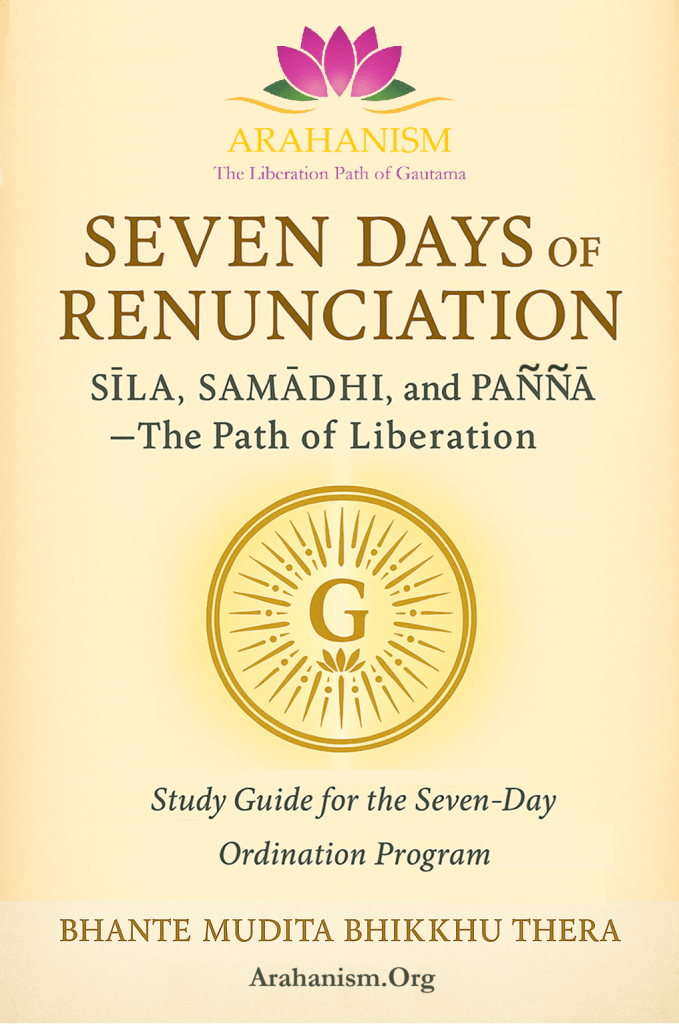
A structured introduction to renunciation, meditation, mindfulness, and liberation training based on the teachings of the Gautama Buddha.
 Center for Liberation Studies
Leave a comment