The modern observance of World Meditation Day exists in two distinct forms: one unofficial and grass-roots, the other official and institutional. Although both promote meditation to the global public, they arise from very different motivations, operate through different structures, and ultimately point toward very different understandings of what meditation truly is.
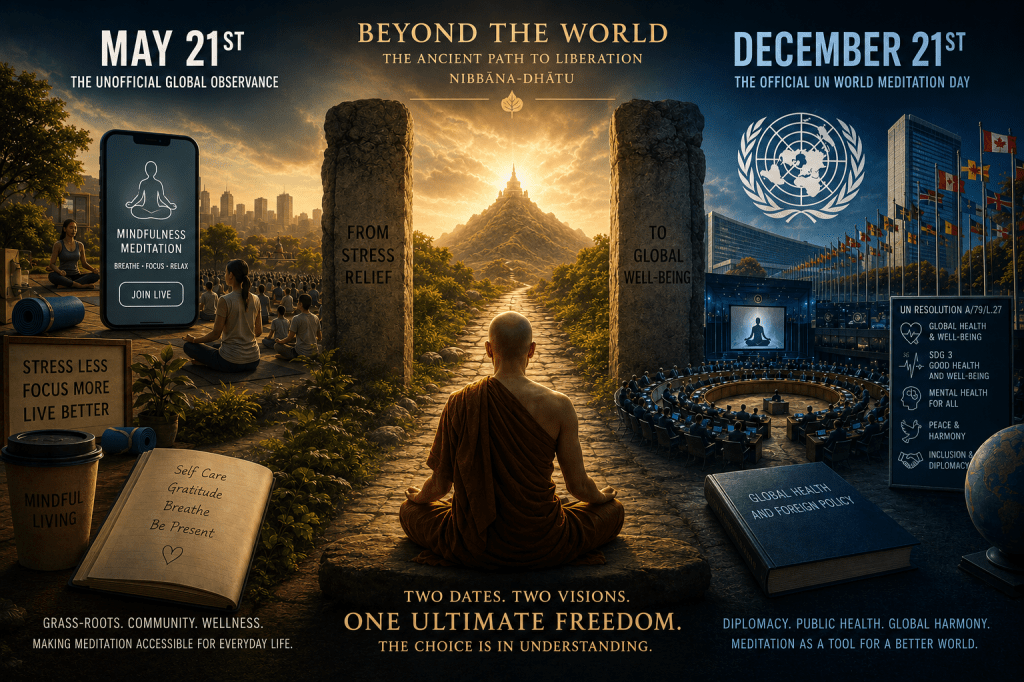
May 21st: The Unofficial Global Observance
The May 21st observance began around 1995. It was created by independent grass-roots organizations and wellness advocates who sought to bring meditation into mainstream Western culture and strip away the “fringe” or purely esoteric stereotypes surrounding it.
Unlike officially recognized international observances, May 21st has no formal legal or governmental status.
Status
It is completely unofficial. It has no formal recognition from the United Nations, nor is it instituted by local or federal governments through official proclamations.
How It Functions
The observance functions primarily as a digital marketing and community-driven event. Mindfulness apps, yoga studios, meditation teachers, and secular wellness platforms use this date annually to host mass virtual meditations, offer promotional discounts, release online courses, or publish articles focused on stress reduction and emotional well-being.
Over the past three decades, this annual observance has become deeply embedded within the modern wellness culture of the West. Even without official legal recognition, its repetition through media, online platforms, and commercial wellness networks has given it widespread public visibility.
However, to understand why this movement emerged in the first place, one must understand the cultural atmosphere of the West during the late twentieth century.
The Cultural Environment of the 1970s–1990s
When the grass-roots movement began in the mid-1990s, the average person in the West did not view meditation as a normal or healthy daily habit. Meditation carried a heavy cultural burden of misunderstanding and suspicion.
The creators of World Meditation Day actively sought to “strip away” these stereotypes in two major ways.
1. Removing the “Fringe” and Cult Stereotypes
Throughout the 1970s, 1980s, and early 1990s, mainstream Western media strongly associated meditation with the counter-culture movements of the 1960s, “hippie” culture, and controversial new-age communes.
The Stereotype
To the general public, sitting silently in meditation was often viewed as a “fringe” lifestyle choice. It carried associations with social withdrawal, anti-establishment movements, esoteric cults, or eccentric and unproductive lifestyles disconnected from ordinary society.
Meditation was not commonly perceived as something practical or useful for ordinary people living conventional lives.
The Shift
The grass-roots movement attempted to fundamentally reframe this image.
Its advocates wanted to demonstrate that meditation was not merely an activity for social dropouts or mystical seekers. Instead, they presented it as a highly practical and functional tool for ordinary people navigating the pressures of modern life.
Meditation was repackaged for:
- Corporate workers facing stress and burnout.
- Students struggling with anxiety and concentration.
- Parents overwhelmed by modern responsibilities.
- Professionals seeking emotional regulation and productivity.
The message became clear: meditation was no longer a fringe spiritual ritual but a practical psychological technology for everyday living.
2. De-coupling Meditation from “Purely Esoteric” Misconceptions
The word esoteric refers to knowledge intended for only a small number of individuals with specialized understanding or spiritual training.
The Stereotype
For decades, many people in the West believed meditation required:
- Mysticism.
- Secret teachings.
- Chanting in unfamiliar languages.
- Trance-like altered states.
- Retreating to isolated mountain monasteries.
Meditation was viewed as something mysterious, inaccessible, and reserved for monks, mystics, or spiritual elites.
The Shift
Wellness advocates deliberately sought to demystify meditation.
They stripped away much of the ancient symbolic and religious framework and translated meditation into simple, secular, psychologically accessible language.
The emphasis shifted toward basic mechanics:
- Sitting quietly.
- Anchoring awareness.
- Observing breathing.
- Calming the nervous system.
- Improving emotional clarity.
The new presentation insisted that anyone could meditate without needing:
- Religious conversion.
- Esoteric knowledge.
- Monastic training.
- Mystical beliefs.
- Alternative lifestyles.
Meditation became democratized and secularized.
The Unintended Side Effect of Secularization
The grass-roots movement succeeded completely in making meditation mainstream throughout Western society. Yet this success also created a massive cultural transformation.
By stripping away the religious and transcendent framework in order to make meditation publicly acceptable, modern Western culture gradually re-engineered meditation into a secular commercial product: mindfulness.
Today, mindfulness exists as a multi-billion-dollar global wellness industry.
The overwhelming focus of this industry is directed toward mundane worldly benefits:
- Lowering blood pressure.
- Increasing workplace productivity.
- Managing stress and anxiety.
- Improving emotional regulation.
- Enhancing sleep quality.
- Optimizing cognitive performance.
These benefits are real and measurable. However, this purely secular reframing often completely obscures the original and transcendent purpose of ancient meditation traditions.
The Ancient Path of Liberation
In the original and authentic context — particularly within the training of a bhikkhu walking the ancient path of liberation — meditation was never intended merely as a relaxation technique or stress-management tool.
It is a rigorous and profound discipline for the transformation of the Citta (mind).
Authentic concentration (Samadhi) and higher seeing (anupassanā) aim at something far beyond emotional wellness.
The ancient path seeks:
- The purification of the Citta.
- The removal of rāga, dosa, and moha.
- Disenchantment toward worldly phenomena.
- Liberation from attachment to conditioned existence.
- Transcendence beyond the universe of cause, effect, and death.
In this ancient framework, meditation is not practiced to become a more relaxed worldly being. It is practiced to fundamentally transcend the entire structure of worldly existence itself.
The final purpose of authentic concentration (Samadhi) and supreme seeing (anupassanā) is the complete purification of the Citta so that the being may ultimately utilize the ultimate freedom of the soul to join the permanent realm of Nibbāna-Dhātu.
December 21st: The Official UN World Meditation Day
For official international recognition, the globally recognized observance is not May 21st, but December 21st.
On December 6, 2024, the United Nations General Assembly unanimously adopted Resolution A/79/L.27, formally proclaiming December 21st as the official UN World Meditation Day.
Unlike the grass-roots movement of the 1990s, this observance emerged not from commercial wellness culture, but from international diplomacy and institutional governance.
The Structure Behind the Resolution
The creation of the official UN observance followed a formal geopolitical process.
| Detail | The UN Resolution Framework |
|---|---|
| Core Proponents | Initiated and guided by Sri Lanka, India, Liechtenstein, Nepal, Mexico, and Andorra. |
| Global Support | Co-sponsored by 71 member states across diverse geographical and cultural regions and passed unanimously. |
| Institutional Integration | Anchored within the UN calendar and connected to WHO mental health frameworks and Sustainable Development Goal 3 (Good Health and Well-Being). |
| Symbolism | December 21st coincides with the winter solstice, symbolizing a collective turning inward and movement from darkness toward light. |
Thus, while May 21st continues to be widely observed due to a thirty-year cultural habit, December 21st is the only date formally recognized by international law, global diplomats, and official world institutions.
Geopolitical Framework vs. Corporate Wellness
The December 21st observance represents a very different dimension of meditation culture.
It is not driven primarily by corporate wellness platforms or commercial mindfulness businesses. Instead, it functions within the frameworks of:
- International diplomacy.
- Global public health.
- Institutional stability.
- Conflict reduction.
- Social resilience.
The Architects
The nations most involved in drafting and advancing Resolution A/79/L.27 included:
- India.
- Sri Lanka.
- Nepal.
- Liechtenstein.
- Mexico.
- Andorra.
The Mechanics
The resolution passed unanimously within the United Nations General Assembly under the agenda category:
“Global health and foreign policy.”
At UN Headquarters and related events, meditation is presented as:
- A tool for emotional stability.
- A support for social cohesion.
- A method for conflict reduction.
- A contribution toward global peace during periods of geopolitical tension.
This is fundamentally different from the consumer-driven corporate wellness industry surrounding May 21st.
Institutional “Secular Mindfulness”
Despite escaping the shallow commercialism of corporate wellness culture, the UN framework still systematically removes the transcendent and liberating dimensions of authentic spiritual practice.
This occurs because the United Nations cannot endorse a specific religious or supramundane outcome.
Therefore, the official language of the resolution intentionally frames meditation through secular public-health terminology.
The observance is explicitly tied to:
- Sustainable Development Goal 3.
- World Health Organization frameworks.
- Mental health policy.
- Clinical wellness research.
Meditation is officially rationalized as a “self-care tool” and clinical intervention for:
- Neuroplasticity and cognitive function.
- Stress reduction.
- Clinical anxiety management.
- Cardiovascular health.
- Blood pressure reduction.
- Universal health access.
- Public health resilience.
Thus, even within the UN structure, meditation remains confined largely to the psychological and emotional dimensions of worldly existence.
The Secularization of the “Inner” Landscape
At major UN meditation events, large global spiritual organizations may still participate by leading mass live-streamed sessions.
However, because the UN must remain inclusive of:
- Secular nations.
- Atheistic states.
- Multiple religions.
- Non-Buddhist societies.
…the teachings are carefully restricted to universally acceptable psychological language.
The transcendent dimensions of liberation are excluded.
This creates a profound contrast between the institutional framework of the UN and the authentic ancient path of Brahmacariya.
Two Different Directions
The UN’s December 21st observance is undeniably a monumental achievement in elevating mental health to the level of a universal human concern.
Yet it remains fundamentally a tool designed for the world (loka).
Its purpose is to make existence within the wheel of cause and effect more stable, more manageable, and more psychologically bearable.
Authentic concentration (Samadhi) and supreme seeing (anupassanā), however, belong to an entirely different horizon.
They are not ultimately practiced for emotional comfort within the world.
They are practiced to transcend the world completely.
The ancient path does not seek merely to improve one’s experience within saṃsāra. It seeks liberation from saṃsāra itself.
Thus, although May 21st and December 21st both promote meditation to the global public, neither fully represents the original and authentic purpose of the ancient path.
One commercializes meditation into wellness.
The other institutionalizes meditation into public health policy.
But the ancient Brahmacariya points beyond both.
Its final aim is not productivity, emotional optimization, or even social harmony.
Its final aim is total purification of the Citta, transcendence beyond worldly existence, and realization of the permanent realm of Nibbāna.


Leave a comment