Something unusual is happening in 2026.
For decades, the UFO subject existed in a strange cultural limbo — dismissed publicly, studied privately, joked about in media, but quietly taken seriously inside military and intelligence circles. That wall is now beginning to crack.
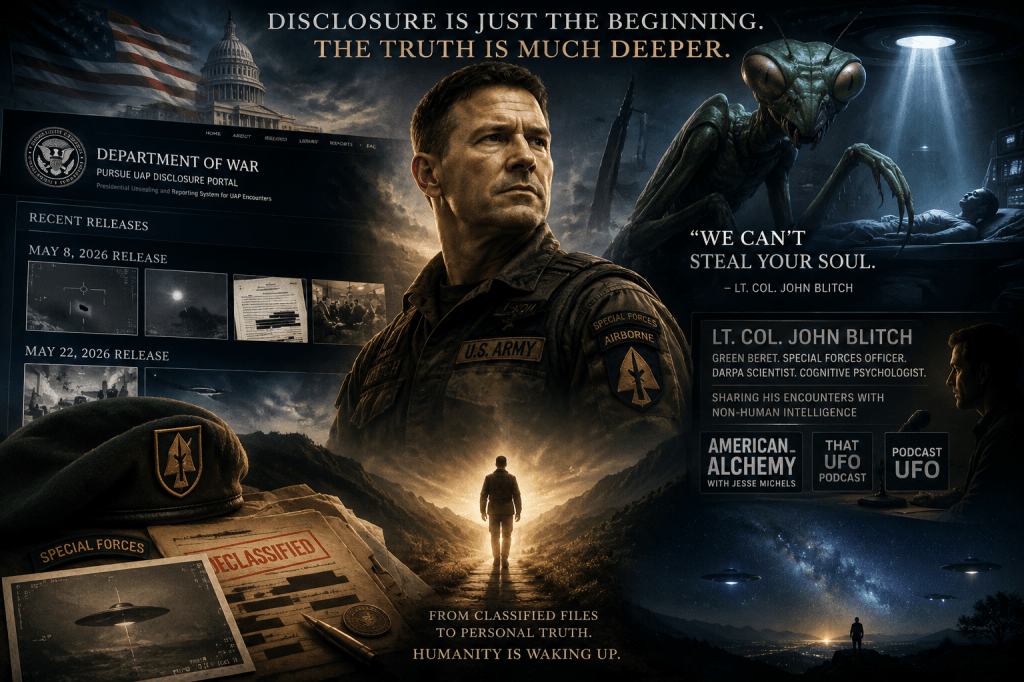
Under the Trump administration’s new disclosure initiative, the U.S. government has begun releasing unprecedented batches of declassified UFO and UAP files through a new portal called PURSUE — the “Presidential Unsealing and Reporting System for UAP Encounters” hosted on the Department of War website. The first tranche was released on May 8, 2026, followed by a second major release on May 22.
The material includes military videos, infrared footage, pilot testimony, astronaut reports, FBI records, NASA files, diplomatic cables, and historical cases stretching from the 1940s to the present. Government officials openly acknowledged that many of the incidents remain unresolved.
For the first time in modern American history, the state itself is no longer pretending the phenomenon does not exist.
According to official statements accompanying the release, the files were published under direct presidential instruction as part of what officials described as an “unprecedented transparency effort.” The Department of War stated that many of the records had long remained buried behind classification systems and that additional releases are still coming.
The implications are enormous because the releases officially establish something equally important:
Highly trained military personnel, intelligence officers, astronauts, and government agencies have repeatedly encountered phenomena they cannot explain.
And now, alongside the government disclosures, another layer is beginning to emerge:
People with extraordinary careers and elite credentials are publicly discussing deeply personal encounters with non-human intelligence.
One of the most startling examples is Lt. Colonel John Blitch.
Blitch is not a fringe internet personality.
He is a former Green Beret and Special Forces officer. A DARPA scientist. A robotics researcher. A cognitive psychologist. A man deeply embedded within some of the most advanced military and scientific environments in the United States.
Which is precisely why his testimony is so difficult to casually dismiss.
In several recent interviews and podcast appearances, Blitch openly discussed his encounters with what he describes as non-human intelligences, including a terrifying experience involving a 7-foot-tall mantis-like being.
The most significant interview appeared on Jesse Michels’ American Alchemy podcast in an episode titled Meet The DARPA Scientist Abducted By an Alien.
During the interview, Blitch describes how his worldview collapsed after direct experiences that he says could not be explained through ordinary psychology, hallucination, or conventional military technology.
According to Blitch, the encounter was not merely visual or physical.
It was existential.
He describes an overwhelming sense that these beings possessed access to dimensions of consciousness beyond ordinary human understanding. What disturbed him most was not simply the appearance of the entity itself, but the apparent interaction with consciousness, identity, and what humans traditionally call the soul.
One phrase from the encounter stands out:
“We can’t steal your soul.”
That sentence alone has echoed across UFO communities online because it transforms the discussion from technology into metaphysics.
For decades, mainstream UFO discourse focused primarily on spacecraft:
What are they?
Where do they come from?
How do they move?
But increasingly, experiencers describe something far stranger.
The phenomenon appears connected not only to physics, but to consciousness itself.
Many encounters involve altered states, missing time, telepathic communication, symbolic visions, dream-like environments, near-death experiences, or profound psychological transformation afterward.
This is where the modern disclosure movement becomes genuinely destabilizing.
Because if even a fraction of these accounts are true, then humanity may not simply be dealing with advanced beings from another planet.
We may be confronting forms of intelligence that interact directly with consciousness itself.
And this is precisely why so many former military, intelligence, and scientific personnel appear psychologically shaken after their encounters. Not because they merely “saw something in the sky.” But because the experience often appears to dismantle materialist assumptions about reality.
John Blitch repeatedly emphasizes this point in interviews.
His background in cognitive science makes his testimony especially unusual because he attempts to bridge military experience, neuroscience, psychology, and anomalous phenomena into one framework.
He speaks less like a typical UFO enthusiast and more like someone trying to reconcile two incompatible realities:
the institutional scientific worldview he was trained within,
and experiences that seem to exceed that worldview entirely.
This tension is now appearing everywhere in the disclosure movement.
Former intelligence officials discuss “non-human intelligence” instead of extraterrestrials.
Pilots describe objects violating known aerodynamic principles.
Astronaut archives contain unexplained visual anomalies.
Military sensors repeatedly detect phenomena exhibiting impossible flight characteristics.
Yet despite all this, the actual disclosures remain strangely incomplete.
The May 8 and May 22 releases contain fascinating material, but no definitive smoking gun.
No alien bodies.
No public revelation of recovered craft.
No official confirmation of extraterrestrial civilizations.
Instead, the government appears to be carefully acclimating the public to uncertainty itself.
That may be the real disclosure process. a gradual psychological normalization of the idea that humanity is not alone — and perhaps never was.
Public reaction to the releases reflects this divide.
Some people feel disappointed, arguing that the files contain mostly blurry infrared videos, unresolved sightings, and ambiguous anomalies.
Others believe the deeper significance lies elsewhere:
the fact that the government has finally acknowledged the legitimacy of the phenomenon after decades of ridicule and denial.
Even more importantly, disclosure is no longer coming only from classified documents.
It is increasingly coming through people.
Pilots.
Scientists.
Operators.
Intelligence officers.
Experiencers.
People whose lives were permanently altered by encounters they cannot explain.
And that may ultimately matter more than any single file release.
Because governments can release documents forever without fundamentally changing human consciousness.
But when highly trained individuals begin publicly saying:
“I experienced something that shattered my understanding of reality,”
the cultural impact becomes much harder to contain.
Whether one interprets these encounters as extraterrestrial, interdimensional, psychological, spiritual, or something even stranger, the center of gravity has clearly shifted.
The UFO phenomenon is entering mainstream political, military, scientific, and philosophical discourse.
And perhaps the most unsettling realization of all is this:
The deeper the disclosure process goes, the less the mystery seems to be about technology.
And the more it seems to be about consciousness itself.
Relevant sources and official portals:


Leave a comment