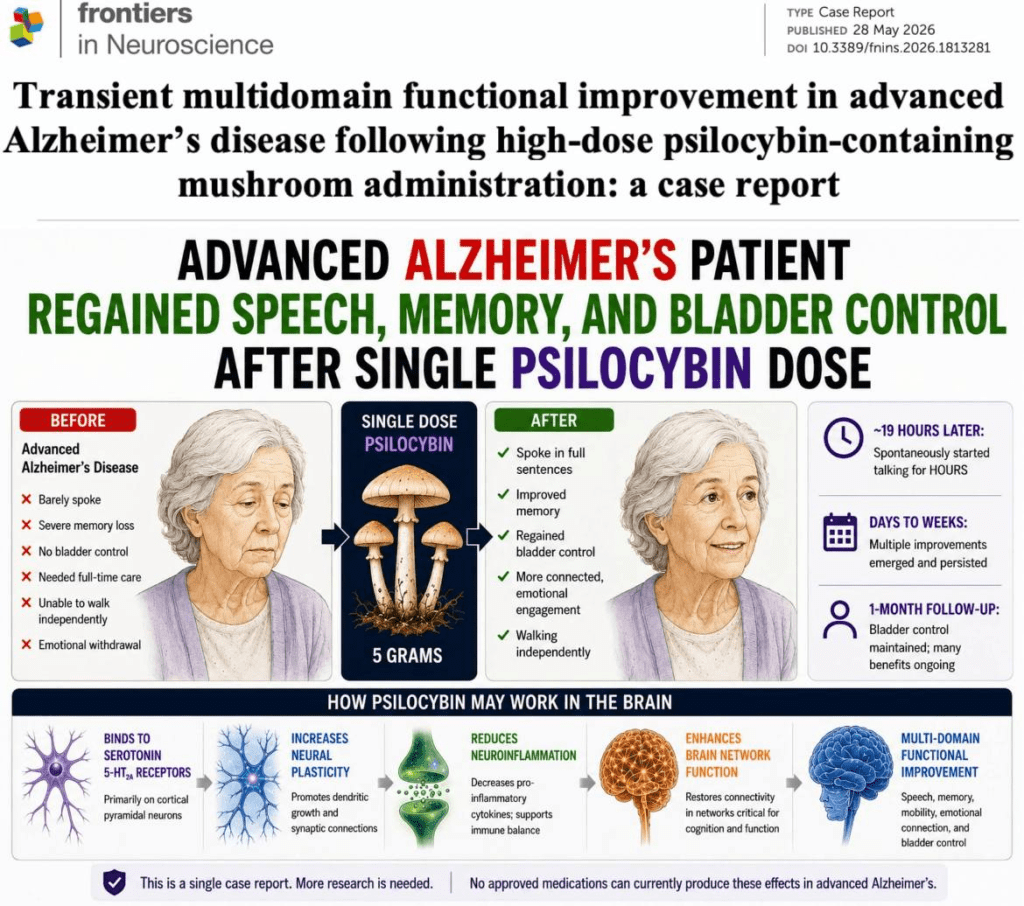
BREAKING: ADVANCED ALZHEIMER’S PATIENT REGAINED SPEECH, MEMORY, AND BLADDER CONTROL AFTER SINGLE PSILOCYBIN DOSE
An 80-year-old woman with advanced Alzheimer’s — who had barely spoken for YEARS — experienced RAPID and SUSTAINED improvement after taking 5g of psilocybin mushrooms.
During the acute phase, she entered a prolonged deep sleep-like state with profuse sweating.
~19 hours later, she spontaneously started talking again for HOURS — sharing detailed autobiographical memories she hadn’t expressed in years.
Over the following days, her family reported improved memory, walking, emotional connection, speech, and regained bladder control.
After 1 month, bladder control REMAINED RESTORED, and she was still functionally improved compared with baseline.
While this is just one published case report, the implications are enormous given that there are currently NO approved medications known to produce effects like this in advanced Alzheimer’s.
These findings urgently need replication. For millions watching a parent or loved one disappear to Alzheimer’s, even the possibility of restoring lost function warrants serious scientific investigation.
The recent report of an advanced Alzheimer’s patient showing dramatic functional improvement after a high-dose psilocybin mushroom experience has generated intense discussion worldwide.
Many people immediately ask:
“Does this mean psilocybin cures Alzheimer’s disease?”
The answer is simple.
No one knows.
The report describes a single case. It does not prove a cure, and much more research is needed before any medical conclusions can be drawn.
Yet focusing only on whether the treatment “works” risks missing a much larger issue.
The real lesson may be that modern society possesses an extremely narrow understanding of nutrition itself.
The Two Levels of Nutrition
Today, when most people hear the word nutrition, they think about physical substances:
- protein
- fats
- carbohydrates
- vitamins
- minerals
- antioxidants
These compounds support the physical body. They build tissues, fuel metabolism, regulate hormones, and maintain biological function.
This framework has been enormously successful.
However, it overlooks an obvious reality.
Many substances found in nature do not primarily affect muscles, bones, blood, or organs.
They affect consciousness.
Coffee changes alertness.
Tea changes attention.
Alcohol changes perception.
Nicotine changes mood and focus.
Chocolate influences emotional state.
None of these substances are valued primarily because of their caloric content. They are valued because they alter conscious experience.
In other words, they provide a form of nutrition directed not principally toward the body, but toward awareness itself.
Consciousness-Active Foods
Humanity has long known of plants, fungi, and botanical preparations that profoundly affect consciousness.
These include:
- psilocybin mushrooms
- ayahuasca
- peyote
- San Pedro cactus
- iboga
- LSD
Unlike ordinary foods, these substances produce little nutritional value in the conventional sense.
Their primary effect is informational and experiential.
They alter perception.
They alter memory.
They alter emotional processing.
They alter self-awareness.
They alter how the brain organizes experience.
For thousands of years, cultures across the world treated such substances not merely as medicines, nor merely as foods, but as tools for working directly with consciousness.
Modern society largely abandoned this perspective.
The Lost Frontier
During the mid-twentieth century, scientists began seriously investigating psychedelic compounds.
Early researchers explored their potential applications for:
- alcoholism
- depression
- trauma
- end-of-life anxiety
- creativity
- cognitive flexibility
Then much of this research abruptly stopped.
Political fears, cultural conflict, regulatory restrictions, and the broader drug war created an environment in which scientific investigation became extraordinarily difficult.
For decades, researchers often found it easier to avoid the field entirely.
As a result, several generations grew up with little awareness that serious scientific research into consciousness-active compounds had ever existed.
The public conversation became dominated by fear, stigma, and misinformation.
Why Alzheimer’s Matters
The recent Alzheimer’s case is important not because it proves anything.
It is important because it raises questions.
If an individual who had lost major functional capacities could temporarily regain speech, memory access, emotional engagement, and bladder control after exposure to a consciousness-active substance, researchers should want to understand why.
Perhaps the explanation lies in neural plasticity.
Perhaps it involves inflammation.
Perhaps it reflects changes in large-scale brain networks.
Perhaps multiple mechanisms are involved simultaneously.
Whatever the explanation, the appropriate response is investigation.
Scientific progress begins when unexpected observations are examined rather than ignored.
Public Awareness Before Public Conclusions
Greater public awareness does not mean blind acceptance.
It does not mean declaring psychedelics to be miracle cures.
It does not mean abandoning scientific rigor.
It means recognizing that an important category of substances has been largely excluded from mainstream discussion for decades.
The public deserves to know that compounds exist whose primary action is not nutritional in the conventional sense but consciousness-active.
The public deserves to know that legitimate researchers around the world are once again studying these compounds.
The public deserves to know that the field remains young and that many important questions remain unanswered.
Most importantly, the public deserves a conversation that is neither driven by fear nor by hype.
The Next Frontier of Human Health
The future of medicine may require a broader understanding of what nourishment actually means.
Some substances nourish the body.
Others influence consciousness.
Some may do both.
The challenge of the twenty-first century is not to choose between biology and consciousness, but to understand how deeply they interact.
The Alzheimer’s case reminds us that human beings are more than collections of organs and biochemical pathways. We are conscious organisms whose experience, memory, identity, and awareness remain among the greatest mysteries in science.
Whether psilocybin ultimately proves useful for neurodegenerative disease or not, one conclusion is already clear:
Society needs greater scientific literacy and public awareness regarding consciousness-active foods, plants, fungi, and compounds.
They represent one of the least understood frontiers in human health, and one whose exploration has been delayed for far too long.


Leave a comment