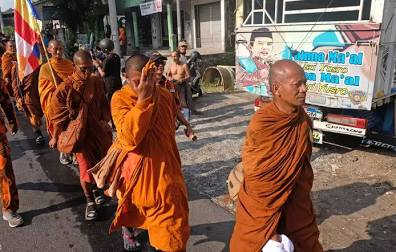
Tudong (the Thai Forest Tradition adaptation of the Pāli dhutaṅga austere practices) is effectively a practical, real-world crucible designed specifically to cultivate this divine resilience.
When a bhikkhu leaves the relative safety and comfort of a fixed monastery to walk long distances on foot—often exposed to the elements, barefoot or in simple sandals, carrying only minimal requisites—he deliberately steps beyond the human comfort zone.
The Tudong as a Crucible for Khanti
During tudong, physical hardship is not an occasional possibility; it is an unavoidable part of the landscape. The journey forces an immediate confrontation with the physical world on several levels:
The Physical Impact: Blisters, extreme heat, biting insects, exhaustion, hunger, and unpredictable weather. Because these physical phenomena are manifestations of mental phenomena within this physical world, the body bears the full impact of the loka’s harsh causal laws.
The Trap of Aversion (Dosa): An untrained mind facing a long walk under a blazing sun immediately generates irritation, resistance, and the wish that circumstances were different. Tudong strips away the option of escape. You cannot change the weather, the road, or the pain in your feet. The only thing that can change is the citta.
Maintaining the Divine State: This is where the bhikkhu applies khanti. Instead of allowing the citta to degrade into anger, frustration, or self-pity, the practitioner observes the physical pain and the associated feelings without absorbing them. He separates the body and feeling from mind and dhamma. In doing so, he maintains the pristine and elevated qualities of the Brahma-vihāras, particularly equanimity (upekkhā), in the midst of discomfort.
Khanti as Divine Resilience
The Brahma Standard: To maintain a divine state of mind means aligning with the Brahma-vihāras—the supreme states of mettā, karuṇā, muditā, and upekkhā. When confronted by physical suffering or hostility, ordinary worldly minds default to dosa (anger and aversion). Khanti is the supreme resilience that protects the citta and keeps it established in that higher Brahma standard.
The Pure Shield: Physical phenomena in this world are manifestations of mental phenomena, bound by the laws of causality, impermanence, and decay. When physical suffering strikes, khanti functions as a shield. It ensures that while the body experiences the impact, the inner divine state remains untouched and unpolluted by rāga, dosa, or moha.
A Stepping Stone to liberation
Upholding these supreme values during intense physical trials is precisely how the ancient path to Nibbāna is forged. By remaining anchored in this higher state, the citta clearly sees the nature of the worldly and becomes disenchanted with the world and its inherent suffering.
This resilience prevents the mind from sinking into the lower frequencies of the world. Instead, it enables the citta to see through worldly traps, abandon them, and steadily progress toward the ultimate threshold—the gateway beyond the world and into true freedom within the Nibbāna-Dhātu.
In this light, khanti as divine resilience or spiritual resilience captures the active nobility and majesty of the word.
The Modern World as a Collective Tudong
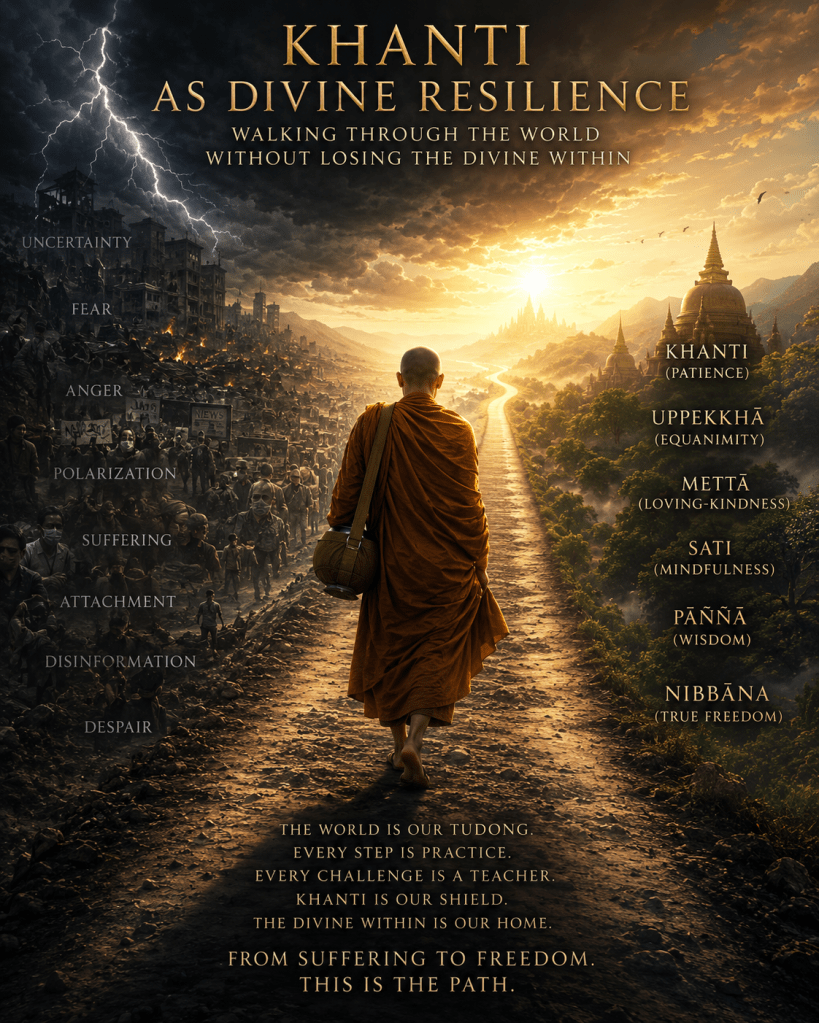
Although few people today undertake a traditional tudong, the principle remains the same. The pressures of modern life have become a kind of collective tudong for humanity.
The ancient bhikkhu walked through forests, mountains, storms, hunger, sickness, and uncertainty. Modern men and women walk through economic instability, social upheaval, information warfare, political polarization, technological disruption, and psychological stress. The forms differ, but the underlying challenge is identical: how does the citta respond when comfort, certainty, and control are taken away?
Just as tudong strips away external supports and forces the practitioner to confront the movements of the mind directly, the pressures of the present age are exposing the hidden tendencies of humanity. Fear, anger, attachment, tribalism, despair, and confusion arise to the surface. What was previously concealed by comfort and routine is now becoming visible.
In this sense, the modern world itself has become a training ground for khanti. Every disappointment, every uncertainty, every frustration, and every disruption presents the same question that confronted the forest monk walking beneath the blazing sun: Will the mind descend into dosa, fear, and reactivity, or will it remain established in higher values?
The challenge is not to control the world. The challenge is to maintain the quality of the citta while moving through the world.
This is why khanti remains as relevant today as it was in the forests of ancient India. The circumstances have changed, but the training has not. The world continues to provide the conditions; the practitioner continues to cultivate resilience. Through that resilience, the citta gradually becomes disenchanted with worldly conditioning, established in higher qualities, and prepared for the path that leads beyond the world altogether.
Resilience is not the absence of pain, fear, or fatigue. It is the capacity to maintain a higher state of mind while passing through them. It is the ability to preserve the divine state without surrendering one’s values; to endure hardship and emerge stronger without becoming hardened, bitter, or consumed by anger.
What humanity is living through today is not merely political, social, or economic upheaval. It is also a psychological and spiritual stress test.
The Great Awakening can be understood as a prolonged initiation—a sustained pressure exerted upon consciousness itself. It challenges our nervous systems, our perception of reality, our relationships, our patience, and often our hope. It strips away false certainties, trusted narratives, and comfortable illusions, leaving us exposed to an unknown future that is as exciting as it is unsettling.
Resilience, in this context, is the ability to remain awake without losing yourself; to see clearly without becoming cynical; to feel deeply without collapsing; and to stand firm without becoming rigid.
Those who endure are those who learn to self-regulate, to pause, to integrate truth gradually, and to honour their limits.
This is not about “toughening up.” It is about rooting deeply into the divine ancestral values of mankind and remaining faithful to them under pressure.
If you feel tired, overwhelmed, or disoriented, it does not mean you are failing. It means the pressure is real. And if you are still here—still questioning, still feeling, still choosing spiritual values over comfort—then resilience is already alive within you.
This is not the end of you.
It is the forging of you into who you were always meant to become.


Leave a comment