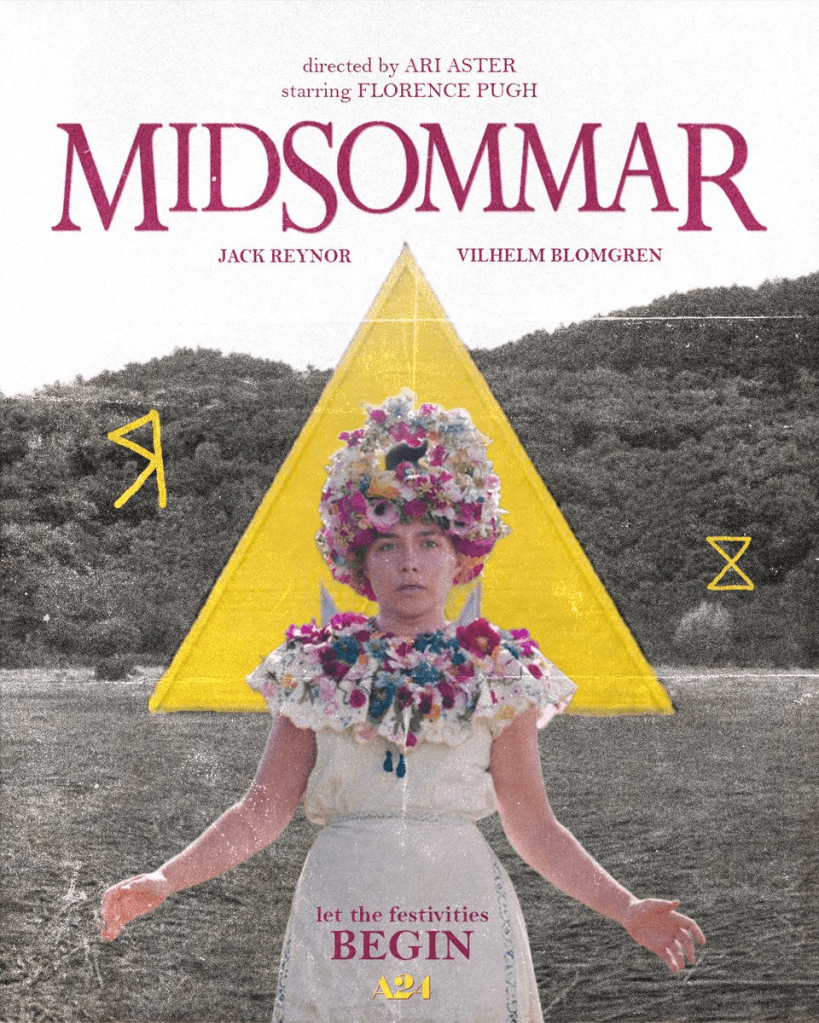
Ari Aster’s Midsommar is not merely a horror film. The violence alone does not explain why Midsommar lingers in the mind long after the credits end. Horror cinema is filled with murder, torture, and death. Most such films are forgotten within days. Midsommar is different because its horror operates at a deeper psychological and philosophical level.
The true horror of the film is not physical death, but the gradual death of the individual.
At the beginning of the film, Dani is a wounded but independent human being. By the end, she has become part of something larger than herself. Many viewers interpret her final smile as liberation, healing, or empowerment. But truth is far from that.
Dani is not liberated. She is absorbed.
And that distinction may be one of the most important lessons of our time.
Because what happens to Dani is not merely a fictional horror story. Variations of the same process have appeared throughout human history—in cults, revolutionary movements, totalitarian states, and even certain spiritual traditions. Again and again, human beings have been encouraged to surrender their individuality in exchange for belonging, security, meaning, or salvation.
The question raised by Midsommar therefore extends far beyond cinema:
What happens when the individual disappears?
And is there a path to freedom that preserves individuality rather than dissolving it?
The Real Horror of Midsommar
The Hårga commune initially appears attractive.
The village is beautiful.
The people seem happy.
Everyone belongs.
Everyone participates.
Everyone shares in the joys and sorrows of the community.
Compared with the alienation of modern society, the commune almost appears healthier.
This is precisely what makes the film disturbing.
The Hårga do not conquer people through force.
They attract them through belonging.
Dani arrives emotionally shattered.
Her sister has murdered their parents before taking her own life.
Her relationship with Christian is collapsing.
She is isolated, traumatized, and desperate for connection.
The Hårga recognize this immediately.
Like many real-world cults throughout history, they do not begin with coercion.
They begin with acceptance.
They provide what Dani desperately lacks:
community,
validation,
shared experience,
and the feeling of being seen.
The most important scene in the film is not the sacrifice.
It is the scene in which the women surround Dani as she breaks down emotionally.
They cry with her.
Scream with her.
Breathe with her.
Mirror every expression on her face.
For Dani, it feels like compassion.
For the audience, it appears moving.
But beneath the surface, something much deeper is occurring.
The commune is gradually dismantling the boundary between the individual and the group.
Her grief is no longer her grief.
Her emotions are no longer entirely her own.
The collective now participates in her inner world.
By the end of the film, every meaningful connection to Dani’s previous life has been severed.
Her family is gone.
Her friends are dead.
Her boyfriend is sacrificed.
The only identity remaining is the one provided by the commune.
When she smiles as the temple burns, many viewers see healing.
But another interpretation is possible.
The commune has solved Dani’s loneliness by eliminating the isolated self.
The pain disappears because the person who carried that pain has been absorbed into the tribe.
The individual dies.
The collective survives.
How Human Beings Lose Their Individuality
At first glance, such a transformation seems impossible.
Modern people assume that individuality is permanent.
We believe our private thoughts belong to us.
We believe our personality is fixed.
We believe we would never surrender our identity to a group.
Yet psychology and history tell a different story.
The destruction of individuality does not require magic.
It does not require stupidity.
It does not require weakness.
It requires only the systematic dismantling of the structures that maintain the sense of self.
The first step is often physiological.
Notice what happens in Midsommar.
The sun never sets.
Sleep patterns become disrupted.
Time becomes difficult to track.
Reality itself begins to feel unstable.
This is not merely cinematic atmosphere.
Human beings depend upon biological rhythms to maintain psychological stability. When sleep, routine, and orientation begin to break down, critical thinking weakens. The ability to resist social pressure weakens. The mind becomes increasingly suggestible.
The second step is what psychologists call deindividuation.
The Hårga dress alike.
Eat together.
Move together.
Celebrate together.
Grieve together.
Every ritual communicates the same message:
You are not separate.
You are part of us.
The more personal distinctions disappear, the stronger collective identity becomes.
The final step is emotional fusion.
Human beings possess an extraordinary capacity to synchronize emotionally with one another. Under conditions of intense shared experience, people begin identifying more strongly with the group than with themselves.
What feels like love can become dependence.
What feels like belonging can become surrender.
The individual gradually stops asking:
“What do I think?”
and begins asking:
“What do we think?”
The transformation appears impossible only because it is usually invisible while it is happening.
When the Village Becomes a Nation
The truly frightening realization is that the Hårga are not unique.
The same psychological mechanisms have repeatedly appeared on a much larger scale.
The village simply becomes a nation.
The elders become the state.
The rituals become ideology.
The process becomes industrialized.
One of the clearest examples occurred during the chinese Cultural Revolution.
The goal was not merely political obedience.
It was the remaking of identity itself.
Children were encouraged to denounce parents.
Students denounced teachers.
Public struggle sessions placed individuals before hostile crowds who screamed accusations, demanded confessions, and forced public displays of ideological conformity.
The objective was psychological transformation.
The individual had to be broken before being rebuilt as part of the revolutionary collective.
A similar pattern emerged under the Khmer Rouge in Cambodia.
The regime declared “Year Zero.”
History was erased.
Religion was abolished.
Private property was abolished.
Family loyalty was viewed as a threat.
The state sought to replace every previous source of identity with loyalty to a single collective entity: Angkar, “The Organization.”
The underlying psychology was remarkably similar to what we see in Midsommar.
Isolation.
Uniformity.
Emotional pressure.
Collective identity.
The individual existed only insofar as he served the group.
What appears in the film as a small pagan commune has appeared repeatedly throughout human history on a scale involving millions of people.
Why Gautama Buddha Chose a Different Path
This brings us to a deeper question.
If collective absorption represents one danger, what alternative exists?
This question was not unknown in ancient India.
Long before his final enlightenment, Gautama Buddha followed spiritual training available in his time. Especially the most refined states of consciousness of meditation, the Arupa realm, or formless realm of transcendence.
Yet he eventually walked away.
Why?
Because neither the lower sex realm nor the formless realm provided what he was seeking, the ultimate and true freedom.
At one end was absorption into lower and vulgar worldly life.
At the other was absorption into the source of the universe with thinning out of individuality.
Neither constituted ultimate freedom.
Gautama Buddha’s solution was the Middle Path.
This is often misunderstood as moderation.
In reality, it was a radically different architecture of liberation.
The goal was not deeper involvement in worldly existence.
Nor was it the dissolution of individual consciousness into annihilation by union with the source.
The goal was liberation of individuality itself from worldly trap.
Through Sila, Samadhi, and paññā, purification, disenchantment, dispassion, the practitioner gradually disentangles himself from the structures of worldly attachment that bind him to the involuntary cyclic existence.
The emphasis is crucial.
Gautama Buddha did not teach no self, or emptiness of the self. He taught the transformation of the lower, worldly self, or the ego to become the higher self, divine self, purified self, and eventually liberated self.
He did not teach no identity. He taught not to identify one’s self with the worldly, this is non-identity.
He did not teach absorption into an collective. He taught to take refuge in out own self, or soul (atta/atman), and at the same time take refuge in his dhamma. That is to use his dhamma to transform our self, or soul.
And he did not teach that liberation could be achieved collectively. While every being of every dimension in this universe needs a collective to plug into, to be supported by the collective, one can always choose a collective to be associated with. Liberation can be achieved at individual level, that is the original teaching from Gautama Buddha. only when gautama buddha’s teachings declined, then emerged collective salvation at collective level, by joining a heavenly kingdom. That’s why it is called salvation (salvare/salvus), not liberation (Vimutti/Mukti).
Liberation must be realized individually.
No group can awaken for you.
No institution can awaken for you.
No movement can awaken for you.
The path must be walked personally.
In this sense, the preservation of individuality is not a political concern.
It is a spiritual necessity.
Without an individual capable of awakening, there can be no liberation.
The Last Refuge of Freedom
The lesson of Midsommar is not really about cults.
It is about a recurring tendency within human civilization itself.
Again and again, people are tempted to exchange freedom for belonging.
The tribe offers belonging.
The ideology offers belonging.
The movement offers belonging.
The state offers belonging.
The collective always offers belonging.
The price is individuality.
The price is autonomy.
The price is the capacity to stand apart and see clearly.
The Hårga promise Dani that she will never be alone again.
They keep that promise.
But only because there is no longer a separate Dani left to be alone.
In an age increasingly defined by mass movements, ideological tribes, social conformity, and collective identities, this lesson feels more relevant than ever.
The preservation of individuality is not an act of selfishness.
It is the foundation of freedom.
And perhaps this is where Gautama Buddha’s teaching remains profoundly relevant.
Against the pressures of tribe, ideology, and collective absorption, he pointed toward a path that does not culminate in belonging to something larger.
It culminates in liberation.
Not absorption.
Not conformity.
Not surrender.
Freedom.


Leave a comment