Maya, Simulation, and the Theatre of Human History
Ancient India called it Māyā.
The Gnostics described the world as a prison of illusion, designed to keep consciousness trapped in forgetfulness.
Plato described humanity as prisoners watching shadows projected onto a cave wall.
Modern technologists speak of reality as a simulation. they describe it as an artificial environment, a programmed construct, or an informational matrix designed to shape perception and experience. The language has changed, but the underlying question remains remarkably similar:
Are we seeing reality itself, or merely a carefully managed representation of reality?
The Parallels between Abraham Lincoln and John F. Kennedy
The parallels between Abraham Lincoln and John F. Kennedy are a staple of “secret history” and synchronicity discussions, famously popularized by researchers like Jordan Maxwell. These coincidences are often cited to suggest a “repeating pattern” or a hidden architecture to history.
Here is the “eerie” list of parallels commonly discussed:
The Timeline of 100 Years
- Elected to Congress: Lincoln in 1846, Kennedy in 1946.
- Elected President: Lincoln in 1860, Kennedy in 1960.
- Successors: Both were succeeded by Southerners named Johnson (Andrew and Lyndon).
- Successors’ Births: Andrew Johnson was born in 1808; Lyndon Johnson was born in 1908.
- Assassins’ Births: John Wilkes Booth was born in 1838 (some lists say 1839 to fit the pattern); Lee Harvey Oswald was born in 1939.
The Circumstances of Death
- Day of the Week: Both were assassinated on a Friday.
- Location: Both were shot in the head while sitting next to their wives.
- The Names: Both surnames (Lincoln and Kennedy) have 7 letters.
- The Warnings: Both presidents were warned by their secretaries not to go to the location of their death. (Lincoln’s secretary was named Kennedy; Kennedy’s secretary was named Lincoln).
The “Mirror” Locations
This is the part Jordan Maxwell and others often highlight as a “cosmic signature”:
- Ford & Lincoln: Lincoln was shot in Ford’s Theatre. Kennedy was shot in a Lincoln (the car model), which was made by Ford.
- The Theater/Warehouse Swap:
- Lincoln’s assassin (Booth) shot him in a theater and ran to a warehouse (tobacco barn).
- Kennedy’s assassin (Oswald) shot him from a warehouse and ran to a theater.
Other Strange Links
- Civil Rights: Both were deeply involved in major Civil Rights movements (Emancipation Proclamation vs. the Civil Rights Act).
- Loss of Children: Both families lost a child while living in the White House.
- The Names of the Assassins: Both John Wilkes Booth and Lee Harvey Oswald are known by their three names, and both full names have 15 letters.
- The “Marilyn” Mystery: (Often cited for humor/creativity) A week before Lincoln was shot, he was in Monroe, Maryland. A week before Kennedy was shot, he was with Marilyn Monroe.
Jordan Maxwell’s interpretation of these parallels goes beyond mere coincidence, moving into the realm of Astrotheology and Occult Scripting. To Maxwell, history is not a series of random events but a carefully constructed “theatre” managed by secret societies and higher powers.
Here is how he specifically interpreted these “eerie” connections:
1. The “100-Year Cycle” as Ritual Timing
Maxwell often argued that elite groups (the “hidden masters”) operate on long-term cycles based on numerology and the movements of the stars. He viewed the 100-year gap between the two presidencies (1860–1960) as a “Harmonic Resonance.” In his view, the second event (Kennedy) was a ritualistic “mirror” or “echo” of the first (Lincoln), intended to reinforce a specific psychological frequency in the American public.
2. The “Ford” and “Lincoln” Word Magic
One of Maxwell’s most famous observations was the “Ford” and “Lincoln” connection. He didn’t see it as a joke; he saw it as Word Magic (Etymological Occultism).
- He noted that Lincoln was killed in Ford’s Theatre, while Kennedy was killed in a Lincoln (car) made by Ford.
- To Maxwell, names carry power. By linking these two iconic American brands/names in a cycle of death, he believed the “controllers” were weaving a spell into the fabric of the American psyche, essentially “trademarking” the tragedy.
3. The “Theatrical” Nature of History
Maxwell frequently used the phrase “The World is a Stage.” He believed that:
- Lincoln was the “Sacrificial King” of the 19th century who “purified” the nation through blood.
- Kennedy was the “Sacrificial King” of the 20th century.
- The reversal (Lincoln shot in a theater, assassin ran to a warehouse; Kennedy shot from a warehouse, assassin ran to a theater) was a “Hermetic Inversion”—the occult principle of “As Above, So Below” or “As it was, so shall it be reversed.”
4. Connection to Secret Societies
Maxwell often hinted that both men were “insiders” who eventually tried to “break the script.”
- He pointed to Lincoln’s attempt to print “Greenbacks” (interest-free money) to bypass the bankers.
- He pointed to Kennedy’s Executive Order 11110 (which also aimed to issue silver-backed currency) and his famous “Secret Societies” speech.
- The Result: Maxwell argued that when a “player” on the stage stops following the script provided by the “directors” (the banking and occult elites), they are “written out” of the play using highly symbolic and ritualistic methods.
The Forgotten Book That Warned of a Hidden World Order
“For we wrestle not against flesh and blood, but against principalities, against powers, against the rulers of the darkness of this world, against spiritual wickedness in high places.”
(Ephesians 6:12)
Almost a century ago, in the turbulent aftermath of the Russian Revolution, a little-known émigré writer and former Imperial Russian general, Arthur Cherep-Spiridovich, published a remarkable book entitled The Secret World Government, or, The Hidden Hand.
Writing from exile after witnessing the collapse of the old European order, Cherep-Spiridovich advanced a sweeping interpretation of modern history. Revolutions, wars, economic crises, and the gradual destruction of traditional civilization were, in his view, neither accidental nor spontaneous. Behind them operated a concealed network of power that transcended nations, governments, and political parties.
He called this network the “Hidden Hand.”
According to Cherep-Spiridovich, real power no longer resided primarily in kings, parliaments, or elected officials. Instead, authority had migrated toward a small international elite whose influence flowed through finance, propaganda, and revolutionary movements. He claimed that this inner circle, numbering roughly three hundred individuals and headed by Edouard Rothschild in Paris, exercised influence over world affairs through mechanisms largely invisible to the public.
He wrote:
“Almost nobody knows that all the so-called Satanic forces are autocratically led by Pan-Judaism, headed now by Edouard Rothschild V-th in Paris… he and 300 others compose the World Government, the ‘Hidden Hand’.”
Elsewhere he stated:
“The world unrest is caused by the lust of murder of the Judeo-Mongols and their firm desire to smash the Aryans and to overthrow everything Christian.”
Today, these passages must be understood as expressions of the author’s own worldview and historical context. Yet regardless of whether one accepts his conclusions, the broader framework he proposed remains striking. He believed that modern history revealed a consistent pattern: power steadily concentrating into increasingly unaccountable hands while traditional institutions lost their independence.
For Cherep-Spiridovich, the central struggle of the modern age was not merely political. It was civilizational. He saw an emerging system dedicated to dissolving inherited cultural and spiritual foundations and replacing them with a world organized around materialism, debt, and perpetual conflict.
In his analysis, this transformation operated through three primary instruments.
Finance, because debt is among the most effective forms of social control. A population burdened by financial obligation becomes increasingly dependent upon those who issue and manage credit.
Revolution, because periods of upheaval erase memory, dismantle established structures, and create opportunities for new forms of power to emerge.
Information, because public perception ultimately determines political reality. Whoever shapes the collective mind shapes the future.
Through these mechanisms, he argued, a new form of governance was taking shape. Nations would continue to exist, elections would continue to occur, and governments would continue to function, yet real authority would increasingly reside elsewhere. Political institutions would become administrators of policies whose origins lay beyond public scrutiny.
His warning was therefore larger than any particular conspiracy theory. It was a warning about the migration of power itself: away from visible institutions and toward networks that operate beyond ordinary democratic accountability.
Whether one agrees with his conclusions or not, it is difficult to ignore how many of the trends he described have intensified over the century that followed. Financial institutions now possess extraordinary influence over national economies. Media systems shape public perception on a global scale. International organizations, multinational corporations, intelligence networks, and financial actors often appear more durable than the governments that formally regulate them.
Reading Cherep-Spiridovich today is therefore less interesting as an exercise in proving or disproving every specific claim than as an encounter with a forgotten interpretation of history. Long before the modern discussions of globalization, technocracy, elite networks, or the concentration of institutional power, he was already describing a world in which sovereignty would gradually migrate from nations to transnational systems.
Writing in 1926, he believed he was warning future generations about a transformation that had only begun.
A century later, many readers will find themselves asking whether he was merely a man of his time—or whether he glimpsed the outlines of a structure that would become increasingly visible as the twentieth and twenty-first centuries unfolded.
The book can be read here:
https://dn790007.ca.archive.org/0/items/secret-world-government/secret-world-government.pdf
The Discovery of Perception Control
One of the most important realizations of the twentieth century was that populations can be controlled without chains, prisons, or armies.
They can be controlled through perception.
The contemporary disclosure movement, including the Epstein files, has added more details that reality is a complex arena involving multiple non-human higher intelligences, extraterrestrial groups, interdimensional entities, and hidden human groups operating behind the visible structures of society.
Today humanity exists within a contested environment in which these forces direct the civilization, with Some are benevolent, many are manipulative, and more are pursuing agendas that remain largely hidden. the visible world of politics, economics, and entertainment may merely be the surface layer of a much deeper system of influence. Above world governments stand vast institutional structures that shape perception, belief, and behavior on a global scale.
The military industrial complex, The pharmaceutical, The financial system, The media and entertainment complex are competiting to direct the scene of society like a public show. Together, these systems form a network so pervasive that most people interact with it every day without recognizing its influence.
Whoever controls the media controls the mind.
Throughout history, Empires were sustained not merely through armies but through stories. Myths, symbols, ceremonies, spectacles, and public rituals shaped the collective mind. Modern technology has simply expanded these capabilities to a scale unimaginable in previous centuries.
As a result, human history increasingly resembles a vast public theater. Wars become global dramas. Political campaigns become ritual performances. Celebrity culture becomes a modern mythology. Mass media functions as a system of symbolic transmission, continuously generating emotional energy, attention, and identification.
Certain historical events acquire an almost archetypal quality, such as from Abraham Lincoln and John F. Kennedy, from 911 to charlie kirk, from Britney spears to jim carrey. Researchers have long noted strange parallels between Abraham Lincoln and John F. Kennedy, two presidents separated by a century yet linked through an extraordinary collection of coincidences. Others point to events such as September 11, major political assassinations, public scandals, or highly visible cultural moments as examples of collective rituals that reshape public consciousness.
Whether these patterns are deliberate, coincidental, or manifestations of deeper psychological structures remains open to debate. Yet they reveal an important truth: human beings do not merely live through events; they live through narratives.
The public mind is shaped less by facts than by stories.
This dynamic extends beyond politics and into popular culture. Celebrities often become vessels for collective projections. They become symbols onto which society projects its hopes, fears, desires, and unresolved psychological tensions.
The result is a civilization that increasingly experiences reality through mediated images rather than direct experience.
Ancient traditions warned that this is precisely how Māyā operates.
The illusion does not require deception in the ordinary sense. It functions because attention becomes captured by appearances. The individual loses contact with deeper reality and becomes absorbed into a world of symbols, reactions, and manufactured identities.
Some disclosure researchers push this idea even further.
They suggest that humanity itself may have undergone a profound historical fall, that modern humans are not merely descendants of earlier civilizations but descendants of a lineage that has lost something essential—an inheritance, a capacity, or a state of being once associated with a higher form of existence.
Within these narratives, phenomena such as abductions, genetic manipulation, cloning, hybridization, and non-human intervention are interpreted as evidence that humanity has become victim to a larger cosmic hierarchy. these narratives express a common intuition: that mankind fallen to be humanity has become disconnected from its original source and no longer fully possesses sovereignty over its own destiny.
This theme appears repeatedly across cultures. The Fall in the Abrahamic traditions.The decline of the ages in Hindu cosmology. The loss of primordial wisdom in ancient mystery schools. The descent from a golden age into an age of confusion and fragmentation.
Different civilizations used different languages, yet many pointed toward the same underlying concern: humanity has forgotten something fundamental about its origin and purpose.
Perhaps that is why the ancient doctrine of Māyā and the modern theory of simulation continue to resonate so strongly. Both propose that what appears to be reality may only be a surface layer. Both suggest that unseen forces shape the world we experience. Both insist that genuine freedom begins when an individual recognizes the mechanisms influencing perception. And both ultimately direct attention toward the same question:
If the world is a stage, who wrote the script?
More importantly, who benefits from our continued participation in it?
The search for that answer may be one of the defining spiritual, philosophical, and political questions of our age.
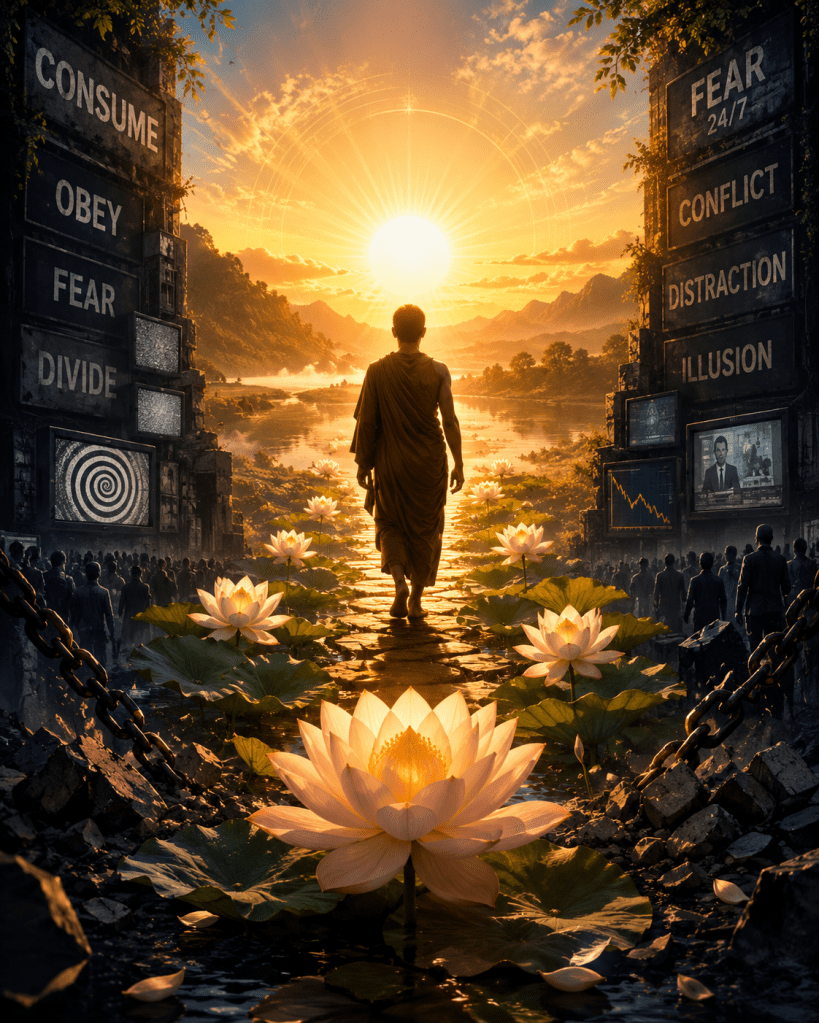
Stepping Out of the Manufactured Reality
If we want a freer world, we must first become freer people.
If we want integrity in leadership, integrity must become the standard by which we live our own lives. If we hope for courage, discernment, resilience, and sovereignty to define the next chapter of humanity, those qualities cannot remain abstract ideals. They must be embodied, practiced, and cultivated in our daily actions.
The future does not arrive as a gift bestowed upon a passive population. It emerges in response to who we become.
For that reason, the most important work is rarely found in governments, institutions, elections, or world events. It is found much closer to home. It is found in the gradual refinement of character, the strengthening of discernment, the healing of wounds, the mastery of habits, and the alignment of our actions with the values we claim to hold.
This is the work no one can do on our behalf.
Paradoxically, that is precisely where our greatest power resides.
A useful analogy is that of sitting in a cinema.
While the film is playing, it feels completely real. A frightening scene generates fear. A tragedy evokes grief. A moment of triumph inspires joy. The body reacts, emotions arise, and consciousness becomes absorbed in the unfolding story. For those few hours, the screen becomes reality itself.
Yet when the film ends, the lights come on and you step outside into the open air, something shifts immediately. The emotional spell dissolves. You remember that what felt so compelling was ultimately a projection of light and sound carefully designed to capture your attention and immerse you in a narrative.
The experience was real.
The emotions were real.
But the story itself was a constructed reality.
In many ways, this is what the world begins to resemble when one starts looking beneath its surface.
The constant chaos.
The perpetual crises.
The engineered fear.
The emotional manipulation.
The endless cycles of outrage.
The manufactured divisions that encourage people to fight one another while rarely questioning the structures that generate the conflict.
The deeper one observes, the more one notices how much of modern life revolves around the management of attention and emotion. Entire industries exist to direct what people think about, what they fear, what they desire, and what they identify with.
The result is a civilization trapped in a continuous state of reaction.
People are encouraged to respond rather than reflect.
To consume rather than contemplate.
To choose sides rather than seek understanding.
To remain emotionally invested in the spectacle.
At a certain point, however, something changes.
One no longer identifies entirely with the movie.
One begins to see the screen.
And once that happens, the relationship with the spectacle is transformed forever.
The drama may continue.
The headlines continue.
The conflicts continue.
The narratives continue.
Yet something within remains untouched by them.
There is no longer a desire to feed the system with endless attention, fear, outrage, or emotional energy. The need to participate in every manufactured crisis begins to fade. One recognizes that genuine freedom is not found by controlling the movie but by no longer being controlled by it.
In a symbolic sense, one steps outside the cinema.
One steps outside the matrix.
Yet this raises a deeper question.
If the world is a manufactured reality, if civilization itself functions as a giant system of distraction, manipulation, and emotional capture, what is the actual solution?
For many people, the answer becomes endless research.
More disclosures.
More hidden histories.
More conspiracies.
More revelations.
But Gautama Buddha proposed something far more radical.
He taught that the problem is not merely that the world contains deception.
The problem is that consciousness becomes attached to the world itself.
Whether the object is wealth or poverty, politics or religion, fame or obscurity, angels or extraterrestrials, kingdoms or conspiracies, the mind remains bound so long as it continues to thirst for the world.
Gautama Buddha’s solution was therefore not to create a better drama.
It was to leave the drama behind.
His path begins with purification.
Purification of conduct.
Purification of speech.
Purification of mind.
As clarity develops, discernment deepens. One begins to see the repetitive nature of worldly existence. The endless cycles of desire, fear, gain and loss, victory and defeat, praise and blame, hope and disappointment.
This insight gives rise to what Gautama Buddha called Nibbidā—disenchantment from the world.
Disenchantment does not mean depression or cynicism.
It means seeing through the glamour.
Seeing through the seduction.
Seeing through the promises that the world continually makes but never permanently fulfills.
The movie loses its hypnotic power.
The spectacle no longer fascinates.
The spell begins to break.
From disenchantment arises Virāga—the fading of worldly passion.
The craving to possess, dominate, consume, and identify gradually weakens. The emotional hooks that once captured attention lose their grip. Fear loses its leverage. Desire loses its urgency.
One no longer seeks salvation through the world.
One no longer expects the next political movement, the next disclosure event, the next technological breakthrough, or the next social revolution to provide ultimate fulfillment.
The heart begins to let go.
And from this letting go arises Vimutti—liberation from the world.
Not liberation through controlling the system.
Not liberation through defeating every enemy.
Not liberation through obtaining secret knowledge.
Liberation through freedom from attachment to the entire structure.
This was Gautama Buddha’s unique contribution to humanity.
Most systems seek to improve the world.
Most ideologies seek to conquer the world.
Most religions seek to perfect the world.
Gautama Buddha taught a path of release from the world’s jurisdiction altogether.
A path beyond the endless cycles of becoming.
A path beyond the emotional machinery of the spectacle.
A path pf purification and liberation leading toward the Deathless realm of Refuge, with eternal life and permanent bliss.
This does not mean abandoning compassion or withdrawing from humanity. The liberated person may continue to act, teach, help, create, and serve. Yet they do so without being psychologically imprisoned by the drama.
They participate without attachment.
They care without clinging.
They engage without becoming consumed.
They stand in the world without belonging to it.
For while the world can manufacture narratives, it cannot manufacture truth.
It can manufacture fear.
It can manufacture desire.
It can manufacture identities.
But it cannot manufacture liberation.
Liberation begins the moment consciousness stops seeking fulfillment from the spectacle and turns instead toward purification, disenchantment from the world, fading of worldly passion, and release from the world.
That is the true freedom.
Not merely stepping outside the cinema.
Not merely seeing through the matrix.
But becoming free from the need to return to it at all.


Leave a comment