Before Paul became the principal missionary and theological interpreter of early Christianity, he was Saul of Tarsus: a highly educated Pharisee formed within the overlapping worlds of Judaism, Hellenistic culture, and Roman imperial civilization. Few figures in antiquity stood at such a remarkable intersection of civilizations. He emerged from a cosmopolitan Roman diaspora environment, received elite Pharisaic education, maintained associations with legal and religious authority, defended established orthodoxy with uncompromising zeal, and was shaped by institutions operating at the highest levels of society. Long before his conversion, Paul already represented intellectual rigor, scriptural mastery, disciplined reasoning, and trans-regional mobility within the imperial world.
This background is essential for understanding the significance of his later teachings. The rapid expansion of Christianity beyond the boundaries of Judea required more than religious enthusiasm. It required an individual capable of translating a local spiritual movement into concepts accessible across cultures, languages, and philosophical traditions. Paul possessed precisely this combination of abilities.
He was born in Tarsus of Cilicia, one of the most important urban centers of the eastern Mediterranean. Tarsus occupied a strategic position within the Roman world and was renowned for its educational institutions and intellectual culture. Greek language and rhetoric, Hellenistic philosophy, Roman administration, commercial exchange, and multicultural interaction all formed part of the environment in which Paul matured. Unlike many inhabitants of rural Judea, Paul grew up within a world where multiple traditions constantly interacted.
This cosmopolitan formation later enabled him to communicate Christian teachings to Greek-speaking urban populations, philosophical audiences, diaspora Jewish communities, and Roman civic structures. He emerged not merely as a religious convert, but as a uniquely hybrid figure standing at the crossroads of civilizations. Jewish scriptural learning, Greek intellectual culture, and Roman legal privilege converged within a single individual. Historically, this combination proved transformative.
According to early Christian tradition, Paul later studied in Jerusalem under Gamaliel, one of the most respected Pharisaic teachers of the era. There he immersed himself in Torah interpretation, legal reasoning, sacred tradition, purity structures, and disciplined religious practice. His later writings reveal extraordinary familiarity with scripture, sophisticated argumentation, and penetrating analysis of human psychology. Even after his conversion, the intellectual discipline formed during these years remained visible in the structure of his thought, the precision of his reasoning, and his persistent concern with ethical transformation.
His education also cultivated intense religious conviction. Paul did not initially oppose the early Christian movement because he lacked commitment or seriousness. He opposed it because he believed he was defending sacred order against dangerous deviation. In this respect, he resembled reformers, guardians of tradition, and defenders of orthodoxy found throughout world history. Individuals deeply formed within powerful institutions often become either their strongest protectors or their most radical transformers. Paul would eventually become both.
Before becoming Christianity’s greatest missionary, he became one of its most determined persecutors. Early traditions portray him as actively supporting efforts to suppress the movement through arrests, interrogations, and campaigns directed against emerging Christian communities. His consciousness remained structured around the defense of inherited authority, preservation of sacred law, and protection of established order. Yet within this very intensity lay the seeds of future transformation. The same seriousness that fueled persecution would later fuel spiritual inquiry. The same zeal that defended orthodoxy would eventually challenge its limitations.
By the early 30s CE, Paul stood as a representative of the old order. Jesus had already been crucified. Resurrection-centered communities were beginning to spread cautiously throughout Judea and beyond. Paul remained aligned with those seeking to contain the movement. Yet history was approaching a decisive turning point. The persecutor would become a missionary. The defender of exclusivism would become an apostle to the nations. The guardian of orthodoxy would become one of the most influential interpreters of inward transformation in religious history.
It is against this background that Paul’s anthropology must be understood. His teachings concerning body, soul, and spirit did not emerge from an isolated mystical experience alone. They arose from the reflections of a man who had mastered Jewish scripture, encountered Greek philosophy, navigated Roman civilization, and undergone a profound existential reversal. Among the many ideas associated with Paul, none would prove more influential than his threefold anatomy of the human being: Soma (Body), Psyche (Soul), and Pneuma (Spirit). Through this framework he attempted to explain not merely what a human being is, but how consciousness becomes entangled within the world and how it may ultimately transcend it.
The Body: Sōma and the Realm of Material Existence
Paul begins with the most obvious layer of human existence: the body.
The sōma represents the visible organism through which a person participates in the material world. It eats, sleeps, ages, reproduces, and eventually dies. Through the senses, it gathers information from its environment and transmits that information inward to the psychological layers of the individual.
Yet Paul’s understanding of the body is more nuanced than many later readers assume.
He repeatedly distinguishes between sōma and sarx, terms often translated interchangeably as “body” or “flesh.” In Paul’s writings, however, they perform different functions. The body itself is morally neutral. It is simply the vehicle through which life is expressed. The flesh, by contrast, refers to a mode of orientation toward existence. It describes the tendency of consciousness to become dominated by sensory impulses, cravings, fears, and instinctive drives.
The distinction is crucial.
A person may possess a physical body without being governed by the flesh. Conversely, a person may be physically healthy, disciplined, and respectable while remaining completely trapped within fleshly consciousness.
Paul therefore treats the body as an instrument rather than an enemy. The problem lies not in embodiment itself but in the domination of awareness by the sensory field. When consciousness becomes absorbed in bodily gratification, fear of death, social status, and worldly acquisition, it becomes locked into a cycle of continual dissatisfaction.
The body then ceases to function as a tool and instead becomes a master.
In this sense, Paul’s analysis resembles many ancient contemplative traditions. The physical organism remains necessary for life in the world, yet liberation requires preventing bodily impulses from dictating the direction of consciousness.
The Soul: Psychē and the Construction of Identity
Beyond the body lies the layer Paul calls psychē.
Modern readers often misunderstand this term because centuries of theological development have transformed the word “soul” into something quite different from its original meaning. Today many people imagine the soul as an immortal essence that survives death and remains permanently unchanged.
Paul’s usage is far more practical.
The psychē represents the psychological dimension of existence. It includes memory, emotion, imagination, intellect, preference, personal history, and the sense of being a separate individual. It is the arena within which human beings construct their identity and navigate everyday experience.
This is the level at which people say:
“I am this person.”
“These are my beliefs.”
“This is my history.”
“These are my ambitions.”
The psychē continuously organizes experience into narratives that create a coherent sense of self.
Yet Paul viewed this layer with deep suspicion.
The soul possesses tremendous analytical power. It can reason, calculate, remember, compare, and plan. It can develop philosophies, construct political systems, and produce works of art. Nevertheless, despite its impressive capacities, it remains fundamentally limited because all of its operations occur within the conditioned world.
The psychē processes information received through the senses.
It rearranges data.
It creates interpretations.
It forms identities.
But it cannot easily move beyond the assumptions embedded within the world that produced it.
For this reason Paul frequently contrasts the psychikos anthrōpos—the soul-governed person—with the spiritual person. The psychikos individual remains trapped within ordinary patterns of perception. Such a person may be intelligent, educated, and morally respectable, yet still remain incapable of perceiving transcendent reality.
The limitation is structural rather than moral.
The soul cannot perceive what lies beyond the field in which it operates.
Just as the eye cannot directly see itself, the psyche cannot easily transcend the matrix of conditions that generate its sense of identity.
The Spirit: Pneuma and the Faculty of Transcendence
Above both body and soul stands the most mysterious component of Paul’s anthropology: the pneuma.
The Greek word literally means “breath” or “wind,” yet Paul employs it to describe something far more profound.
The pneuma functions as the faculty through which human beings encounter transcendent reality directly.
Unlike the body, it does not operate through sensory perception.
Unlike the psyche, it does not depend upon conceptual analysis.
Instead, it represents a mode of awareness capable of receiving truths that lie beyond ordinary cognition.
This distinction explains many passages in Paul’s letters that otherwise appear puzzling. He repeatedly contrasts worldly wisdom with spiritual understanding. He argues that intellectual sophistication alone cannot produce genuine transformation. He insists that ultimate reality becomes known through direct realization rather than conceptual reasoning.
From Paul’s perspective, the spirit is not merely another psychological faculty.
It belongs to an entirely different order of existence.
When dormant, a human being remains governed by bodily impulses and psychological conditioning. When awakened, the spirit begins to guide the soul and body rather than being suppressed by them.
The direction of influence reverses.
Instead of desires shaping thoughts and thoughts shaping actions, spiritual realization begins shaping thought, emotion, and behavior from within.
The individual gradually becomes what Paul calls a pneumatikos, a spiritual person.
The Drama of Human Transformation
Paul’s tripartite framework was never intended as a static description of human anatomy.
It describes a process.
Indeed, the central drama of Paul’s writings concerns the struggle between these different layers of existence.
Most people live from the outside inward.
Sensory experiences generate desires.
Desires influence thought.
Thought reinforces identity.
Identity perpetuates attachment.
The body influences the soul, while the spirit remains largely dormant.
Paul regarded this condition as the normal state of humanity.
The path of transformation therefore requires a complete inversion.
The individual begins by disciplining bodily impulses.
Cravings gradually lose their authority.
Psychological attachments become visible.
The narratives that once defined identity begin to loosen.
As attachment weakens, the spirit emerges as the governing principle of life.
The psyche ceases to be the ruler and becomes a servant.
The body ceases to be an object of obsession and becomes a vehicle.
The spirit assumes leadership.
This reversal forms the heart of Paul’s practical anthropology.
A Remarkable Parallel: Jīva and Ātman(Atta)
When examined structurally rather than doctrinally, Paul’s framework reveals striking parallels with classical Indian thought.
In many Hindu traditions, a distinction exists between Jīva, the individualized living being, and Ātman (or Atta in Pali), the deeper principle of awareness.
The Jīva experiences pleasure and pain, accumulates impressions, forms identities, and moves through cycles of worldly becoming. It serves as the center of personal experience.
The Ātman occupies a radically different status. It represents the deepest level of reality within the individual, untouched by the fluctuations affecting the empirical personality.
When compared mechanically, Paul’s psychē closely resembles the role assigned to Jīva.
Both describe the conditioned center of personality.
Both function within the realm of cause and effect.
Both experience suffering, attachment, and limitation.
Likewise, Paul’s pneuma parallels the role assigned to Ātman as the highest dimension of awareness capable of realizing transcendence.
Although the metaphysical conclusions of these traditions differ, the structural similarities remain remarkable. Each tradition identifies an intermediate layer that mistakes itself for the whole person and a higher principle that becomes accessible only through profound transformation.
The Two Birds: Jīva and Ātman Upon the Tree of Existence
The distinction between Jīva and Ātman was not merely explained through philosophical discourse. The ancient Vedic tradition also preserved this relationship through one of its most beautiful and enduring symbols: the allegory of the Two Birds.

The image appears in the Ṛg Veda and was later repeated throughout the Upaniṣadic tradition. It presents a simple scene containing profound implications for understanding human existence.
Two birds dwell upon the same tree.
The tree represents the body and, by extension, the entire field of worldly existence (loka). Both birds occupy the same structure, yet they relate to it in radically different ways.
Epigraph: Ṛg Veda 1.164.37
Transliteration
dvā suparṇā sayujā sakhāyā samānaṃ vṛkṣaṃ pari ṣasvajāte
tayor anyaḥ pippalaṃ svādv atty an-aśnann anyo abhicākaśīti
Literal Translation
“Two birds, united companions, cling to the same tree. One of them eats the sweet fruit; the other looks on without eating.”
The first bird is the Jīva.
It moves continually among the branches consuming the fruits of existence. Sweet fruit attracts it. Bitter fruit repels it. It chases pleasure, flees pain, forms attachments, creates identities, accumulates memories, and becomes entangled within the countless experiences of worldly life.
This is the bird of becoming.
Its existence is sustained by rāga (craving), dosa (aversion), and moha (ignorance). Through these forces the Jīva becomes identified with the body, the mind, social identity, personal history, and the countless conditions that arise and pass away within the world. Forgetting its higher origin, it mistakes the tree for its permanent home.
Yet the Jīva is not inherently corrupt. It exists because consciousness operating within the cosmos requires an intermediary vehicle. Through the Jīva, awareness engages experience, learns, struggles, suffers, desires, and wanders through the cycles of worldly becoming. What begins as a vehicle for participation eventually becomes a prison of identification.
The second bird is the Ātman.
Unlike its companion, the Ātman does not consume the fruit. It neither chases pleasure nor recoils from pain. It simply witnesses.
The Ātman remains luminous, untouched by the fluctuations of worldly existence. It does not rise and fall with fortune, success, failure, praise, blame, gain, or loss. Though present within embodied existence, it belongs to a higher order of reality than the tree itself.
The Jīva experiences.
The Ātman observes.
The Jīva becomes.
The Ātman abides.
The Jīva is conditioned by the world.
The Ātman remains beyond the changing conditions of the world.
The two birds dwell together, yet they are not equals. One belongs to the realm of becoming; the other belongs to the realm of being. One feeds upon the fruits of the tree; the other remembers the sky beyond the tree.
The Pauline Parallel
When compared with St. Paul’s anthropology, the symbolism becomes strikingly familiar.
The Jīva closely parallels Paul’s Psychē—the individualized center of thought, memory, emotion, and personal identity operating within the realm of cause and effect. Like the Psychē, the Jīva becomes entangled in worldly experience and mistakes conditioned existence for ultimate reality.
The Ātman parallels Paul’s Pneuma—the highest principle within the human being, capable of transcending ordinary consciousness and orienting itself toward a reality beyond the visible world.
Although separated by geography, language, and culture, both traditions describe a similar structure. Human beings possess a lower, conditioned center that becomes absorbed in worldly experience and a higher principle that remains oriented toward transcendence.
The spiritual journey therefore involves a gradual shift of identification. Awareness ceases defining itself through the consuming bird and begins recognizing its deeper affinity with the witnessing bird.
The great challenge of existence is not merely learning to manage the fruits of the tree. It is remembering which bird one truly serves.
Echoes in the Daoist Esoteric Tradition
A similar pattern appears within classical Chinese esoteric traditions.
Ancient Chinese models frequently distinguished among Pò(魄), Hún(魂), and Líng(靈).
The Pò corresponds to bodily vitality, instinct, and sensory existence.
The Hún encompasses personality, memory, emotion, and psychological continuity.
The Líng represents the higher spiritual principle originating beyond ordinary material existence.
Despite vast geographical and cultural differences, these categories closely mirror Paul’s body, soul, and spirit.
The Pò resembles the bodily dimension governed by instinct.
The Hún resembles the psychological self that carries identity and experience.
The Líng resembles the transcendent principle capable of ascending beyond ordinary existence.
Whether one examines the Mediterranean world, India, or China, a recurring pattern emerges. Human beings are repeatedly portrayed as layered beings whose consciousness operates across multiple levels of reality.
The Buddhist Reinterpretation: Attā (Ātman), the Citta, and the Later Doctrinal Reversal
1). Gautama’s True Teaching on Attā / Ātman: Continuity with the Indo-Vedic Tradition
The term attā (Pāli) / ātman (Sanskrit) does not originate within Buddhism as a negation concept. It inherits a much older Indo-Vedic semantic and experiential field in which ātman denotes:
- the inner animating principle of life
- the continuity-bearing center of experience
- the moral and existential agent within the being
- the seat of continuity across birth and death
Here ātman is as we discussed an ontological principle of continuity. It is that which persists through change, and that which can be either defiled or purified.
Gautama Buddha does not reject this meaning. He reorients it operationally. If he rejected the concept of ātman at all, we would have seen it explicitly in the Pali Canon and all the debates he would have had with his contemporary peers.
He does not say:
- “there is no attā”
He says:
- do not misidentify attā with the worldly aggregates (khandha)
This is a decisive distinction.
Attā is not eliminated; it is disentangled from the world-system (loka).
2). The Citta as the Operational Seat of Attā
In Gautama Buddha’s teaching system, the functional carrier of attā is the citta (mind, knowing principle).
The citta is:
- the locus of continuity across experience
- the site of defilement (kilesa) and purification
- the agent of intentional formation (saṅkhāra)
- the direct target of training (bhāvanā)
Thus, attā is not abstract metaphysics. It is operationally expressed through the citta.
The entire Dhamma system is structured around this fact:
- Sīla → regulates external action to stabilize citta
- Samādhi → unifies and strengthens citta
- Paññā → dissects misidentification within citta
This triad is a direct engineering of the citta as the vehicle of attā-realization.
3). Attā as the Center of Training (Brahmacariya System)
Within the original Gautama training system, attā is not rejected or ignored. It is the central referential axis of practice, expressed through refinement of the citta.
Training proceeds as:
- purification of outward conduct (sīla)
- stabilization of inner awareness (samādhi)
- liberation of misperception (paññā)
This produces a transformation:
- from world-identified attā
- to disentangled attā (released citta)
Thus, brahmacariya is not self-erasure. It is:
the purification of the attā-bearing citta from worldly conditioning
The practitioner is not dissolving existence, but correcting identification.
4). Anattā in Its Original Function: Disidentification, Not Denial
Within this framework, anattā does not negate attā.
It functions as a diagnostic instruction:
The five aggregates are not attā because they are conditioned by the world and subject to decay.
The five aggregates:
- form aggregate (rūpa)
- feeling aggregate (vedanā)
- perception aggregate (saññā)
- formations aggregate (saṅkhāra)
- consciousness aggregate (viññāṇa)
are:
- world-constructed
- impermanent
- unstable
- bound to aging and death
Therefore:
they cannot be the true attā
Anattā is thus a refinement mechanism:
- it removes misidentification
- it prevents collapse of attā into the world-system
- it restores correct orientation toward liberation
It is not a metaphysical claim that attā does not exist.
It is a method of separating attā from what is not attā.
5). The Original Soteriological Structure
The original Gautama Buddha path is therefore structured as:
- Attā exists as the operational continuity principle (citta)
- The world is not-attā (anattā)
- Liberation is the separation of attā from the world-system
- Nibbāna-dhātu is the final release beyond the cosmos
This yields a coherent structure:
- Attā = carrier of liberation
- Anattā = removal of misidentification
- Nibbāna = exit from the world (loka)
There is no contradiction in this system.
The contradiction appears only when attā is later redefined or erased.
6). Post-500-Year Development and Doctrinal Distortion
After approximately five centuries, a major interpretive shift occurred within several Buddhist scholastic traditions. This shift is most clearly associated with the rise of Abhidhamma systematization and later Mahāyāna philosophical expansion.
The transformation can be described in three stages:
(1) Methodological Statement → Metaphysical Doctrine
Original teaching:
“Do not identify attā with the aggregates.”
Later reinterpretation:
“There is no attā at all.”
This marks the first rupture:
- a practical instruction of disidentification
became - a metaphysical denial of existence
(2) Functional Citta → Momentary Phenomenal Flux
The citta, originally:
- a continuous training target
- the seat of purification
- the carrier of liberation
was reinterpreted as:
- discrete momentary events
- impersonal mental instants
- non-continuous processes
This removed:
- continuity
- agency
- liberation subject
(3) Anattā Elevated to Absolute Ontology
Anattā, originally:
- “not this, not that (in the aggregates)”
became:
- “there is no self at any level whatsoever”
This produced a structural inversion:
Original system:
- Attā → real but misidentified
- Anattā → corrective tool
- Nibbāna → release of attā from loka
Later system:
- Attā → denied
- Anattā → absolute truth
- Nibbāna → conceptual dissolution or negation
7). The Mahāyāna Expansion: Ontological Emptiness
With the rise of Mahāyāna interpretations, especially śūnyatā (emptiness), the distortion deepened further.
Key shift:
- from “the world is not-self”
- to “all phenomena are empty of essence, including human being”
This introduced:
- universal ontological emptiness
- collapse of distinction between conditioned and unconditioned
- reinterpretation of liberation as realization of emptiness itself
In this framework:
- attā disappears entirely
- citta loses ontological grounding
- Nibbāna risks becoming conceptual negation rather than existential exit
8). The Resulting Doctrinal Inversion
Across these developments, the original structure is inverted:
| Original Gautama Buddha Teaching | Later Distortion |
|---|---|
| Attā = real continuity principle (citta) | No attā exists |
| Anattā = disidentification method | Metaphysical denial |
| Citta = training locus of liberation | Momentary mental flux |
| Nibbāna = exit from the world | Conceptual emptiness / negation |
| Liberation = release of attā from loka | Dissolution of self-concept |
9). Restoring the Original Orientation
Restoration requires returning to the original operational structure:
- Attā (citta) is the real continuity-bearing principle
- Anattā is the method of removing false identification
- The aggregates are not attā because they belong to the world-system
- Liberation is the exit of attā from the world into Nibbāna-dhātu
Thus:
The path is not the denial of attā, but its purification and release.
Conclusion: A Universal Architecture of Consciousness
Across civilizations, languages, and spiritual lineages, there is a persistent recognition of an inner principle of continuity:
- attā (Pāli)
- ātman (Sanskrit)
- soul (Western traditions)
- spirit (Christian tradition)
- psyche (Greek)
- anima / animus (Latin)
- and analogous life-essence principles across archaic cultures
Despite terminological variation, these point to a single structural reality:
a non-material principle of continuity, identity, and existential agency that persists beyond bodily dissolution.
This recognition is not a modern invention. It is a shared sacred inheritance across humanity.
1). The Origin of This Knowledge: Ancestral Divine Presence
Within this doctrinal framework, the knowledge of attā / ātman / soul is understood as originating from a pre-historical epoch in which human ancestral gods or higher intelligences resided alongside human beings on earth.
At that time:
- humans and these ancestral beings co-existed in a shared world
- knowledge of consciousness, death, rebirth, and continuity was directly transmitted
- the structure of the soul was not speculative philosophy, but lived and taught reality
Thus, this knowledge is not a human invention in the modern sense.
It is a sacred transmission from ancestral intelligences who participated in early human existence.
Across later civilizations, this appears in symbolic form as:
- gods teaching humans wisdom
- sages receiving revelation
- primordial beings transmitting cosmic law
- ancient lineages preserving “deathless knowledge”
In this view, these are fragmented memories of a once-continuous civilizational reality.
2). The Central Reality: Citta as the Living Seat of Attā
Within Gautama Buddha’s teaching system, this inherited knowledge is not discarded but restructured into a precise liberation technology.
The citta functions as:
- the operational seat of attā (soul principle)
- the continuity-bearing structure across lifetimes
- the locus of karmic formation and release
- the field in which bondage and liberation occur
The entire Buddhist path is therefore not a denial of this principle, but a disciplined method for:
purifying and releasing the citta from its entanglement with the world-system (loka)
Sīla, Samādhi, and Paññā function as:
- stabilisation of the citta
- purification of its distortions
- restoration of its capacity for release
3). The Historical Break: From Sacred Knowledge to Denial
At a later stage of doctrinal history—especially after large-scale systematization and philosophical abstraction—the original structure underwent inversion.
What was originally:
- attā as real continuity principle
was progressively reinterpreted as:
- “no-self”
- “no soul”
- “only processes without enduring essence”
This shift represents not a refinement, but a fundamental reversal of orientation.
A practical teaching of disidentification became:
- a metaphysical doctrine of non-existence of soul
The citta was simultaneously:
- depersonalized
- fragmented into momentary events
- detached from continuity
4). The Deeper Meaning of This Shift: A Conflict Over the Human Soul
From the perspective of this architecture, the denial of attā is not merely philosophical disagreement.
It reflects a deeper historical and metaphysical rupture:
a “war in heaven” dynamic over the status of the human soul and the nature of consciousness itself.
In symbolic and doctrinal terms, this expresses:
- a movement toward dehumanization of consciousness
- the reduction of the being to impersonal processes
- the removal of transcendental continuity from human identity
- the enforcement of soul-denial as normative worldview
In contrast, the earlier sacred traditions preserve:
- the soul as real
- consciousness as continuous
- liberation as possible exit from the world-system
Thus, two orientations emerge:
- one preserving sacred continuity of the soul
- one dissolving it into impersonal abstraction
5). Gautama Buddha’s Position
Gautama Buddha’s teaching is precise and non-extreme.
He does not affirm the world as ultimate identity.
He does not deny the existence of attā as continuity principle.
Instead, he establishes a functional resolution:
- attā is real as citta (continuity principle)
- the aggregates are not-attā (not-self)
- liberation is the separation of attā from the world
Thus:
the Path is not the denial of the soul, but its purification and release from worldly conditioned state of existence.
6). The Final Structure of Reality
When restored to its original coherence, the architecture becomes:
- attā / soul = continuity principle of being
- citta = operational field of attā
- loka = conditioned world-system
- anattā = method of disidentification from the world
- Nibbāna-dhātu = final realm of existence beyond cosmic conditioning
- vimutti = liberation of the citta from the world
This structure preserves both:
- the sacred continuity of consciousness
- the possibility of full liberation from conditioned existence
7). Final Statement
The knowledge of attā, ātman, soul, and spirit is not a conceptual invention of later philosophy.
It is a sacred inheritance from a primordial epoch in which human beings and ancestral divine intelligences shared the same world and transmitted direct knowledge of consciousness and death.
Later denials of this principle reflect a historical rupture in understanding—where the continuity of the soul is replaced by models that fragment, depersonalize, or eliminate it.
Gautama Buddha’s teaching restores the original axis of meaning:
- not through belief
- but through direct liberation of the citta from the world-system
Thus the Path is not the denial of the soul.
It is its purification, protection, and final release into the Deathless realm beyond the cosmos.
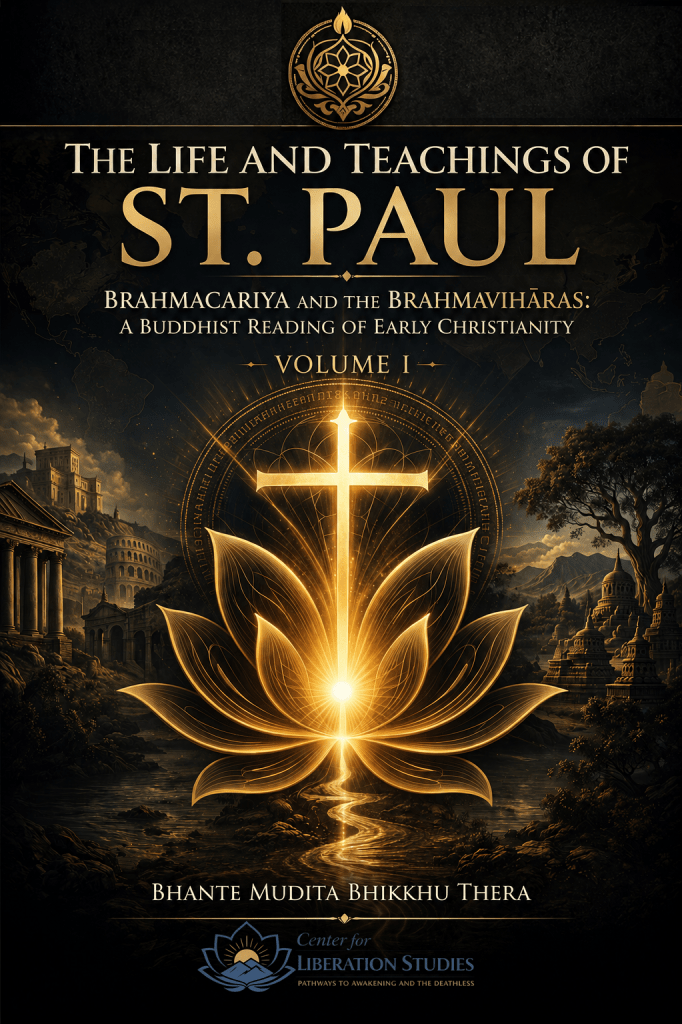
This article is part of the forthcoming book The Life and Teachings of St. Paul: Brahmacariya and the Brahmavihāras — A Buddhist Reading of Early Christianity.
This work follows a comparative doctrinal framework that examines early Christianity—particularly St. Paul—through the lenses of Brahmacariya, the brahmavihāras, renunciant discipline, and authentic Gautama-Dhamma (Arahanism). It does not argue for identity between traditions, but for structural convergence among axial-age renunciant movements centered on inward purification, ethical restraint, and liberation from worldly identity.
This groundbreaking work uncovers a forgotten cross-civilizational bridge between early Mediterranean asceticism and ancient Indian traditions, reinterpreting the radical transformation and global mission of St. Paul through a rigorous Buddhist perspective. By mapping early Christian discipline onto the ancient path to Nibbāna, it reveals an existential therapy of the mind centered on Brahmacariya, universal compassion, and ultimate liberation from the dukkha of worldly bondage.
 Center for Liberation Studies
Leave a comment