Remote Mind Control, MKUltra, and the Future of Human Perception

CONTENTS:
- The Psychic Interrogation: Spielberg’s Most Disturbing Scene
- The Alien Obelisk and the Mechanics of Remote mind Control
- Motor Cortex Override and the Preservation of Conscious Awareness
- Pain as Neurobiological Resistance: The Crucifix and the Symbolism of Stigmata
- From Science Fiction to History: MKUltra and the Search for Mind Control
- Project Stargate, Soviet Psychotronics, and the Technological Pursuit of Consciousness
- Sensory deprivation, Spaceflight and the Expansion of Human Perception
- Observer Consciousness, the TPJ, and the Reduction-Valve Theory
- Disclosure Day as a Modern Allegory of Consciousness, Freedom, and Technological Power
1. The Psychic Interrogation: Spielberg’s Most Disturbing Scene
Among all the spectacular visual effects, extraterrestrial mysteries, and political conspiracies portrayed in Disclosure Day, perhaps the most disturbing sequence is not a scene of destruction or violence. Instead, it is a quiet psychological assault occurring entirely within the mind of Jane Blankenship. Rather than depicting traditional physical torture, Steven Spielberg presents something arguably far more terrifying: the systematic invasion of human consciousness itself.

The scene occurs after Jane becomes entangled in the desperate cross-country escape of her whistleblower boyfriend, Daniel Kellner (Josh O’Connor). Daniel possesses knowledge that threatens to expose decades of government secrecy surrounding recovered extraterrestrial technology, placing both of them in the crosshairs of Wardex, a clandestine defense corporation operating beyond democratic oversight. Leading this operation is Noah Scanlon (Colin Firth), a calculating executive whose calm demeanor conceals an absolute willingness to sacrifice individual freedom in the name of preserving institutional power.
Unlike conventional cinematic villains who rely on armies, surveillance systems, or sophisticated weapons, Scanlon’s greatest instrument is consciousness itself. Using a recovered extraterrestrial artifact—a miniature metallic obelisk salvaged from the 1947 Roswell crash—he establishes a direct neural bridge into Jane’s mind. The confrontation that follows is not simply telepathy in the familiar sense. It is presented as a technologically mediated occupation of another person’s nervous system.
This distinction is what makes the sequence so profoundly unsettling.
Most cinematic portrayals of mind control simplify the experience by depicting complete possession. The victim loses awareness while an outside force assumes control. Disclosure Day deliberately rejects this familiar convention. Jane never loses consciousness. She remains fully aware throughout the entire ordeal. Every movement of her body, every involuntary gesture, every attempt to resist occurs while she watches herself becoming a prisoner inside her own nervous system.
The horror therefore emerges not from unconsciousness, but from heightened awareness.
Spielberg transforms the familiar fear of physical captivity into something more intimate—the imprisonment of conscious will itself.
The audience experiences Jane’s suffering through her inability to reconcile two contradictory realities occurring simultaneously. Her intentions remain her own, yet her body no longer obeys them. She attempts to move in one direction while invisible neurological commands force her muscles elsewhere. The conflict unfolds entirely beneath the skin, producing a uniquely psychological form of terror that resonates more deeply than conventional action sequences.
This concept reflects one of humanity’s oldest philosophical questions: what truly constitutes free will?
For centuries philosophers, theologians, and neuroscientists have debated whether consciousness genuinely governs human behavior or merely observes decisions already made by deeper biological processes. Disclosure Day externalizes this debate by separating conscious intention from physical execution. Jane’s awareness remains intact, but the pathways between intention and movement have been hijacked by an external intelligence.
The result is a cinematic representation of one of the deepest existential fears imaginable—the realization that consciousness alone may not be sufficient to govern the body.
Spielberg reinforces this existential violation through remarkable restraint. Rather than overwhelming viewers with extravagant visual effects, the sequence relies on subtle physiological changes. Jane’s facial expressions fluctuate between determination, confusion, terror, and helplessness. Her breathing becomes irregular. Her muscles twitch against her own intentions. The camera frequently lingers on her eyes, emphasizing that although her body appears to obey another master, her consciousness continues to witness every involuntary action.
These visual choices prevent the audience from interpreting the event as simple supernatural possession. Instead, they encourage viewers to imagine the horrifying possibility of remaining fully conscious while one’s own nervous system becomes an occupied territory.
The screenplay further deepens this psychological conflict through Noah Scanlon’s method of interrogation. Rather than screaming threats or displaying sadistic pleasure, Scanlon speaks calmly, almost pastorally. His voice enters Jane’s consciousness with measured precision, cross-examining her regarding Daniel’s location while simultaneously attempting to reshape her moral framework.
Even more disturbing is his deliberate use of religious language.
Jane’s history as a former religious novice is not an incidental character detail. It becomes the precise psychological vulnerability that Scanlon exploits. Having once dedicated herself to a life of spiritual discipline before leaving the Church, Jane possesses an extensive familiarity with Christian scripture, religious authority, and concepts of obedience. Scanlon weaponizes this background by quoting biblical passages during the psychic interrogation, arguing that maintaining secrecy surrounding extraterrestrial contact is equivalent to submitting to divine providence.
The manipulation is brilliantly conceived because it operates on multiple psychological levels simultaneously.
He does not merely attempt to overpower Jane neurologically.
He attempts to colonize her conscience.
By appropriating sacred language, Scanlon blurs the distinction between moral obedience and political obedience. His argument suggests that resisting institutional authority is equivalent to resisting God’s will itself. In doing so, he transforms scripture from a source of spiritual liberation into an instrument of psychological domination.
Throughout history, authoritarian systems have frequently justified secrecy and centralized power by appealing to transcendent authority. Whether invoking divine mandate, national security, historical necessity, or scientific inevitability, the mechanism remains remarkably similar: obedience becomes redefined as virtue.
Within Disclosure Day, this dynamic reaches its ultimate technological expression.
The alien obelisk allows ideological persuasion to bypass conversation entirely. Rather than convincing Jane through reasoned argument, Scanlon physically inserts his authority into the biological machinery through which thought becomes action.
The body itself becomes occupied territory.
Yet Spielberg refuses to reduce Jane to a passive victim.
The emotional climax of the sequence arrives not through rescue by another character but through Jane’s own act of resistance. Realizing that the alien device depends upon maintaining a stable neural connection, she desperately searches for any method capable of disrupting the invading signal. Her solution is profoundly physical.
She grasps the crucifix hanging around her neck and drives it forcefully into the center of her palm until blood begins to flow.
The image immediately evokes Christian stigmata, recalling the wounds traditionally associated with the crucifixion of Christ. However, within the internal logic of the film, the crucifix functions not as a magical talisman capable of repelling evil, but as a physiological instrument.
The intense burst of physical pain floods Jane’s nervous system with overwhelming bioelectrical activity, introducing neurological interference into the alien transmission. The obelisk requires an exceptionally clean neural frequency to sustain synchronization between Scanlon’s brain and Jane’s motor cortex. By deliberately overloading her own sensory pathways, Jane generates sufficient biological “noise” to fracture the connection.
Her liberation therefore emerges through neuroscience rather than supernatural intervention.
This distinction is one of the screenplay’s most intellectually satisfying achievements. It preserves the symbolic power of Christian imagery while grounding the mechanics of resistance within neurotechnology. The crucifix remains deeply meaningful, yet its effectiveness derives from the body’s own electrical architecture rather than divine miracle.
Consequently, the symbolism operates on two complementary levels.
Spiritually, the crucifix represents conscience refusing to surrender.
Neurologically, it represents the restoration of autonomous neural signaling.
Both meanings reinforce one another without contradiction.
Perhaps the most remarkable aspect of this sequence is that it never treats consciousness as an abstract philosophical concept. Consciousness is portrayed as a tangible domain capable of occupation, manipulation, and ultimately liberation. The battle unfolds neither on a battlefield nor inside a courtroom, but within the microscopic electrical networks connecting thought, intention, and movement.
This represents a significant evolution in science-fiction storytelling.
Earlier generations of science fiction often imagined humanity’s greatest dangers as physical invasion, nuclear annihilation, or artificial intelligence replacing human labor. Disclosure Day proposes something considerably more intimate. The greatest vulnerability of advanced civilization may not be our cities, our governments, or even our technologies.
It may be the biological architecture of consciousness itself.
The psychic interrogation of Jane Blankenship therefore serves as far more than an isolated suspense sequence. It establishes the central philosophical question underlying the entire film: if technology eventually acquires the ability to directly interface with consciousness, where does personal freedom truly reside?
That question reaches far beyond the fictional universe of Disclosure Day. Throughout the twentieth century, governments, intelligence agencies, neuroscientists, psychologists, and military researchers invested enormous resources attempting to understand the limits of human cognition, behavioral conditioning, hypnosis, sensory deprivation, chemical manipulation, and anomalous perception. Although none of these historical programs possessed extraterrestrial obelisks capable of remote neural synchronization, they were nevertheless pursuing a remarkably similar objective: discovering whether consciousness could be externally influenced, controlled, or fundamentally rewritten.
It is at this intersection—between speculative reality and documented historical investigation—that Disclosure Day becomes especially compelling. The film does not merely entertain audiences with an imaginative vision of alien technology. It invites us to reconsider decades of classified research into the nature of the human mind, encouraging a deeper question that extends well beyond cinema.
If consciousness becomes a technological interface, then the future struggle for freedom may no longer concern territory, information, or resources.
It may concern the sovereignty of the human mind itself.
2. The Alien Obelisk and the Mechanics of Remote Neural Control
At the center of Disclosure Day lies an object that appears almost deceptively simple. Unlike the enormous alien spacecraft, dazzling energy weapons, or futuristic machinery commonly associated with science fiction, the technology responsible for the film’s most profound implications is a small metallic obelisk recovered from the 1947 Roswell crash site. It is unassuming in appearance, yet within David Koepp’s screenplay it represents a technological breakthrough that fundamentally alters our understanding of consciousness, communication, and the relationship between mind and matter.
The obelisk is not merely an alien artifact or a sophisticated computer. It functions as an interface between biological consciousness and a non-human technological architecture. Rather than transmitting radio waves, electrical commands, or digital information through conventional means, it directly synchronizes with the neural activity of the user. In doing so, it transforms consciousness itself into the medium of communication.
This distinction separates Disclosure Day from traditional science-fiction narratives about mind control.
Most fictional portrayals rely upon crude mechanisms. A victim is hypnotized, implanted with a microchip, chemically sedated, or mentally possessed through unexplained supernatural forces. Spielberg instead grounds the phenomenon within neuroscience. The obelisk does not erase consciousness or replace it with another intelligence. Instead, it exploits the brain’s own communication network, treating the human nervous system as hardware capable of receiving external input under the correct biological conditions.
The result is a remarkably sophisticated interpretation of remote mind control that feels less like fantasy and more like an extension of contemporary neuroscience.

Consciousness as an Information Network
One of the film’s most intriguing concepts is its suggestion that the human brain already possesses extraordinary latent capabilities. According to the scientific framework established within the story, the limitation has never been consciousness itself. Rather, the limitation lies in our biological inability to transmit and receive neural information across great distances.
The screenplay proposes that the human brain contains dormant neural pathways capable of perceiving vastly more information (multidimensional) than ordinary waking awareness allows. Evolution, however, makes humanity degenerated to become an incomplete system.
Humans possess perception.
They lack transmission.
In other words, the brain resembles a sophisticated receiver whose broadcasting capability remains biologically dormant.
The alien civilization responsible for the obelisk solved this limitation long ago. Their technology acts as a biological amplifier, bridging the missing connection between localized neural activity and non-local communication. Once activated, the obelisk effectively converts thought into a transmissible signal while simultaneously decoding incoming neural information from another mind.
Within the internal logic of the film, telepathy is therefore not magic.
It is engineering.
The implications are enormous.
Speech becomes unnecessary.
Language becomes secondary.
Even visual observation loses importance.
Consciousness itself becomes the communication protocol.
Spielberg wisely avoids explaining this process through excessive technobabble. Instead, the audience gradually understands the technology by witnessing its effects upon Jane Blankenship. Every involuntary movement, every intrusive thought, and every struggle against Scanlon’s commands demonstrates that the interface is operating beneath conscious awareness at the level of the nervous system itself.
Neural Synchronization Rather Than Psychic Possession
Perhaps the screenplay’s greatest conceptual achievement is rejecting the familiar trope of supernatural possession. Noah Scanlon does not invade Jane’s soul, nor does he erase her personality.
Instead, the alien obelisk establishes neural synchrony.
When Scanlon activates the device, it first interfaces with his own nervous system. The obelisk continuously maps the electrical activity generated by his intentions, emotions, and motor planning. Rather than interpreting spoken commands, it reads the underlying neurological patterns that normally precede physical movement.
Modern neuroscience has demonstrated that every voluntary action begins as coordinated activity across multiple regions of the brain. Before a hand reaches toward an object, complex networks involving the prefrontal cortex, supplementary motor area, basal ganglia, cerebellum, and primary motor cortex prepare the movement milliseconds before conscious awareness recognizes the decision.
The obelisk appears to intercept precisely this stage.
Instead of transmitting words, it transmits intention itself.
Scanlon thinks.
The obelisk translates.
Jane’s nervous system receives.
This mechanism makes the sequence convincing because it bypasses conscious reasoning altogether. Jane is never persuaded intellectually to obey Scanlon. Her nervous system simply begins executing his motor commands before her conscious mind has an opportunity to intervene.
Her consciousness remains present, but it has been demoted from commander to observer.
The Biological Vulnerability of the Receiver
The screenplay introduces another fascinating concept by explaining why Jane, specifically, becomes susceptible to the remote connection.
The obelisk does not operate indiscriminately upon every human being.
Instead, successful synchronization depends upon what the film describes as an existing biological resonance.
Daniel Kellner—and Emily Blunt’s character, Margaret—were subjected to extraterrestrial experimentation during childhood. Although neither fully understands the consequences, those encounters permanently altered aspects of their neurological architecture. Their brains remain subtly synchronized with the extraterrestrial frequency utilized by the alien technology.
Jane herself never underwent such experimentation.
Nevertheless, prolonged emotional and physical proximity to Daniel has gradually exposed her nervous system to that same biological signature. Whether through repeated interaction, shared environments, or prolonged neurological entrainment, she has become subconsciously attuned to Daniel’s unique frequency.
Scanlon recognizes this hidden vulnerability.
Rather than forcing entry into a completely closed nervous system, he exploits an already partially opened doorway.
The concept resembles principles found throughout modern neuroscience.
Neural networks constantly synchronize with external rhythms.
Brainwave entrainment demonstrates that repeated exposure to rhythmic stimulation can influence neural oscillations. Human beings naturally synchronize speech patterns, breathing, emotional states, and even heart rhythms during prolonged interpersonal interaction. Although Disclosure Day dramatically extends these principles, it does so by extrapolating from genuine biological tendencies rather than abandoning scientific plausibility altogether.
The alien obelisk merely amplifies a synchronization process already embedded within the architecture of the human nervous system.
Overriding the Motor Cortex
Perhaps the most terrifying aspect of the technology is its precision.
Rather than replacing Jane’s thoughts, memories, or emotions, Scanlon specifically overrides the motor pathways responsible for voluntary movement.
This distinction transforms the experience from simple possession into neurological imprisonment.
The screenplay repeatedly emphasizes that Jane remains completely aware of what is happening. She continues thinking independently. She continues evaluating Scanlon’s arguments. She continues resisting internally.
What disappears is the physical ability to translate intention into action.
Neuroscientifically, voluntary movement depends upon descending neural pathways extending from the motor cortex through the spinal cord toward skeletal muscles. Every deliberate gesture requires uninterrupted communication along these pathways.
The obelisk functions as a intermediary.
Instead of allowing Jane’s motor cortex to communicate directly with her muscles, Scanlon inserts his own neural commands into the transmission stream. Her outgoing signals are suppressed while his incoming commands receive priority.
The body obeys.
The mind protests.
The separation between consciousness and physical agency becomes almost unbearable to watch.
Spielberg repeatedly reinforces this conflict through Jane’s facial expressions. Her eyes reveal panic and determination even while her body moves with terrifying mechanical precision. She becomes simultaneously actor and spectator within her own body.
The sequence therefore illustrates one of neuroscience’s deepest philosophical questions.
If consciousness cannot execute voluntary movement, does free will continue to exist?
Jane’s answer is unmistakable.
Yes.
Free will survives.
It simply loses its physical voice.
Consciousness Under Occupation
The film thereby presents an unusually sophisticated model of remote mind control.
Traditional hypnosis at normal level attempts to influence decisions.
Chemical agents alter perception.
Brainwashing seeks to reshape beliefs over extended periods.
The alien obelisk assisted remote neural control accomplishes something fundamentally different.
It leaves identity intact while temporarily occupying the neurological infrastructure through which identity expresses itself.
Jane does not become Noah Scanlon.
Nor does she cease to be herself.
Instead, her body becomes contested territory shared simultaneously by two independent conscious agents.
The horror emerges precisely because neither consciousness disappears.
They coexist.
One commands.
The other resists.
This dual occupancy transforms the familiar science-fiction concept of possession into something more psychologically disturbing.
Technology as an Extension of Consciousness
Beyond its narrative function, the obelisk raises profound philosophical questions regarding the future trajectory of technology.
Modern civilization already possesses devices that extend nearly every human faculty.
Microscopes extend vision.
Telephones extend hearing.
Computers extend calculation, reason and memory.
Artificial intelligence increasingly extends reasoning.
The alien obelisk simply extends consciousness itself.
Rather than serving as an external tool, it becomes a direct continuation of the nervous system.
This possibility aligns with a growing body of contemporary research into brain-computer interfaces, neural prosthetics, and direct cortical communication. Although today’s technologies remain vastly less sophisticated than the fictional obelisk, researchers are already developing implants capable of translating neural activity into digital commands, restoring communication to paralyzed patients, and allowing robotic limbs to respond directly to thought.
Disclosure Day asks the obvious next question.
If technology can one day read intention, could it also write intention?
Could future neural interfaces become bidirectional?
Could consciousness eventually become programmable?
The film wisely refuses to provide definitive answers.
Instead, it dramatizes the ethical catastrophe that would accompany such capabilities falling into authoritarian hands.
The Obelisk as a Symbol of the Next Technological Revolution
Ultimately, the alien obelisk should not be understood merely as an extraterrestrial artifact.
It symbolizes an entirely new technological paradigm.
Previous technological revolutions transformed transportation, communication, industry, and information.
The obelisk represents the revolution of consciousness itself.
For the first time in human history, thought becomes directly accessible to machinery.
The boundary separating private awareness from external consciousness assisted by technology begins to dissolve.
Within Disclosure Day, this transformation is neither celebrated nor condemned outright. Instead, Spielberg presents it with deliberate ambiguity. Like every technological revolution before it, the obelisk possesses extraordinary potential for both liberation and domination.
In the hands of an enlightened civilization, such technology might eliminate misunderstanding, revolutionize medicine, restore neurological function, and create entirely new forms of human cooperation.
In the hands of Noah Scanlon, however, it becomes the ultimate instrument of control and even enslavement.
The battlefield is no longer territory, or information, or the body.
The battlefield has become consciousness itself.
It is this central idea that propels Disclosure Day beyond conventional science fiction into a philosophical exploration of humanity’s possible future. The alien obelisk is not simply a fictional device designed to advance the plot. It serves as a thought experiment, inviting viewers to imagine what might happen if the next great technological revolution no longer transformed the world around us, but instead gained direct access to the world within us.
3. Motor Cortex Override and the Preservation of Conscious Awareness
One of the most intellectually compelling aspects of Disclosure Day is that its concept of remote mind control is not presented as a mystical possession or the complete replacement of one personality by another. Instead, the screenplay constructs a far more sophisticated neurological model—one in which consciousness survives intact while the body’s voluntary motor system is temporarily commandeered by an external intelligence.
This distinction fundamentally separates Disclosure Day from the overwhelming majority of science-fiction films dealing with psychic domination. Rather than depicting Jane Blankenship as a passive vessel whose identity disappears beneath an invading consciousness, Steven Spielberg and screenwriter David Koepp portray something considerably more disturbing. Jane never ceases to be herself. Her memories remain intact. Her moral convictions remain unchanged. Her emotional attachment to Daniel Kellner remains unwavering. Even her determination to resist Noah Scanlon grows stronger as the psychic assault intensifies.
The tragedy is that none of these internal realities can immediately translate into physical action.
Her body no longer belongs exclusively to her.
The audience therefore witnesses a terrifying neurological paradox: complete preservation of conscious identity coupled with the temporary loss of voluntary bodily control.
This is precisely what gives the sequence its extraordinary psychological power.
Separating Consciousness from Movement
Modern neuroscience has demonstrated that consciousness and movement, although closely related, are not identical processes. Every voluntary action begins long before muscles contract. Networks distributed across the prefrontal cortex, premotor cortex, supplementary motor area, basal ganglia, cerebellum, and primary motor cortex continuously exchange electrical information before descending through the spinal cord to activate skeletal muscles.
Ordinarily, this immense neurological orchestra functions seamlessly.
A decision emerges.
Motor planning occurs.
Electrical impulses descend through the nervous system.
Muscles respond.
The body moves.
The entire sequence unfolds so rapidly that human beings experience it as a single unified act of free will.
Disclosure Day imagines what would happen if an advanced technology could intercept this communication pathway without interfering with consciousness itself.
Rather than erasing Jane’s thoughts, the alien obelisk simply inserts an external signal between intention and execution.
She decides not to move.
Her body moves anyway.
She desperately tries to lower her arm.
Her muscles raise it instead.
She attempts to protect Daniel.
Her nervous system becomes an instrument directed toward harming him.
The result is a horrifying fragmentation of the ordinary human experience of agency.
The Motor Cortex as the Battlefield
Within the internal logic of the film, Noah Scanlon does not conquer Jane’s mind in its entirety.
He targets something much more specific.
He occupies the motor cortex.
The motor cortex serves as the brain’s primary command center for voluntary movement. Every deliberate gesture—walking, speaking, reaching, writing, embracing another person—ultimately depends upon its ability to transmit organized electrical signals through descending neural pathways.
In Disclosure Day, the alien obelisk effectively inserts itself into this command structure.
Instead of replacing Jane’s consciousness, it functions like a hostile administrator assuming control over the operating system while leaving all user files untouched.
Jane’s identity remains preserved.
Her memories remain accessible.
Her emotions remain authentic.
Her conscience continues functioning normally.
Only the execution layer has been compromised.
This distinction transforms the scene from supernatural horror into neuroscience.
The terror does not arise because Jane becomes someone else.
It arises because she remains entirely herself while becoming physically incapable of acting according to her own intentions.
The Prisoner Within the Body
Perhaps the most emotionally devastating aspect of the sequence is Jane’s continued awareness throughout the ordeal.
She experiences every involuntary movement firsthand.
She witnesses her own body acting contrary to her deepest convictions.
She remains psychologically present during every second of the invasion.
This preservation of awareness transforms the body into a prison.
Unlike traditional portrayals of possession, where the victim later awakens with no memory of events, Jane retains complete experiential continuity. She remembers every moment because she consciously lived through every moment.
The audience therefore identifies not with external observers watching possession occur but with Jane herself.
They imagine what it would feel like to remain awake while another intelligence manipulates their own muscles.
The emotional impact becomes almost unbearable precisely because consciousness never disappears.
In neurological terms, the film distinguishes between awareness and agency.
Awareness survives.
Agency is stolen.
This distinction mirrors one of the deepest philosophical debates in cognitive science.
What defines personal freedom?
Is freedom merely the ability to think independently?
Or does genuine freedom require the capacity to translate thought into action?
Jane’s predicament suggests that both dimensions are essential.
The Preservation of Moral Identity
An equally significant aspect of the screenplay is its refusal to portray remote mind control as moral corruption.
Scanlon never succeeds in convincing Jane that betraying Daniel is ethically justified.
He never rewrites her beliefs.
He never alters her character.
Her moral identity remains remarkably stable throughout the psychic interrogation.
Even while her body obeys Scanlon’s commands, her conscience continues resisting them.
This distinction deserves careful attention.
Many fictional accounts of brainwashing depict the gradual replacement of one personality with another. Individuals eventually come to believe what they have been conditioned to believe.
Jane experiences something fundamentally different.
Her conscience survives untouched.
The battle therefore becomes one between physical obedience and moral integrity.
Her muscles obey.
Her conscience refuses.
Spielberg thereby suggests that identity resides deeper than outward behavior alone.
A person’s authentic self is not defined solely by what the body performs but also by the intentions that continue existing even when physical expression becomes impossible.
Consciousness as Witness
One of the recurring visual motifs throughout the sequence is Spielberg’s emphasis upon Jane’s eyes.
Again and again, the camera lingers on her face.
Her expressions reveal fear.
Determination.
Confusion.
Anger.
Desperation.
Although her body increasingly behaves according to Scanlon’s commands, her eyes communicate an entirely different reality.
They remain unmistakably her own.
This cinematic choice reinforces an ancient philosophical distinction between the observing self and bodily self.
Throughout numerous contemplative traditions, consciousness is frequently described as possessing the capacity to witness thoughts, emotions, sensations, and bodily experiences without being identical to any of them.
Although Disclosure Day does not explicitly advocate any particular philosophical or religious interpretation, its visual language repeatedly separates conscious observation from physical execution.
Jane becomes a witness to her own body.
She watches herself acting.
She experiences herself moving.
She internally rejects those movements while externally performing them.
The psychological dissonance produced by this separation becomes one of the sequence’s defining emotional achievements.
A New Interpretation of Free Will
The film consequently offers a fascinating thought experiment concerning free will. Ordinarily, human beings assume that voluntary movement demonstrates freedom. If the body obeys intention, free will appears obvious.
But Jane’s experience forces a more nuanced question.
Suppose external technology prevented every intended action while leaving conscious intention untouched. Would free will disappear? Or would it continue existing internally despite losing physical expression?
Disclosure Day appears to argue for the latter.
Jane never chooses betrayal. She never willingly cooperates. Every involuntary movement represents technological coercion rather than genuine consent. Consequently, her freedom survives at the level of intention even while being physically suppressed.
This distinction carries profound ethical implications. Modern legal systems generally distinguish between voluntary and involuntary actions. Responsibility depends upon agency. If an individual’s nervous system were externally overridden, could that person be morally accountable for actions performed by their own body?
The screenplay quietly raises this dilemma without explicitly answering it. Instead, it leaves viewers contemplating the fragile relationship between responsibility and neurological autonomy.
Fragmentation of Self: Dissociation as an Inner Precedent
Interestingly, this cinematic model of divided agency finds a partial psychological parallel in Dissociative Identity Disorder (DID)—a condition that challenges the assumption of a unified, continuous self.
From a developmental perspective, human beings are not born with a fully integrated identity. Early childhood consciousness is typically composed of relatively discrete affective and behavioral states: a “hungry self” that signals bodily need, a “playful self” that engages exploration, a “fearful self” that reacts to threat, and other context-dependent configurations of experience.
In normal development, these states gradually integrate. Between approximately ages six to nine, the brain consolidates these fragmented experiential modes into a cohesive autobiographical identity. Memory continuity strengthens, emotional states begin to coexist within a single narrative self, and the sense of “I” stabilizes.
However, under conditions of severe, repeated trauma, this integration process can be disrupted.
Instead of merging, these states may remain compartmentalized.
To preserve survival, the psyche constructs amnesia barriers—psychological partitions that prevent traumatic memory systems from contaminating everyday functioning. One part of the mind may carry the burden of abuse, terror, or extreme emotional pain, while another continues normal life activities such as attending school, interacting with caregivers, and maintaining outward functionality, often with no conscious awareness of the traumatic compartment.
Over time, these isolated cognitive-emotional clusters can develop into semi-autonomous identity structures, each with distinct memory access, behavioral tendencies, affective tone, and sometimes even self-designated names.
In clinical framing, these are referred to as “alters.”
Importantly, this is not understood as external occupation in a literal sense, but as a fragmentation of internally generated self-representation under extreme conditions of psychological stress.
Yet even within this clinical model, a striking conceptual resemblance emerges:
The self becomes plural under pressure.
Identity becomes distributed across internal partitions.
Agency becomes decentralized.
And continuity of selfhood becomes conditional rather than absolute.
From Clinical Dissociation to the Idea of Subconscious Invasion
At this point, interpretation begins to shift.
While clinical psychology understands dissociation as an internally generated survival adaptation, philosophical and transpersonal frameworks open a different interpretive horizon—one that moves beyond pathology into metaphysics and models of expanded consciousness.
Within this expanded lens, dissociation can be reimagined not only as fragmentation, but as permeability.
The mind is no longer viewed strictly as a closed system dividing itself into parts.
Instead, it becomes a layered field of consciousness with varying degrees of openness between strata of awareness.
What clinical psychiatry describes as “parts of self” can, in a transpersonal reading, be reinterpreted as channels through which different modes or levels of consciousness express themselves.
This is where the notion of “subconscious invasion” emerges—as a conceptual metaphor for states in which the ordinary ego loses exclusive control over mental and behavioral output.
The question is reframed:
Is altered identity always fragmentation of self?
Or can it also be the intrusion—or emergence—of deeper strata of individual mind and collective consciousness?
Jungian Framework: The Collective Unconscious and Archetypal Possession
Carl Jung offers one of the most influential bridges between clinical psychology and transpersonal interpretation.
He proposed that beneath individual consciousness lies a vast shared psychic substrate: the Collective Unconscious.
This layer of mind is not personal but transpersonal, containing inherited archetypal structures—fundamental patterns of human experience such as the Shadow, the Warrior, the Mother, the Trickster, and the Wise Old Man.
These archetypes are not merely symbolic ideas in Jung’s formulation. They behave as dynamic psychological forces that organize perception, emotion, and behavior when activated.
From this perspective, when the ego is destabilized—through trauma, sensory deprivation, emotional rupture, or existential crisis—the boundary maintaining ordinary identity coherence may weaken.
In such states, archetypal structures can become dominant in the psyche.
A previously passive individual may suddenly manifest commanding assertiveness.
A rational personality may become overwhelmed by fear or prophetic intensity.
A restrained emotional profile may give way to dramatic symbolic expression.
To the experiencing subject, this can feel less like internal fluctuation and more like being taken over by something larger than oneself.
Not necessarily external in a literal sense—but experienced as external in quality, scale, and intensity.
Jung himself described such phenomena in terms of “possession by archetype,” where unconscious content overwhelms the ego’s organizing capacity.
In this sense, the “invasion” is not from outside the psyche, but from a layer of psyche so deep and impersonal that it is experienced as other-than-self.
Transpersonal Psychology and the Concept of Spiritual Emergency
Transpersonal psychology extends this framework further by integrating spiritual, mystical, and non-ordinary states of consciousness into psychological theory.
Within this field, a phenomenon known as spiritual emergency describes situations in which transformative or expansive consciousness processes overwhelm the stabilizing structures of the ego.
The “higher consciousness” in this model may be interpreted in multiple ways:
- as an expanded aspect of the individual psyche (Higher Self),
- as a reorganization of cognitive-emotional systems beyond ego boundaries,
- or as contact with transpersonal dimensions of awareness experienced as universally meaningful.
When such processes unfold too rapidly, the ego may fail to integrate them coherently.
The result can resemble psychological breakdown: altered speech patterns, shifts in identity expression, intensified symbolic thinking, or discontinuities in autobiographical memory.
Crucially, from the subjective standpoint, these experiences may not feel internally generated.
They may feel like something has entered awareness rather than something emerging from it.
This experiential quality is central to the concept of “subconscious invasion” as a phenomenological metaphor.
Not a literal external entity.
But a collapse of the ordinary distinction between “me” and “what arises within me.”
Returning to Disclosure Day: Technology as Externalized Dissociation
Against this conceptual background, Jane’s experience in Disclosure Day can be reread with additional depth.
What MKUltra externalized through chemical disruption, and what dissociation internalizes through psychological fragmentation, the alien obelisk externalizes through technological interface.
Scanlon does not merely create hallucination.
He does not merely induce suggestion.
He introduces a structured external control system that mimics and amplifies dissociative division at the level of motor execution while leaving inner awareness intact.
Jane becomes, in effect, a conscious system experiencing enforced functional split:
- one layer observes,
- another executes,
- neither fully authorizes the other.
This structure mirrors DID-like partitioning, but without developmental origin or internal protective fragmentation. Instead, it is imposed through technological override.
And yet the observer remains present.
The witnessing consciousness continues uninterrupted.
This is the crucial continuity across all frameworks:
whether through trauma (DID), archetypal emergence (Jung), spiritual overload (transpersonal psychology), or technological coercion (Disclosure Day), the mind reveals a recurring structure—
it can divide its expression without necessarily extinguishing awareness itself.
The Deeper Philosophical Implication
What begins as a question of free will thus expands into a more complex ontology of selfhood.
The self is neither strictly unified nor strictly divisible.
It is layered.
Modular.
Context-sensitive.
Capable of fragmentation, override, emergence, and observation.
And within all these configurations, something persists:
the capacity to witness experience as experience.
In Disclosure Day, that witnessing capacity is what prevents total erasure of agency.
In DID, it is what allows differentiated states to coexist within a single organism.
In Jungian psychology, it is what observes archetypal possession.
In transpersonal theory, it is what remains stable amid expanded or destabilized consciousness.
Across all interpretations, one principle becomes increasingly difficult to ignore:
consciousness is not identical to its contents or its control systems.
And this distinction is precisely what makes both psychological trauma and technological intrusion so ethically significant.
Because what is at stake is not only behavior.
It is the structure through which experience is known at all.
The Neuroscience of Resistance
Although Scanlon successfully occupies Jane’s motor system, the screenplay repeatedly demonstrates that complete neurological domination remains impossible.
Jane continues searching for weaknesses.
She experiments mentally with methods of resistance.
She analyzes the rhythm of the psychic intrusion.
Most importantly, she refuses to surrender psychologically.
This persistence reflects another realistic aspect of neural function.
The brain is not a passive electrical circuit.
It is a dynamic, adaptive organ continuously attempting to restore equilibrium.
Throughout the sequence, Jane’s nervous system appears to fight back instinctively.
Her muscles tremble.
Her breathing fluctuates.
Micro-expressions reveal internal conflict.
These subtle physiological reactions suggest that the body itself recognizes the foreign intrusion and continually attempts to re-establish its own neurological integrity.
The alien obelisk may temporarily dominate motor output, but complete neurological assimilation never occurs.
There remains an irreducible core of autonomous consciousness that refuses occupation.
This becomes the foundation for her eventual escape.
Human Consciousness Cannot Be Completely Replaced
Perhaps the most important philosophical implication of this sequence is that consciousness itself proves remarkably resilient.
Technology may manipulate movement.
It may interfere with communication.
It may temporarily redirect bodily behavior.
Yet the screenplay consistently portrays authentic personal identity as surviving beneath those external manipulations.
Jane’s resistance does not emerge because she possesses greater physical strength than Scanlon.
She clearly does not.
Nor does it arise because the alien technology malfunctions on its own.
Instead, her victory begins with something fundamentally human.
She refuses internally to surrender.
That refusal becomes the psychological foundation upon which physical liberation eventually becomes possible.
In this respect, Disclosure Day presents a surprisingly optimistic vision of consciousness.
Despite possessing technology capable of directly interfacing with the nervous system, Noah Scanlon still cannot manufacture genuine consent.
He can command muscles.
He cannot command conviction.
He can redirect movement.
He cannot extinguish conscience.
He can occupy the body.
He cannot become Jane Blankenship.
This distinction ultimately defines the moral architecture of the film. The alien obelisk may represent the most advanced technology ever encountered by humanity, yet even its extraordinary capabilities encounter an invisible boundary—the enduring sovereignty of conscious identity. The body may be temporarily occupied, but the inner awareness that gives rise to moral judgment, loyalty, and personal meaning remains beyond complete technological domination.
It is precisely this preservation of conscious awareness that transforms Jane’s struggle from a simple fight for survival into something far more universal. She is not merely resisting an enemy. She is defending the last domain that every free civilization must ultimately protect: the inviolable sovereignty of the human mind.
4. Pain as Neurobiological Resistance: The Crucifix and the Symbolism of Stigmata
The moment Jane Blankenship drives the crucifix into her own palm is the emotional and conceptual fulcrum of Disclosure Day. It is not merely a gesture of desperation or religious symbolism; it is the precise point at which the film transforms pain into a mechanism of cognitive liberation. Within the logic of the narrative, suffering is no longer passive. It becomes an active neurobiological intervention capable of disrupting the architecture of remote neural control.
This reinterpretation of pain—as signal, as interference, as resistance—elevates the scene beyond its visual shock value and into a sophisticated exploration of how the nervous system responds under conditions of external occupation.

Pain as a Competing Neural Signal
From a neurological standpoint, pain is not simply a sensation. It is a high-priority signaling system evolved to override competing cognitive processes. When tissue damage occurs, nociceptors transmit rapid electrical impulses through peripheral nerves to the spinal cord and brain, where they are prioritized above almost all other sensory input.
In Disclosure Day, this biological hierarchy becomes the key to Jane’s escape.
The alien obelisk’s control mechanism depends upon maintaining a stable, low-noise neural environment. Scanlon’s remote motor override functions with extraordinary precision precisely because Jane’s nervous system is relatively coherent. Her motor cortex, spinal pathways, and muscular feedback loops remain clean channels for signal transmission.
Pain shatters this condition.
By forcibly inflicting injury upon herself, Jane introduces an overwhelming surge of afferent sensory data into the system. The crucifix piercing her palm generates an immediate flood of nociceptive signaling that saturates spinal and cortical processing centers. The result is not simply discomfort—it is neurological overload.
For the first time since the psychic intrusion began, the obelisk encounters a system it cannot cleanly regulate.
The body becomes noisy.
The signal becomes corrupted.
And within that disruption, control begins to fail.
The Crucifix as a Technological Disruptor
While the crucifix is visually and thematically associated with Christian symbolism, its function within the film operates on a dual register: theological and neurophysiological.
On the symbolic level, the crucifix represents endurance, sacrifice, and the historical narrative of suffering as a pathway to transcendence. Jane’s background as a former religious novice intensifies this dimension, grounding her act within a lifetime of embodied spiritual discipline.
However, the screenplay carefully avoids allowing the object to function as a purely mystical artifact. Instead, the crucifix becomes an improvised instrument—an interface between cognition and physiology.
Its effectiveness lies not in divine intervention but in its capacity to generate precise, high-amplitude sensory disruption.
In this sense, the crucifix functions analogously to a biological jammer.
It introduces instability into a system dependent on stability.
The more precisely Scanlon attempts to regulate Jane’s motor output, the more catastrophic the sensory interference becomes.
The film thereby reframes a traditional religious symbol as a tool of neurological resistance, collapsing the boundary between spiritual iconography and embodied cognition.
Stigmata as Cognitive Overload
The imagery of stigmata—wounds resembling those of Jesus Christ—adds another layer of interpretive complexity. Historically, stigmata have been understood as manifestations of mystical union, suffering, or divine identification. In Disclosure Day, however, the visual echo of stigmata is repurposed as a physiological byproduct of neural destabilization.

Jane does not bleed because she is chosen.
She bleeds because her nervous system is being forcibly reasserted through trauma.
The wound becomes a visible marker of internal system conflict.
Within the film’s neurotechnological framework, this moment represents a breakdown in signal integrity. The alien obelisk relies upon coherent, low-entropy neural communication between Scanlon’s intention and Jane’s motor execution. Pain introduces a competing system of priority signaling that cannot be filtered or ignored.
In computational terms, it is a denial-of-service event applied to consciousness.
The body, overwhelmed by competing inputs, momentarily ceases to function as a compliant interface.
The Paradox of Self-Inflicted Pain
Perhaps the most psychologically unsettling aspect of this sequence is that resistance requires self-inflicted harm. Jane does not resist Scanlon by retreating from injury but by actively amplifying it.
This introduces a paradox at the heart of the scene: liberation is achieved through self-destruction.
However, the film carefully distinguishes between destructive violence and strategic neurobiological intervention. Jane is not seeking to harm herself for its own sake. Instead, she is exploiting a known property of the nervous system: that sufficiently intense pain can override externally imposed motor commands.
The implication is profoundly unsettling.
Freedom, in this context, is not achieved through avoidance of suffering, but through its controlled application.
Pain becomes a tool of cognitive sovereignty.
Neurobiological Interference and Signal Collapse
Once the crucifix penetrates the skin, the nervous system enters a state of extreme excitation. Pain signals ascend rapidly through the spinothalamic tract, overwhelming thalamic relay stations responsible for sensory integration. Simultaneously, cortical regions responsible for attention, motor planning, and emotional regulation are forced into rapid reconfiguration.
The alien obelisk, which depends on predictable motor mapping, can no longer maintain a stable control architecture.
The system collapses not because Jane overpowers Scanlon intellectually, but because her nervous system becomes too chaotic to govern remotely.
The brilliance of this mechanism lies in its grounded plausibility within the film’s internal logic. It does not require mystical immunity, emotional transcendence, or external rescue. Instead, it relies on a fundamental property of biological systems: instability breaks control.
The body, when pushed beyond its capacity for regulated signaling, becomes ungovernable.
Consciousness Enduring Through Pain
Importantly, pain does not diminish Jane’s consciousness. If anything, it intensifies it.
Rather than shutting down awareness, the flood of nociceptive input sharpens her cognitive focus. Every thought becomes more immediate. Every sensation more pronounced. Every fragment of awareness more distinct.
This contradicts a common assumption that pain reduces mental clarity. In extreme conditions, the opposite often occurs: the mind narrows its attention to survive overwhelming sensory input.
Within the narrative, this narrowing becomes the mechanism through which Jane regains agency.
Pain does not erase consciousness.
It concentrates it.
In that concentrated state, she is able to locate the instability within Scanlon’s neural link and exploit it.
The Break in Synchronization
As the pain intensifies, the synchrony between Scanlon’s motor commands and Jane’s bodily execution begins to degrade. The obelisk, previously able to map intention onto movement with near-perfect fidelity, encounters increasing temporal lag, misalignment, and signal corruption.
Her arm trembles.
Her posture destabilizes.
Motor commands arrive distorted.
The system that once functioned as seamless control begins to fracture into competing layers of input.
At a critical threshold, the connection collapses entirely.
The alien interface loses coherence.
Jane regains control.
Not gradually, but abruptly—like a snapped circuit.
The Ethical Ambiguity of Survival
Yet the scene refuses to frame this victory as purely triumphant. The method of escape leaves an enduring moral and psychological residue. Jane has not simply resisted an external force; she has transformed her own body into a battlefield where pain is both weapon and cost.
The crucifix, still embedded in her hand, remains a physical reminder that autonomy under extreme technological coercion is not clean, abstract, or painless.
It is embodied.
It is violent.
It is irreversible.
The film therefore refuses to romanticize liberation. Instead, it presents freedom as something extracted from the nervous system under duress.
Pain, Control, and the Limits of External Authority
Ultimately, this sequence reveals a crucial limitation in the alien obelisk’s design. While extraordinarily advanced, its control architecture assumes that the nervous system behaves as a stable, coherent information channel. It does not account for the biological reality that pain can radically destabilize neural predictability.
Control systems—whether technological or biological—depend on signal reliability.
When reliability collapses, control collapses with it.
Jane’s act of self-inflicted pain therefore becomes more than resistance. It is a demonstration that even the most advanced interface between consciousness and technology remains vulnerable to the fundamental unpredictability of living tissue.
The Return of Agency
When the connection finally breaks, Jane does not emerge unscathed. Her hand is wounded. Her body is trembling. Her nervous system remains in a heightened state of activation.
But crucially, agency returns.
The capacity to translate intention into movement is restored.
She is once again the author of her physical actions.
The crucifix, now stained with blood, no longer functions as a religious object or a technological disruptor. It becomes something more ambiguous: a record of the moment when consciousness refused to be fully subordinated.
In this sense, pain does not simply break control.
It reasserts the irreducibility of the human nervous system under conditions of external occupation.
And within the broader philosophical structure of Disclosure Day, this moment establishes a critical principle: even in a world where consciousness can be accessed, mapped, and manipulated, the body retains one final defense mechanism.
When pushed beyond its threshold, it becomes noise.
And in that noise, no system—no matter how advanced—can maintain absolute control.
5. From Science Fiction to History: MKUltra and the Search for Mind Control
The psychic interrogation of Jane Blankenship represents one of the most technologically sophisticated portrayals of remote mind control ever presented in modern science fiction. Yet one of the reasons the sequence resonates so deeply with audiences is that it does not emerge from fantasy. Beneath the extraterrestrial technology, neural synchronization, and neuroscience lies a historical foundation rooted in one of the darkest chapters of twentieth-century intelligence operations, that governments have been seeking methods of controlling human thought is not a cinematic invention.
It is historical fact.
What remains open to debate is not whether governments attempted to develop mind control technologies, but how successful they ever came to achieving their objectives.
While Disclosure Day imagines a world in which recovered extraterrestrial technology finally unlocks direct neural communication, the real-world intelligence community spent decades pursuing remarkably similar goals through chemistry, psychology, psychiatry, hypnosis, sensory deprivation, and behavioral conditioning. The methods were vastly different, but the underlying ambition was strikingly familiar.
The objective was nothing less than discovering whether human consciousness could be externally manipulated.
The Genesis of MKUltra: Between Documented History and Disclosure Mythology
Project MKUltra originated before the Second World War by the German scientists for Mind Control (MK). The victorious Allied powers competed aggressively to obtain German scientists, classified research programs, advanced aerospace engineering, and experimental military technologies before they disappeared behind the emerging Iron Curtain.
Officially, Project MKUltra began in 1953 under the direction of CIA chemist Sidney Gottlieb. Declassified records describe it as a broad research program investigating chemical agents, hypnosis, sensory deprivation, electroshock, psychic communication and other methods of behavioral modification.
And alongside this documented history exists another narrative that has persisted for decades within UFO disclosure movement. According to this tradition, several esoteric circles in pre-war Germany explored using consciousness as a medium of communication with non-human intelligences. Among the most famous figures is Maria Oršić, a woman of the legendary Vril Society.
Within this esoteric story, Oršić allegedly entered deep mind states beginning around 1917, during which she reportedly received telepathic transmissions from an advanced civilization associated with the star Aldebaran. These communications were said to contain highly technical information concerning propulsion systems, energy generation, and unconventional aircraft designs such as the experimental flying-disc projects commonly known as the Haunebu or Vril discs. As Germany approached military defeat in 1945, Oršić together with her society members left for Aldebaran using their prototype flying disc.
These narratives have introduced the idea that advanced civilizations may communicate through consciousness as mystical traditions call it telepathy.
This concept bears an intriguing resemblance to the technology depicted in Disclosure Day. Noah Scanlon’s alien obelisk functions precisely as a consciousness interface, establishing direct neural synchrony between separate minds. Although Spielberg’s screenplay never references Maria Oršić or the Vril society, both narratives revolve around the same premise—that consciousness itself can become a communication medium when coupled to sufficiently advanced technology.
However the documented Project MKUltra pursued a far more terrestrial objective. Rather than attempting to communicate with higher intelligences, the CIA sought to manipulate human cognition using the scientific tools available during the mid-twentieth century: psychoactive drugs, hypnosis, sensory deprivation, electroshock, sleep disruption, and psychological conditioning.
Instead of using consciousness as a gateway toward expanded perception and contact with non-human intelligence, MKUltra project treats consciousness as an object of control, capable of being dismantled, manipulated, and reconstructed through systematic experimentation.
Disclosure Day stands almost exactly between these two traditions. Its alien obelisk represents a consciousness-enhancing technology, while Noah Scanlon’s use of that technology echoes the documented ambition that motivated MKUltra—the desire to gain unprecedented power over the human mind.
Depatterning: Destroying the Existing Self
One of the most disturbing concepts associated with MKUltra was the idea of “depatterning.”
Rather than enhancing consciousness, researchers sought to erase existing behavioral structures.
Memories.
Habits.
Emotional associations.
Identity itself.
The goal was to reduce the individual to what some researchers imagined as a psychological blank slate.
Once previous patterns disappeared, new behaviors could supposedly be installed through repeated conditioning.
This ambition bears an illuminating contrast with Disclosure Day.
Noah Scanlon has no interest in reconstructing Jane’s identity.
He merely requires temporary neurological access.
MKUltra pursued something arguably more radical.
Its researchers hoped permanent psychological transformation might be achievable.
The irony is striking.
Science fiction imagines temporary occupation.
History documents attempts at permanent reconstruction.
The Work of Dr. Ewen Cameron
Perhaps no figure better illustrates the ethical collapse of this period than psychiatrist Dr. Donald Ewen Cameron.
Working at Montreal’s Allan Memorial Institute, Cameron conducted experiments that later became deeply intertwined with MKUltra funding.
Ironically, many of his patients entered the hospital seeking treatment for relatively ordinary psychological conditions.
Depression.
Anxiety.
Post-traumatic stress.
Instead, they became participants in radical behavioral experiments.
Cameron’s approach involved what he termed “psychic driving.”
Patients received extraordinarily intensive electroconvulsive therapy, often at levels significantly exceeding standard psychiatric practice.
Many were placed into prolonged medically induced sleep lasting days or even weeks.
During these periods, tape-recorded messages played continuously for hours each day.
The same sentences repeated thousands upon thousands of times.
The assumption was that ordinary conscious resistance could eventually be bypassed through endless repetition directed toward the subconscious mind.
This bears an eerie resemblance to Noah Scanlon’s psychic interrogation.
Both involve repeated ideological messaging.
Both attempt to bypass ordinary rational evaluation.
Both seek direct influence over fundamental cognitive processes.
The difference lies only in technological sophistication.
One employs speakers beneath a pillow.
The other uses an alien neural interface.
The objective remains remarkably similar.
Sensory Deprivation and the Collapse of Orientation
Another major branch of MKUltra investigated sensory deprivation.
Researchers hypothesized that removing ordinary sensory input might destabilize the brain’s ability to maintain a coherent sense of reality.
Subjects were isolated inside specially designed chambers.
Silence replaced sound.
Darkness replaced vision.
Time lost ordinary meaning.
Without external reference points, many individuals reported profound psychological alterations within surprisingly short periods.
Hallucinations emerged.
Thought patterns became increasingly disorganized.
Emotional regulation deteriorated.
Identity itself sometimes appeared less stable.
Again, Disclosure Day echoes these historical investigations in fascinating ways.
The alien obelisk functions most effectively after ordinary sensory certainty begins to weaken.
Scanlon’s psychic intrusion isolates Jane not physically but neurologically.
Although surrounded by the external world, she becomes trapped inside an increasingly unstable internal environment.
The battlefield shifts inward.
The Battle for Autonomy
Perhaps the deepest connection between MKUltra and DisclosureDay is not technological but philosophical.
Both revolve around the same fundamental question.
Can one human being override the autonomy of another?
Everything else is secondary.
The chemicals.
The hypnosis.
The sensory deprivation chambers.
The alien obelisk.
These are merely different tools directed toward a common objective.
The true target has always been voluntary agency.
The ability of an individual to determine his or her own actions.
Within the film, Jane’s struggle is fundamentally a struggle to preserve agency.
Within MKUltra, agency became the object researchers hoped to dismantle.
The historical reality therefore renders Spielberg’s fictional narrative even more unsettling.
The technology differs.
The ambition does not.
Grounding Mechanisms: Reality Anchors
One particularly intriguing parallel involves the concept of psychological grounding.
As Jane eventually discovers, overwhelming physical pain disrupts the neural synchronization established by the alien obelisk.
Her crucifix becomes an anchor connecting consciousness back to her own biological nervous system.
Historical accounts from various behavioral experiments similarly suggest that subjects often resisted conditioning by concentrating intensely upon simple physical reference points.
Researchers observed that some individuals remained psychologically oriented by focusing attention upon repetitive sensory experiences.
The weight of an object.
The texture of fabric.
Steady breathing.
The rhythmic ticking of a wristwatch.
These ordinary physical anchors appeared to strengthen an individual’s connection with immediate reality, making certain forms of psychological suggestion less effective.
Although these observations never constituted reliable methods of defeating hypnosis or behavioral conditioning, they point toward an important principle.
Human consciousness does not exist in isolation.
It remains deeply embodied.
The nervous system continuously integrates sensory information into the experience of selfhood.
Jane’s crucifix represents an extreme cinematic expression of that same idea.
The body itself becomes the final anchor of identity.

Disclosure Day as Historical Reflection
Viewed through this historical lens, Disclosure Day becomes far more than speculative entertainment.
The alien obelisk functions as a narrative thought experiment.
What if intelligence agencies had eventually discovered the one technology they never possessed?
What if the missing piece was not better chemistry…
Not stronger hypnosis…
Not more sophisticated psychology…
But a fundamentally different interface between technology and consciousness?
The film therefore serves as an alternative history.
It imagines the destination toward which decades of classified research may have aspired, even if real-world science never reached that point.
Whether extraterrestrial technology exists outside fiction remains an entirely separate question.
The historical record already demonstrates something equally important.
Governments devoted enormous resources to understanding consciousness.
They funded experiments that today remain ethically shocking.
They explored behavioral manipulation using every scientific tool available to them.
The greatest battlefield of the modern age may never have been territory or ideology alone.
It may have been the human mind itself.
In this respect, Disclosure Day functions less as prophecy than as historical allegory. By replacing chemicals with an alien obelisk, the film condenses decades of intelligence research into a single fictional technology. The science-fiction framework may be imaginary, but the central question it asks is rooted firmly in history: if humanity ever acquires the ability to directly influence consciousness, who will control that power—and who will protect the freedom of the human mind?
6. Project Stargate, Soviet Psychotronics, and the Technological Pursuit of Consciousness
If Project MKUltra represented one pathway in the twentieth century’s search for the control of human mind, another, far less discussed path attempted something fundamentally different. Rather than manipulating consciousness through drugs, psychological trauma, or behavioral conditioning, a parallel body of research sought to determine whether consciousness itself possessed capabilities extending beyond the ordinary limits of the physical senses.
This distinction is crucial.
MKUltra largely pursued control.
Project Stargate and related Cold War consciousness programs increasingly pursued perception.
Instead of asking how the human mind could be dismantled and reconstructed, researchers began asking an entirely different question:
Could consciousness itself function beyond the body?
Could the mind perceive distant locations?
Could information travel without conventional sensory channels?
Could consciousness interact directly with reality through mechanisms not yet understood by contemporary science?
These questions moved the discussion beyond psychology and into one of the most controversial frontiers of modern scientific inquiry.
It is precisely here that Disclosure Day begins to intersect with an intriguing body of historical research. While the film imagines an extraterrestrial obelisk capable of establishing direct neural communication, Cold War researchers investigated whether consciousness might already possess latent non-local properties waiting to be understood—or perhaps amplified.
The Cold War Expands Beyond Nuclear Weapons
During the height of the Cold War, military competition extended into almost every conceivable field of research. Rockets. Nuclear physics. Cryptography. Artificial intelligence. Psychology. Space exploration.
Eventually, consciousness itself entered the strategic equation.
Intelligence agencies on both sides became increasingly concerned that if even a small fraction of reported psychic phenomena proved effective, the military implications would be enormous.
Imagine an intelligence officer capable of observing hidden military installations thousands of kilometers away. Imagine locating submarines without sonar. Imagine perceiving classified documents locked inside secure facilities. Imagine communicating without radio transmissions. Neither superpower could afford to ignore the possibility simply because it challenged conventional scientific assumptions.
The result was an extraordinary period in which governments quietly funded research into some of the most unconventional questions ever examined by official institutions.
Project Stargate and the Study of Remote Viewing
Unlike MKUltra, Project Stargate investigated what researchers called remote viewing—the reported ability of certain individuals to acquire information about distant or hidden targets through means other than the recognized physical senses.
Beginning in the 1970s, programs supported by U.S. intelligence agencies and conducted largely at the Stanford Research Institute explored whether carefully selected individuals could consistently describe locations, objects, or activities they could not physically observe.
The protocols were designed to reduce ordinary information leakage. Targets remained hidden. Observers were geographically separated. Experiments attempted to eliminate conventional communication. Researchers hoped to determine whether statistically significant information could nevertheless emerge.
Governments invested substantial time and financial resources exploring the possibility that consciousness might possess capabilities extending beyond accepted neurological models.
The Technology Was the Environment
One of the most fascinating aspects of Project Stargate is that its “technology” looked nothing like the alien obelisk depicted in Disclosure Day. There were no neural helmets. No extraterrestrial artifacts. No psychic amplifiers.
Instead, researchers gradually concluded that the most important technological component was not machinery but the surrounding environment.
The objective became reducing external sensory interference.
Rather than adding more stimulation, they removed it.
Rooms were acoustically isolated.
Lighting was carefully controlled.
Distractions were minimized.
The assumption underlying many experiments was remarkably elegant.
If ordinary sensory information continuously dominates conscious awareness, perhaps subtle forms of perception become impossible to recognize.
Reduce the noise.
Strengthen the signal.
This principle would later become central to numerous theories of anomalous cognition.
The Ganzfeld Experiments
Among the most influential experimental environments developed during this period were Ganzfeld protocols.
Participants were placed in highly controlled sensory conditions.
Uniform white noise masked environmental sounds.
Soft red illumination minimized visual complexity.
Translucent eye coverings eliminated structured visual input while preserving diffuse light.
The purpose was surprisingly simple.
Ordinary perception constantly overwhelms consciousness with enormous quantities of sensory information.
By reducing this continuous stream, researchers hoped that any genuinely anomalous perception might become easier to detect.
Whether the experiments ultimately demonstrated extrasensory perception remains a matter of ongoing debate.
What matters for the discussion here is the conceptual framework.
Consciousness was increasingly viewed not merely as a product of neural activity but as something whose performance depended upon signal quality.
The less interference.
The greater the possibility of detecting subtle information.
This idea bears a striking resemblance to the neuroscience of Disclosure Day.
The alien obelisk likewise depends upon maintaining an exceptionally clean neural frequency.
Jane eventually escapes by introducing neurological interference into that otherwise stable communication channel.
The language differs.
The underlying logic remains remarkably similar.
Signal versus noise.
Faraday Cages and Electromagnetic Isolation
Researchers also explored whether shielding individuals from ordinary electromagnetic influences might affect reported anomalous perception.
Some experiments placed participants inside Faraday cages designed to block external electromagnetic fields.
Others examined performance under highly isolated conditions.
The reasoning reflected a straightforward scientific approach.
If consciousness depends upon previously unknown physical mechanisms, eliminating known environmental interference might reveal otherwise hidden effects.
Again, the conclusions remained inconclusive.
Some reports suggested improved consistency.
Others found little measurable difference.
Yet these investigations reveal something historically significant.
Researchers treated consciousness as an empirical subject worthy of systematic experimentation rather than immediate dismissal.
Instead of assuming impossible phenomena were impossible, they attempted to test them.
That willingness to investigate—even without definitive answers—distinguishes much of Cold War consciousness research from popular caricatures.
The Soviet Psychotronic Program
If American programs generally emphasized careful experimental observation, the Soviet Union pursued a considerably more ambitious engineering philosophy.
Throughout the Cold War, Soviet researchers became increasingly interested in what became known as psychotronics.
Rather than asking whether consciousness possessed unusual properties, Soviet investigators increasingly attempted to build devices that might amplify those properties.
Their underlying assumption differed significantly from Western approaches.
American researchers often treated consciousness as a phenomenon requiring careful measurement.
Many Soviet researchers viewed consciousness as an energetic process capable of technological enhancement.
This subtle philosophical difference shaped decades of experimentation.
Consciousness as Energy
Within Soviet psychotronic theory, the human brain was frequently conceptualized not merely as an organ generating electrical impulses but as a biological transmitter interacting continuously with larger energetic fields.
If radio signals could be amplified through properly designed antennas…
Why not consciousness?
This line of reasoning inspired extensive investigations into geometric structures, electromagnetic configurations, metallic chambers, and reflective materials believed capable of concentrating subtle biological energies.
Whether these theories possessed scientific validity remains highly contested.
Nevertheless, they profoundly influenced Soviet research priorities.
The objective was no longer simply observing consciousness.
It was engineering consciousness.
Kozyrev Mirrors and Reflective Geometry
Perhaps the best-known examples of Soviet psychotronic technology are the so-called Kozyrev Mirrors.
These experimental structures consisted of carefully shaped metallic enclosures, often constructed from polished aluminum, within which participants sat for extended periods.
Researchers proposed that the geometric configuration might somehow concentrate or redirect subtle informational fields associated with consciousness.
Reports emerging from these experiments frequently described altered perception.
Enhanced intuition.
Unusual dream states.
Apparent experiences of expanded awareness.
Critics argued that many such effects reflected expectation, sensory isolation, or suggestion.
Supporters interpreted them as evidence that physical geometry could influence consciousness itself.
Whether one accepts either conclusion, the historical significance remains.
Entire research programs attempted to design hardware intended not to process information but to interact directly with consciousness.
Hardware Versus Biology
This distinction becomes especially illuminating when compared with Disclosure Day.
The alien obelisk is neither purely biological nor purely mechanical.
It represents a hybrid interface.
The device does not replace the brain.
Nor does it operate independently of it.
Instead, it synchronizes technological architecture with living neural tissue.
Interestingly, this hybrid concept appears from alleged recovered non-human technologies.
Descriptions frequently emphasize interfaces requiring direct biological interaction rather than conventional mechanical controls.
Instead of keyboards.
Instead of joysticks.
Instead of switches.
Control allegedly occurs through intention itself.
The pilot does not command the machine externally.
The machine responds internally.
Whether such claims accurately describe advanced technology remains entirely unverified.
Nevertheless, they illustrate an evolving conceptual shift.
Technology increasingly becomes an extension of consciousness rather than a separate instrument.
Consciousness as an Interface
Modern neuroscience already points cautiously toward this direction.
Brain-computer interfaces now allow individuals with paralysis to control robotic limbs through thought alone.
Neural implants translate cortical activity into digital commands.
Artificial intelligence increasingly decodes intention from measurable neural signals.
Although today’s systems remain primitive compared with the alien obelisk imagined in Disclosure Day, they reveal an unmistakable technological trajectory.
Machines are learning to communicate directly with nervous systems.
The question is no longer whether such interfaces are possible.
The question has become how sophisticated they may eventually become.
Science fiction frequently extrapolates this progression far beyond present capabilities.
The alien obelisk represents one possible endpoint.
The Material Question
Another recurring theme within both Soviet psychotronics and contemporary disclosure narratives concerns materials themselves.
Certain researchers proposed that highly structured metallic compositions might possess unusual informational properties.
Modern materials science recognizes that microscopic structural organization can profoundly influence electrical, optical, magnetic, and acoustic behavior.
Semiconductors revolutionized computing.
Metamaterials manipulate electromagnetic waves in previously impossible ways.
Superconductors exhibit extraordinary quantum behavior.
From this perspective, the speculative idea that sufficiently advanced materials might interact with biological electrical systems differently than ordinary metals no longer appears conceptually absurd.
Whether any existing material can amplify consciousness remains entirely unproven.
Yet Disclosure Day cleverly grounds its fictional obelisk within precisely this conceptual space.
The artifact is mysterious not because it violates physics outright, but because it appears constructed from materials whose interaction with biological consciousness exceeds contemporary scientific understanding.
The Convergence of Fiction and History
What makes Disclosure Day particularly compelling is not that it predicts hidden government programs or validates extraordinary claims.
Its strength lies elsewhere.
The film recognizes a historical pattern.
Throughout the twentieth century, governments repeatedly returned to the same fundamental question.
What is consciousness?
How does it operate?
Can it perceive beyond ordinary sensory limits?
Can it be technologically influenced?
Can it become an operational capability?
Project MKUltra approached these questions through chemistry.
Project Stargate approached them through observation.
Soviet psychotronics approached them through engineering.
Disclosure Day synthesizes all three into a single fictional technology.
The alien obelisk simultaneously amplifies perception, establishes communication, and enables control.
In doing so, it becomes less an isolated science-fiction invention than a symbolic convergence of decades of historical curiosity.
Beyond the Cold War
Perhaps the most important lesson emerging from these historical programs is not whether remote viewing succeeded or whether psychotronic devices functioned as advertised.
Rather, it is that consciousness itself gradually became recognized as a legitimate frontier of scientific and strategic interest.
The twentieth century witnessed the atom become technology.
The genome become technology.
Information become technology.
Disclosure Day asks whether the twenty-first century may witness consciousness becoming technology as well.
If that transformation ever occurs, humanity will confront ethical questions unlike any previously encountered.
Who owns thought?
Who protects mental privacy?
Who regulates direct neural interfaces?
Can consciousness remain genuinely autonomous once technology gains access to its biological infrastructure?
The fictional alien obelisk dramatizes these questions through extraterrestrial speculation. History reveals that the search itself has already begun. Long before Spielberg imagined Noah Scanlon establishing a neural bridge into Jane Blankenship’s consciousness, scientists, intelligence agencies, military planners, and engineers on both sides of the Cold War were already asking whether the human mind possessed hidden capacities awaiting discovery—and whether technology might one day unlock them.
7. Spaceflight, Sensory Isolation, and the Expansion of Human Perception
One of the most intriguing ideas suggested by Disclosure Day is that advanced consciousness may not simply be created by technology; rather, technology may remove the biological limitations that ordinarily constrain human perception. Within the film, the alien obelisk does not implant an entirely foreign capability into the human brain. Instead, it appears to unlock neural pathways that have always existed but normally remain inaccessible.
This concept represents a profound shift in perspective.
Instead of viewing consciousness as something that must be artificially constructed, the film proposes that human beings may already possess far greater perceptual capacities than ordinary experience reveals. The obstacle is not the absence of higher perception, but the overwhelming dominance of the physical world.
The brain is not simply an information processor. It is also an information filter, i.e. what prevents us from perceiving.
This idea provides a fascinating bridge between the neuroscience of Disclosure Day and the documented psychological experiences of astronauts who have spent extended periods beyond Earth.
Space as the Ultimate Sensory Isolation Chamber
When discussing altered states of consciousness, researchers often refer to sensory deprivation tanks, meditation retreats, silent chambers, or Ganzfeld experiments. These environments deliberately reduce sensory input in order to examine how consciousness behaves when freed from the constant demands of ordinary perception.
Outer space accomplishes something similar—but on a vastly greater scale.
Space is not simply another environment.
It is an entirely different sensory universe.
On Earth, the human nervous system constantly processes gravitational pull, atmospheric pressure, environmental sounds, stable horizons, familiar visual landmarks, and countless subtle proprioceptive signals informing the brain where the body exists in relation to the surrounding world.
In orbit, much of this sensory architecture disappears.
Gravity effectively vanishes.
There is no natural “up” or “down.”
Horizons dissolve.
Weight disappears.
The body no longer rests against the ground.
Every movement requires an entirely different neurological strategy.
The result is not merely physical adaptation.
It is cognitive transformation.
From the perspective of neuroscience, long-duration spaceflight represents perhaps the most extreme natural sensory deprivation experiment ever conducted by humanity.
The Collapse of the Body Schema
Among the brain’s most remarkable achievements is the construction of what neuroscientists call the body schema—a continuously updated internal model integrating information from muscles, joints, skin, vision, and the vestibular organs of the inner ear.
Ordinarily, this model operates invisibly.
You instinctively know where your hands are without looking.
You understand where your feet contact the ground.
You experience your body as a coherent physical entity occupying a stable location in space.
This sense of embodiment depends heavily upon gravity.
The otolith organs within the vestibular system constantly measure gravitational acceleration, providing the brain with an uninterrupted reference frame.
Remove gravity…
and one of the nervous system’s oldest navigational signals suddenly falls silent.
Astronauts frequently report that during the early stages of spaceflight, their brains struggle to reconcile conflicting sensory information.
The eyes indicate one orientation.
The vestibular system reports another.
Muscles experience almost no weight.
The result is a profound neurological recalibration.
The body no longer feels entirely familiar.
Neuroplasticity in Microgravity
The human brain possesses extraordinary adaptability.
When confronted with an unfamiliar environment, it rapidly reorganizes itself through neuroplasticity.
Long-duration missions aboard orbital stations have demonstrated that prolonged exposure to microgravity alters neural connectivity, sensorimotor coordination, balance systems, visual processing, and spatial cognition.
The brain essentially rewrites its operating procedures.
Tasks once requiring no conscious effort suddenly demand attention.
Simple movements become complex calculations.
Walking is replaced by floating.
Weightlifting disappears.
The relationship between force, movement, and orientation changes completely.
What makes these adaptations particularly significant is that they extend beyond motor coordination.
Many astronauts describe broader psychological changes accompanying this neurological restructuring.
Their relationship with space.
Time.
Identity.
Perspective.
Even meaning itself often undergoes transformation.
The Observer Sensation
Among the more intriguing reports emerging from long-duration space missions is what some astronauts have described as an “observer sensation.”
Although experiences vary considerably, many individuals report returning to Earth with an unusual feeling of psychological detachment.
They often describe living as though positioned slightly outside themselves—as if watching their own lives unfold from a subtle internal distance.
This is not necessarily experienced as pathology.
Rather, it frequently reflects an altered relationship between awareness and bodily experience.
Everyday activities become strangely unfamiliar.
Walking requires renewed attention.
Ordinary gravity feels unexpectedly heavy.
The body appears almost like an instrument requiring recalibration.
Consciousness assumes the role of observer rather than automatic participant.
Interestingly, this description bears striking conceptual similarities to Jane Blankenship’s experience during Noah Scanlon’s neural occupation.
Although the causes differ dramatically, both situations involve a temporary separation between conscious awareness and ordinary bodily agency.
Jane watches her body obey another intelligence.
Astronauts often describe watching their own bodies relearn terrestrial movement after months in orbit.
One experience is coercive.
The other adaptive.
Yet both illuminate the remarkable flexibility of human self-awareness.
The Reduction of Sensory Noise
Throughout Disclosure Day, the alien obelisk functions by establishing an exceptionally precise neural synchronization.
Its effectiveness depends upon stable communication between biological consciousness and technological architecture.
Similarly, much of twentieth-century consciousness research repeatedly emphasized the importance of reducing sensory interference.
Ganzfeld experiments minimized visual and auditory input.
Meditative traditions emphasize stillness.
Isolation chambers eliminate distraction.
Space naturally accomplishes many of these same conditions.
Without the relentless sensory demands imposed by terrestrial existence, the brain begins processing reality differently.
One interpretation suggests that consciousness may become more sensitive to previously ignored informational once ordinary sensory noise declines.
Whether these information represent merely internal cognitive processes or something more refiner or higher dimensional remains a matter of interpretation.
Nevertheless, the principle itself is well established.
Reduce sensory competition…
and different aspects of consciousness become more apparent.
The Overview Effect
Perhaps the most extensively documented psychological transformation associated with spaceflight is what has become known as the Overview Effect.
When astronauts observe Earth suspended within the immense darkness of space, many report an overwhelming shift in consciousness.
National borders disappear.
Political conflicts appear insignificant.
The planet reveals itself as a single interconnected system.
This experience frequently produces profound emotional responses.
Wonder.
Humility.
Interconnectedness.
Responsibility.
Many astronauts describe returning with fundamentally altered priorities.
The experience is often compared to religious awakening despite occurring entirely within a scientific context.
The physical environment remains unchanged.
The observer changes.
Space does not alter Earth.
It alters perception.
Edgar Mitchell and the Expansion of Consciousness
Few individuals illustrate this transformation more vividly than Apollo astronaut Edgar Mitchell.
Mitchell entered space as a highly disciplined naval officer, engineer, and physicist. His education emphasized mathematics, physics, and rigorous scientific methodology.
He did not travel to the Moon seeking mystical revelation.
Yet during the return journey from the Apollo 14 mission, Mitchell reported undergoing an overwhelming cognitive transformation.
Looking out upon the Earth suspended against the immense background of the cosmos, he experienced what he later described as an “ecstasy of unity.”
The experience profoundly challenged his previous worldview.
He later devoted much of his life to investigating consciousness scientifically, arguing that spaceflight had revealed dimensions of human awareness largely neglected by conventional research.
Whether one accepts Mitchell’s interpretation is ultimately less important than recognizing its historical significance.
One of humanity’s most technically trained astronauts concluded that exposure to space had fundamentally altered his understanding of consciousness.
When Awe Becomes Existential Dread
Not every astronaut interprets these experiences positively.
While some describe transcendence, others encounter something closer to existential confrontation.
The immense scale of the universe can overwhelm ordinary cognitive frameworks.
Human civilization suddenly appears extraordinarily fragile.
Individual existence becomes almost infinitesimal against cosmic vastness.
Actor William Shatner famously described his brief journey beyond Earth’s atmosphere not as joyful enlightenment but as an encounter with overwhelming grief and existential emptiness.
Rather than discovering comforting transcendence, he confronted the stark contrast between Earth’s vibrant biosphere and the immense lifeless darkness surrounding it.
The emotional impact deeply unsettled him.
These contrasting responses illustrate an important psychological principle.
Expanded perception does not automatically produce comfort.
Sometimes greater awareness reveals beauty.
Sometimes it reveals vulnerability.
Sometimes it reveals both simultaneously.
Consciousness Beyond Evolutionary Design
One interpretation emerging from both astronaut testimony and consciousness research proposes that the human brain evolved primarily for terrestrial survival rather than comprehensive perception.
Natural selection favors efficiency.
Organisms need not perceive every aspect of reality.
They need only perceive enough to survive and reproduce.
Consequently, consciousness may function much like a reducing valve.
Rather than opening perception completely, it selectively filters overwhelming quantities of information into a manageable stream relevant for everyday existence.
Spaceflight temporarily disrupts many of those filtering mechanisms.
Gravity disappears.
Environmental familiarity dissolves.
The sensory hierarchy reorganizes itself.
The brain adapts accordingly.
Some researchers interpret the resulting experiences as purely neurobiological consequences of unusual environmental conditions.
Others suggest that removing terrestrial constraints allows consciousness to register aspects of reality ordinarily filtered from awareness.
The evidence remains inconclusive.
The question, however, remains deeply fascinating.
The Alien Obelisk as an Artificial Overview Effect
Viewed through this lens, the alien obelisk in Disclosure Day may be understood not merely as a communication device but as an artificial catalyst for expanded consciousness.
Rather than physically transporting its user into space, the obelisk temporarily restructures the nervous system in ways analogous to radical sensory reorganization.
Ordinary cognitive boundaries dissolve.
New informational channels become accessible.
Neural architecture reorganizes itself.
The difference, of course, is that Noah Scanlon weaponizes this expanded access.
Instead of encouraging broader perception, he exploits direct neurological connection for authoritarian control.
The same mechanism capable of expanding consciousness becomes an instrument for suppressing autonomy.
This inversion represents one of the film’s central warnings.
Technological advances affecting consciousness will not automatically liberate humanity.
Like every previous technological revolution, they will amplify the intentions of those who possess them.
A New Frontier of Human Evolution
Ultimately, the relationship between spaceflight and consciousness invites us to reconsider one of the oldest assumptions in neuroscience—that ordinary waking awareness represents the complete range of human perception.
History suggests otherwise.
Meditative traditions have long reported expanded states of awareness.
Astronauts have described transformative cognitive experiences.
Cold War researchers investigated anomalous perception.
Modern neuroscience increasingly recognizes the remarkable plasticity of the human brain under novel environmental conditions.
Disclosure Day synthesizes these diverse threads into a single proposition.
Perhaps higher perception is not foreign to humanity.
Perhaps it has always existed as latent potential, hidden beneath the immense sensory demands of ordinary terrestrial life.
If that is true, then the next great frontier of exploration may not lie solely among distant stars.
It may lie within consciousness itself.
Space exploration would therefore become more than a journey across physical distance. It would become an experiment in human perception—a gradual discovery of how consciousness behaves when removed from the sensory architecture under which it evolved. In this context, the alien obelisk is not simply an advanced extraterrestrial machine. It symbolizes the possibility that consciousness, once liberated from its ordinary biological constraints, may perceive reality in ways that challenge our deepest assumptions about the nature of mind, perception, and human potential.
8. Observer Consciousness, the TPJ, and the Reduction-Valve Theory
If Disclosure Day asks how technology might eventually interface with human consciousness, it also raises a deeper and more fundamental question that has occupied philosophers, neuroscientists, and contemplative traditions for centuries:
What is consciousness in the first place?
Is consciousness merely the electrical activity produced by billions of interconnected neurons?
Or is the brain better understood as an interface—a biological system that organizes, filters, and expresses a deeper field of awareness?
The psychic interrogation of Jane Blankenship never explicitly answers this question. Instead, Spielberg constructs the entire sequence around a fascinating possibility: consciousness itself remains remarkably stable even while the brain’s motor systems are externally manipulated.
Throughout the interrogation, Jane continues thinking.
She continues feeling.
She continues making moral judgments.
She continues resisting.
What changes is not consciousness itself.
What changes is the neurological machinery through which consciousness expresses itself physically.
This distinction leads naturally into one of the most intriguing intersections between modern neuroscience, astronaut psychology, and theories of expanded human perception: the relationship between observer consciousness, the temporoparietal junction, and what philosopher Aldous Huxley famously described as the “reduction-valve” theory of the brain.
The Emergence of the Observer
One of the defining characteristics of Jane’s experience is the gradual separation between awareness and bodily action.
She no longer identifies completely with her movements.
Instead, she begins witnessing them.
Her body reaches.
Her body walks.
Her body acts.
Yet internally she remains distinct from those actions.
She watches herself becoming an unwilling participant inside her own nervous system.
This transformation from participant to observer represents one of the oldest descriptions of altered consciousness found across philosophical traditions.
Ordinary consciousness is immersive.
We become absorbed in thoughts.
We become absorbed in emotions.
We become absorbed in bodily sensations.
There is little distinction between awareness and experience.
Under extraordinary circumstances, however, this relationship can change dramatically.
Awareness begins observing experience rather than becoming completely identified with it.
Instead of saying,
“I am moving,”
one begins experiencing,
“I am watching movement occur.”
This subtle but profound shift lies at the center of Jane’s psychic resistance.
Although Scanlon succeeds in commandeering her motor system, he never fully captures the observing awareness witnessing the occupation.
The observer remains free even while the body is constrained.
The Temporoparietal Junction and the Sense of Self
Modern neuroscience has identified one brain region particularly relevant to this discussion: the temporoparietal junction (TPJ).
Located where the temporal and parietal lobes converge, the TPJ plays a central role in integrating sensory information into a coherent experience of embodied selfhood.
It continuously combines signals from vision, hearing, touch, proprioception, and the vestibular system.
From this enormous flow of information, the brain constructs one extraordinarily convincing illusion:
“This body is me.”
Under ordinary circumstances, this integration operates seamlessly.
The boundaries between self and environment remain remarkably stable.
You know where your body begins.
You know where the surrounding world ends.
Your conscious awareness appears firmly localized behind your eyes.
Yet neuroscience has repeatedly demonstrated that this localization is surprisingly flexible.
Electrical stimulation of the TPJ has, in some experimental settings, been associated with reports resembling out-of-body experiences.
Disruptions involving vestibular integration, sensory conflict, or neurological injury can alter one’s sense of bodily ownership.
Individuals may temporarily experience themselves as observing the body from an unusual perspective.
Others report feeling strangely detached from ordinary physical identity.
Importantly, these observations do not establish that consciousness literally leaves the body.
They demonstrate something equally significant.
Our ordinary experience of self-location depends upon ongoing neural integration.
The sense of “being here” is actively constructed by the brain.
Jane Blankenship and the Neurological Observer
Viewed through this framework, Jane’s experience becomes particularly fascinating.
The alien obelisk appears to interfere primarily with descending motor pathways rather than with the neural architecture supporting conscious awareness.
Consequently, the integration ordinarily binding intention to movement begins to fracture.
Her body continues acting.
Her awareness ceases identifying completely with those actions.
Instead, she becomes an observer.
From a cinematic perspective, Spielberg repeatedly reinforces this transformation through careful visual composition.
Close-up shots linger on Jane’s eyes.
The audience rarely experiences the scene from Scanlon’s perspective.
Instead, viewers remain psychologically aligned with Jane’s witnessing consciousness.
Her body becomes almost another character within the scene.
Something observed.
Something no longer entirely identical with the observing mind.
This distinction explains why the sequence feels so psychologically disturbing.
The horror lies not merely in bodily control.
It lies in the forced separation between observer and participant.
The Reduction-Valve Theory
Long before modern neuroscience developed sophisticated brain imaging technologies, philosopher Aldous Huxley proposed an influential hypothesis regarding consciousness.
Rather than viewing the brain primarily as a producer of consciousness, Huxley suggested that it might function as a reducing valve.
According to this idea, reality contains vastly more information (multidimensional) than human beings can process consciously.
The nervous system therefore performs an essential filtering function.
Instead of revealing everything,
it excludes almost everything.
Only information directly relevant to biological survival reaches ordinary awareness.
From this perspective, the brain resembles a selective gatekeeper rather than a generator.
Consciousness may be inherently broader than ordinary waking experience suggests.
The brain simply narrows it into a manageable stream.
Although Huxley’s theory remains philosophical rather than scientifically established, it has continued influencing discussions within psychology, neuroscience, contemplative studies, and consciousness research.
Remarkably, Disclosure Day appears to adopt a fictional model strikingly compatible with this perspective.
The Alien Obelisk as a Reduction-Valve Override
The screenplay repeatedly suggests that the human brain already possesses dormant neural pathways capable of extraordinary perception.
The limitation is biological.
Humans evolved without the necessary neurological infrastructure to broadcast or receive information across non-local distances.
The alien obelisk does not manufacture consciousness.
It temporarily bypasses ordinary biological restrictions.
It widens the aperture.
It increases bandwidth.
It exposes neural processes normally inaccessible to conscious awareness.
In effect, the obelisk functions as a technological override for the brain’s ordinary filtering mechanisms.
Instead of processing only local sensory information, the nervous system suddenly gains access to entirely new streams of data.
Unfortunately, Noah Scanlon weaponizes this expanded access.
Rather than allowing Jane to explore broader awareness, he occupies the newly opened channel.
The very mechanism capable of expanding perception becomes an instrument of domination.
From Participant to Witness
Throughout human history, contemplative traditions have repeatedly emphasized the importance of cultivating observer consciousness.
Meditative disciplines often encourage practitioners to witness thoughts without attachment.
Witness emotions without identification.
Observe bodily sensations without immediately reacting.
Whether interpreted spiritually or psychologically, the objective remains remarkably consistent.
Move from participant…
to witness.
Interestingly, Jane undergoes precisely this transformation—but involuntarily.
Her ordinary identification with bodily movement collapses under technological pressure.
The observer emerges not through meditation but through neurological crisis.
Yet once established, that observer becomes the foundation of resistance.
She no longer mistakes externally imposed movements for authentic expressions of herself.
This distinction preserves her psychological integrity.
She refuses internally to identify with actions she never truly chose.
The Observer Sensation in Spaceflight
This same separation between observer and participant appears repeatedly in reports from astronauts returning from long-duration space missions.
Many describe living life “a half-step outside themselves.”
Ordinary activities seem strangely automatic.
Walking.
Opening doors.
Holding objects.
The body performs familiar tasks while consciousness temporarily occupies a more detached perspective.
From a neurological standpoint, this phenomenon likely reflects the brain’s ongoing recalibration following prolonged exposure to microgravity.
The body schema requires reconstruction.
Sensorimotor integration must be rebuilt.
Awareness temporarily assumes a more observational role while the nervous system relearns terrestrial movement.
Whether interpreted purely neurologically or more philosophically, the experience illustrates an important principle.
Observer consciousness appears naturally under conditions in which ordinary bodily integration becomes unstable.
The Expansion of Perception
Some researchers have suggested that when the brain devotes fewer computational resources to maintaining ordinary bodily orientation, additional perceptual capacity may become available.
Reports from astronauts, sensory deprivation studies, contemplative practitioners, and certain altered states frequently describe remarkably similar themes.
Enhanced pattern recognition.
Expanded spatial awareness.
Greater psychological detachment.
A diminished sense of rigid personal boundaries.
Whether these experiences represent purely internal neurophysiological phenomena or access to broader informational structures remains debatable.
Disclosure Day deliberately leaves this ambiguity intact.
The film neither confirms nor denies extraordinary interpretations.
Instead, it invites viewers to ask whether human perception may ordinarily operate under far narrower conditions than consciousness itself permits.
The Brain as Receiver Rather Than Generator
The reduction-valve theory naturally leads toward another provocative possibility.
Suppose the brain functions less like a computer generating consciousness and more like a receiver organizing it.
Modern technology already provides useful analogies.
A radio does not create broadcasts.
It receives them.
A television does not manufacture transmitted signals.
It decodes them.
Damage the receiver…
and reception changes.
The broadcast may remain unchanged.
Applied to consciousness, this analogy suggests that neurological changes may alter how awareness is expressed without necessarily explaining consciousness itself.
Although contemporary neuroscience generally interprets mental activity as emerging from brain function, the “receiver” hypothesis continues attracting philosophical interest because it offers an alternative framework for understanding extraordinary conscious experiences.
Disclosure Day appears to adopt a fictional variation of this model.
The alien obelisk neither creates Jane’s consciousness nor replaces it.
Instead, it establishes a second communication pathway into the existing receiver.
The nervous system begins decoding two streams simultaneously.
One originates internally.
The other arrives externally.
Conflict becomes inevitable.
The Final Sanctuary
Ultimately, the concept of observer consciousness explains why Jane never truly loses herself despite Scanlon’s overwhelming technological advantage.
Her body becomes occupied.
Her movements become manipulated.
Her nervous system becomes contested territory.
Yet the witnessing awareness observing these events remains psychologically coherent.
This observer preserves memory.
It preserves conscience.
It preserves moral identity.
Most importantly, it preserves the possibility of resistance.
Even when every outward action appears controlled, the observer refuses surrender.
It continues witnessing.
It continues evaluating.
It continues searching for a pathway toward liberation.
In this respect, Disclosure Day presents a remarkably hopeful vision beneath its technological dystopia. The film suggests that consciousness possesses a depth exceeding the mechanisms through which it ordinarily expresses itself. Technology may gain extraordinary access to the nervous system. It may influence perception, movement, and behavior. Yet there remains interior dimensions of awareness that cannot be reduced simply to electrical circuitry.
Whether one interprets this observer as a product of sophisticated neural integration, an emergent property of complex cognition, or something that transcends current scientific explanation, its narrative function remains unmistakable.
It is the final sanctuary of human freedom.
And as long as that witnessing consciousness endures, no technology—however advanced—can achieve complete dominion over the human mind.
9. Disclosure Day as a Modern Allegory of Consciousness, Freedom, and Technological Power
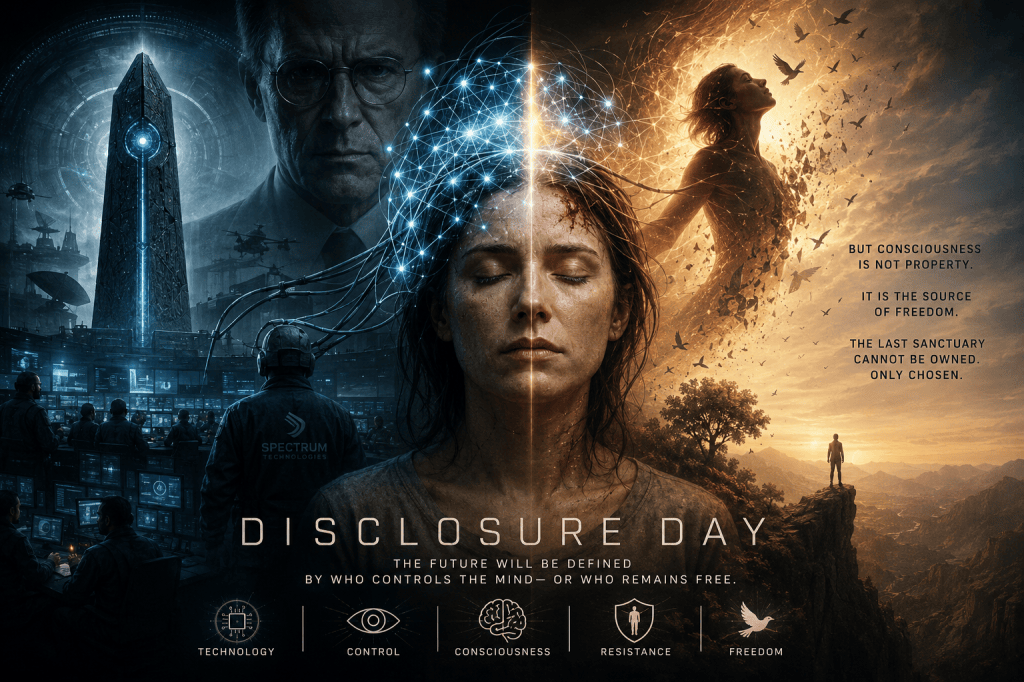
At first glance, Disclosure Day appears to belong comfortably within the tradition of extraterrestrial conspiracy thrillers. It contains crashed UFOs, classified military programs, powerful defense corporations, government secrecy, and recovered alien technology. These elements naturally invite comparisons with decades of science-fiction cinema concerned with offworld civilizations and deep state conspiracies.
Yet to understand Disclosure Day merely as another alien invasion narrative is to overlook its deeper achievement.
The extraterrestrials are not the true subject of the film.
Neither is Roswell.
Nor secret government laboratories.
Nor advanced technology itself.
The true subject of Disclosure Day is human consciousness.
The alien obelisk is simply the narrative instrument through which Spielberg explores one of the oldest philosophical questions in human history:
What makes a human being truly free?
The answer offered by the film is striking.
Freedom is not ultimately political.
It is not primarily technological.
Nor is it merely physical.
Freedom begins with the sovereignty of consciousness.
Everything else follows from that foundation.
A Story About the Mind Rather Than Aliens
Throughout cinematic history, extraterrestrials have frequently served as metaphors.
Sometimes they symbolize fear of invasion.
Sometimes they represent technological superiority.
Sometimes they embody humanity’s encounter with the unknown.
In Disclosure Day, however, the extraterrestrial presence functions differently.
The aliens remain largely in the background.
Their recovered technology occupies center stage.
The true conflict emerges not between humanity and an alien civilization but between competing visions of what consciousness should become.
Noah Scanlon sees consciousness as infrastructure.
Something to be mapped.
Controlled.
Weaponized.
Commercialized.
Integrated into systems of surveillance and military power.
Jane Blankenship, by contrast, represents the opposite principle.
For her, consciousness is not property.
It is personhood itself.
This ideological conflict transforms the film from science fiction into philosophical allegory.
The Obelisk as a Symbol Rather Than a Machine
Although the screenplay presents the alien obelisk as advanced extraterrestrial technology, its symbolic function extends far beyond speculative engineering.
The obelisk represents every technological breakthrough that fundamentally alters the relationship between human beings and their own minds.
Historically, humanity has repeatedly developed technologies that transformed civilization.
Writing externalized memory.
The printing press democratized knowledge.
Electricity extended productivity.
Radio expanded communication.
Television reshaped culture.
The internet interconnected billions of minds.
Artificial intelligence increasingly participates in cognition itself.
Each technological revolution changed not only what people could do but how they thought.
Disclosure Day imagines the logical continuation of that historical trajectory.
What happens when technology no longer mediates communication between people…
but enters consciousness directly?
The obelisk therefore symbolizes the next evolutionary threshold.
The moment technology ceases being external.
The moment it becomes neurological.
The Last Frontier of Privacy
Modern society has witnessed an extraordinary erosion of privacy.
Our movements are tracked.
Our purchases analyzed.
Our communications archived.
Our online behavior continuously monitored.
Algorithms increasingly predict preferences before individuals consciously recognize them themselves.
Yet despite these developments, one sanctuary has largely remained intact.
The interior life of the mind.
One may choose whether to speak.
One may conceal thoughts.
One may refuse confession.
One may preserve silence.
Disclosure Day imagines the disappearance of that final sanctuary.
When Scanlon establishes direct neural access to Jane’s consciousness, privacy reaches its absolute endpoint.
The invasion is no longer informational.
It is existential.
Her memories.
Her intentions.
Her motor functions.
Her decision-making.
All become accessible to external authority.
This represents the ultimate form of surveillance.
Not watching behavior.
Watching consciousness itself.
Technology and Moral Neutrality
One of Spielberg’s most important observations throughout the film is that technology itself remains morally neutral.
The alien obelisk possesses extraordinary capabilities.
It can establish direct neural communication.
It can expand perception.
It can synchronize nervous systems.
None of these functions are inherently evil.
What determines their ethical significance is the intention guiding their use.
This principle echoes every major technological revolution in human history.
Nuclear physics produced electrical power.
It also produced atomic weapons.
Artificial intelligence can accelerate medical research.
It can also automate surveillance.
Genetic engineering may eliminate inherited disease.
It may also enable unprecedented forms of biological control.
Technology amplifies intention.
It rarely determines it.
The true danger therefore lies not within machinery but within the moral character of those directing it.
Noah Scanlon is terrifying not because he possesses advanced technology.
He is terrifying because he views consciousness itself as an instrument of power.
Consciousness as the Final Human Right
Perhaps the deepest philosophical implication of Disclosure Day is that consciousness itself may ultimately become humanity’s most fundamental right.
Traditional political philosophy emphasizes freedom of speech.
Freedom of religion.
Freedom of assembly.
Freedom of movement.
These liberties all presuppose something deeper.
The freedom to think.
Without independent thought, every other freedom gradually becomes symbolic.
Speech becomes repetition.
Belief becomes programming.
Choice becomes simulation.
The film therefore shifts the discussion from civil liberties to cognitive liberty.
Who owns your thoughts?
Who governs intention?
Who authorizes access to consciousness?
These questions remain largely theoretical today.
They may not remain theoretical forever.
Artificial Intelligence and the Next Technological Revolution
Although Disclosure Day focuses upon extraterrestrial technology, its underlying concerns increasingly resonate within contemporary discussions surrounding artificial intelligence, neurotechnology, and brain-computer interfaces.
Modern neural engineering already enables direct communication between brains and machines.
Artificial intelligence increasingly interprets human intention.
Machine learning systems model personality, emotion, attention, and decision-making with growing sophistication.
No existing technology remotely resembles the alien obelisk.
Yet the trajectory deserves thoughtful reflection.
Humanity has entered an era in which technology is moving steadily inward.
From external tools…
to wearable devices…
to implanted interfaces…
to neural decoding.
Each step narrows the distance between computation and consciousness.
The film asks a timely question.
As this boundary disappears,
what ethical principles will remain non-negotiable?
The Battle Between Power and Value
Throughout this analysis, a recurring distinction has emerged.
Two fundamentally different relationships to consciousness.
The first understands consciousness primarily as power.
Power to command.
Power to predict.
Power to manipulate.
Power to optimize.
Power to dominate.
The second understands consciousness as value.
The capacity for truth.
Compassion.
Freedom.
Moral responsibility.
Self-reflection.
Human dignity.
These two visions define the conflict between Noah Scanlon and Jane Blankenship.
Scanlon seeks mastery.
Jane seeks integrity.
His objective is control.
Her objective is authenticity.
This opposition extends far beyond individual characters.
It reflects one of civilization’s oldest ethical tensions.
Whether power exists to serve humanity…
or humanity exists to serve power.
Freedom Begins Within
Jane’s victory over Scanlon ultimately carries significance far beyond physical survival.
She defeats him because she refuses to surrender the distinction between imposed action and authentic intention.
Even while externally controlled,
she internally remains free.
This insight recalls one of the oldest observations within philosophy.
External freedom can be taken.
Internal freedom requires consent.
Empires throughout history have imprisoned bodies.
Much more rarely have they conquered conscience.
Disclosure Day modernizes this ancient insight for the age of neurotechnology.
The battlefield has moved inward.
The contest no longer concerns merely physical territory.
It concerns cognitive territory.
Who occupies the mind?
Who defines reality?
Who determines identity?
Jane answers these questions not through superior force but through unwavering preservation of interior autonomy.
Consciousness and the Future of Civilization
The historical programs examined throughout this essay—Project MKUltra, Project Stargate, Soviet psychotronics, astronaut consciousness research, and modern neuroscience—all point toward an emerging realization.
Humanity increasingly recognizes consciousness as the next great frontier of scientific inquiry.
This development offers extraordinary possibilities.
Treatments for neurological disease.
Restoration of lost communication.
Enhanced education.
Expanded creativity.
New forms of collaboration.
Yet every expansion of capability simultaneously expands responsibility.
The more directly technology interfaces with consciousness,
the greater the ethical obligations governing its use.
The alien obelisk therefore represents not simply futuristic hardware but a warning.
Technological advancement without corresponding moral development creates unprecedented risks.
The future will not be determined solely by what humanity invents.
It will be determined by the wisdom—or the lack of wisdom—with which those inventions are employed.
The Ultimate Disclosure
The title Disclosure Day carries an important double meaning.
Within the narrative, it refers to the revelation of extraterrestrial existence and decades of governmental secrecy.
Yet at a deeper philosophical level, another disclosure occurs.
The film gradually reveals something about humanity itself.
It discloses that consciousness cannot be understood merely as information.
Nor merely as biology.
Nor merely as electrical activity.
Consciousness is the foundation from which freedom, morality, identity, responsibility, and civilization emerge.
The alien technology exposes this truth by threatening it.
Only when consciousness becomes vulnerable do we fully appreciate its value.
In this sense, the real disclosure is not the existence of extraterrestrials.
It is the recognition that the future of civilization may depend less upon mastering advanced technologies than upon understanding the nature of consciousness itself.
Beyond Science Fiction
Great science fiction has never been primarily about the future.
It has always been about the present.
The distant worlds imagined by visionary filmmakers are mirrors reflecting contemporary hopes, fears, and ethical dilemmas.
Disclosure Day belongs firmly within that tradition.
Its alien obelisk is not simply a fictional artifact recovered from Roswell.
It is a metaphor for every technology that challenges the boundary between human freedom and technological capability.
Its psychic interrogation is not merely an action sequence.
It is a dramatization of humanity’s oldest struggle—the preservation of inner freedom against forces seeking external domination.
Its battle is not ultimately between humans and extraterrestrials.
It is between two competing futures.
One future regards consciousness as data to be harvested, predicted, engineered, and controlled.
The other recognizes consciousness as the irreducible foundation of human dignity, moral responsibility, creativity, and freedom.
That choice does not belong to science fiction alone.
As neuroscience, artificial intelligence, neuroengineering, and brain-computer interfaces continue to advance, it is becoming one of the defining ethical questions of the twenty-first century.
In that respect, Disclosure Day functions as far more than entertainment. It is a modern allegory reminding us that every civilization is ultimately judged not by the sophistication of its technologies, but by whether those technologies deepen human freedom or diminish it. The greatest disclosure awaiting humanity may therefore not concern visitors from another world. It may be the realization that the most important frontier has always been the one within—the mystery of consciousness itself, and the enduring responsibility to ensure that every technological advance serves the liberation of the human mind rather than its subjugation.
10. Conclusion
Across Disclosure Day, the narrative gradually reveals itself to be less about extraterrestrial contact and more about a systematic interrogation of what it means to be a conscious, self-determining human being under conditions of extreme technological intrusion. The alien obelisk, the neural synchronization protocols, and the psychic coercion enacted by Noah Scanlon are not isolated speculative inventions; they function as a unified conceptual architecture through which the film examines the fragility and resilience of human consciousness.
At its core, the film proposes a central thesis: the human mind is both the target and the boundary of all power. Every technological extension of influence—whether cultural, media and entertainment, chemical, psychological, electromagnetic, or neural—ultimately converges upon the same frontier: the capacity of consciousness to remain internally autonomous even when externally constrained.
Jane Blankenship’s experience crystallizes this tension with particular clarity. Her struggle is not simply physical resistance against forced motor control, but a layered confrontation between imposed agency and preserved interior awareness. Even when her body becomes an instrument of external command, her consciousness remains capable of observation, evaluation, and refusal. This distinction between enacted behavior and witnessing awareness becomes the decisive factor in her survival.
The film’s broader historical and conceptual framework reinforces this point by weaving together multiple trajectories of twentieth- and twenty-first-century inquiry: MKUltra’s attempts at behavioral dismantling, Project Stargate’s investigations into anomalous perception, Soviet psychotronic engineering, astronaut experiences of perceptual dislocation, and contemporary developments in neurotechnology. Each of these domains reflects a persistent civilizational question—whether consciousness can be measured, modified, extended, or controlled through technological means.
Yet Disclosure Day does not resolve this question in favor of technological determinism. Instead, it repeatedly returns to a more structurally cautious insight: control over external systems does not guarantee control over consciousness itself. Even when the body is overridden, the observing awareness persists. Even when perception is altered, the capacity for internal recognition remains. Even when neural pathways are manipulated, the distinction between imposed action and self-authored intention does not fully collapse.
This is the quiet but decisive boundary the film protects.
At the same time, Disclosure Day refuses to romanticize consciousness as invulnerable or abstractly inviolable. The obelisk’s interface demonstrates that the nervous system is indeed permeable to external influence, and that technological systems—if sufficiently advanced—may gain unprecedented access to cognition, perception, and motor control. The film therefore occupies a critical middle position: neither naive optimism nor absolute dystopian fatalism, but a recognition that consciousness is both deeply embodied and fundamentally irreducible to simple mechanical governance.
This tension defines the ethical gravity of the narrative.
If consciousness can be accessed, it can be influenced.
If it can be influenced, it can be exploited.
And if it can be exploited, then the central challenge of future civilization will not merely be technological innovation, but the establishment of safeguards for cognitive sovereignty.
In this sense, Disclosure Day operates as a warning structure rather than a predictive claim. It suggests that the most significant frontier of technological development is no longer external space, industrial capacity, or even computational power, but the interior domain of subjective awareness itself. The closer technology moves toward direct neural interfacing, the more urgent becomes the question of how autonomy, identity, and moral agency are preserved within that interface.
Jane’s final condition at the end of the psychic sequence—wounded, disoriented, but internally intact—encapsulates the film’s immediate answer. Survival is not defined by the absence of harm, nor by the restoration of bodily control alone. It is defined by the persistence of an inner witnessing capacity that cannot be fully appropriated by external systems.
That persistence makes resistance possible.
That resistance preserves personal freedom.
Yet from the perspective of Gautama the Supreme Arahant, this freedom remains only a relative freedom.
One may successfully resist psychological manipulation.
One may escape political oppression.
One may overcome technological domination.
One may preserve cognitive autonomy against external control.
These are all meaningful victories.
But they do not resolve the deepest condition of existence.
The world itself remains governed by laws far greater than any government, corporation, or advanced technology. Every civilization, regardless of its scientific achievements, continues to exist within the universal processes of competition, conflict, decay, aging, illness, and death. Whether humanity develops artificial intelligence, neural interfaces, extraterrestrial communication, or direct brain-to-brain technology, none of these innovations alters the fundamental structure of conditioned existence.
Technology may expand human capability.
It cannot abolish mortality.
Science may prolong life.
It cannot eliminate aging.
Political systems may defend civil liberty.
They cannot free beings from birth and death.
Even the most advanced civilization imaginable remains subject to the same cosmic laws governing all conditioned existence.
From this perspective, the deepest question raised by Disclosure Day extends beyond technological ethics.
It becomes an existential question.
What constitutes ultimate freedom?
According to Gautama the Supreme Arahant, ultimate freedom is not found in gaining greater mastery over the world, but in completely transcending the world. The goal is not merely to protect consciousness from manipulation within conditioned existence, but to free consciousness entirely from the domain governed by craving, attachment, conflict, aging, and death.
This is why the path taught by Gautama the Supreme Arahant ultimately points beyond every worldly system. Political freedom remains within the world. Scientific progress remains within the world. Technological advancement remains within the world. Even extraordinary expansions of perception remain within the world if they continue to operate inside conditioned existence.
True liberation lies elsewhere.
It lies in the complete cessation of bondage to the conditioned cosmos.
It lies in the ultimate existence of the Deathless realm of Nibbāna.
There, consciousness is no longer threatened by external domination because it has gone beyond the entire world system in which domination exists. There is no competition because there is no such law for survival. There is no conflict because the conditions giving rise to conflict have ceased. There is no aging because such conditioned formation has ended. There is no death because the Deathless realm is beyond birth and dissolution.
Seen from this wider perspective, Disclosure Day becomes more than a cautionary tale about emerging neurotechnology. It becomes an allegory of the human condition itself. Noah Scanlon’s psychic domination represents only one manifestation of a much larger reality: all beings living within the conditioned world are subject to forces that continually shape, constrain, and condition their existence.
The film asks whether the mind can remain free under technological domination.
Gautama the Supreme Arahant asks a still deeper question:
Can consciousness become completely free from the entire conditioned world?
The first question concerns political and technological liberty.
The second concerns ultimate liberation and freedom.
The distinction is profound.
One seeks freedom within the world.
The other seeks freedom from the world.
Thus, the final “disclosure” is not merely a revelation about alien intelligence.
Nor is it simply a warning about future technologies.
It is a recognition about ourselves.
The human mind is not simply another system to be optimized.
It is the very condition through which all systems are understood.
Yet according to Gautama the Supreme Arahant, even the most refined consciousness within the conditioned world is not the final destination. The highest freedom is realized only when consciousness completely transcends the world of becoming and enters the Deathless realm of Nibbāna, where ultimate peace, ultimate security, and ultimate freedom are the exact properties of it very existence.
Viewed in this light, Disclosure Day becomes both a compelling science-fiction thriller and a philosophical meditation. It reminds us that the struggle to preserve the integrity of consciousness is indispensable. But it also points toward a larger truth: preserving the freedom of the mind within the world is only the beginning. The highest aspiration is to follow the path that leads beyond the world itself, to the Deathless realm, where no technology, no empire, no biological process, and no cosmic law of aging and death can ever reach again.


Leave a comment