TEN Principles of Arahanism

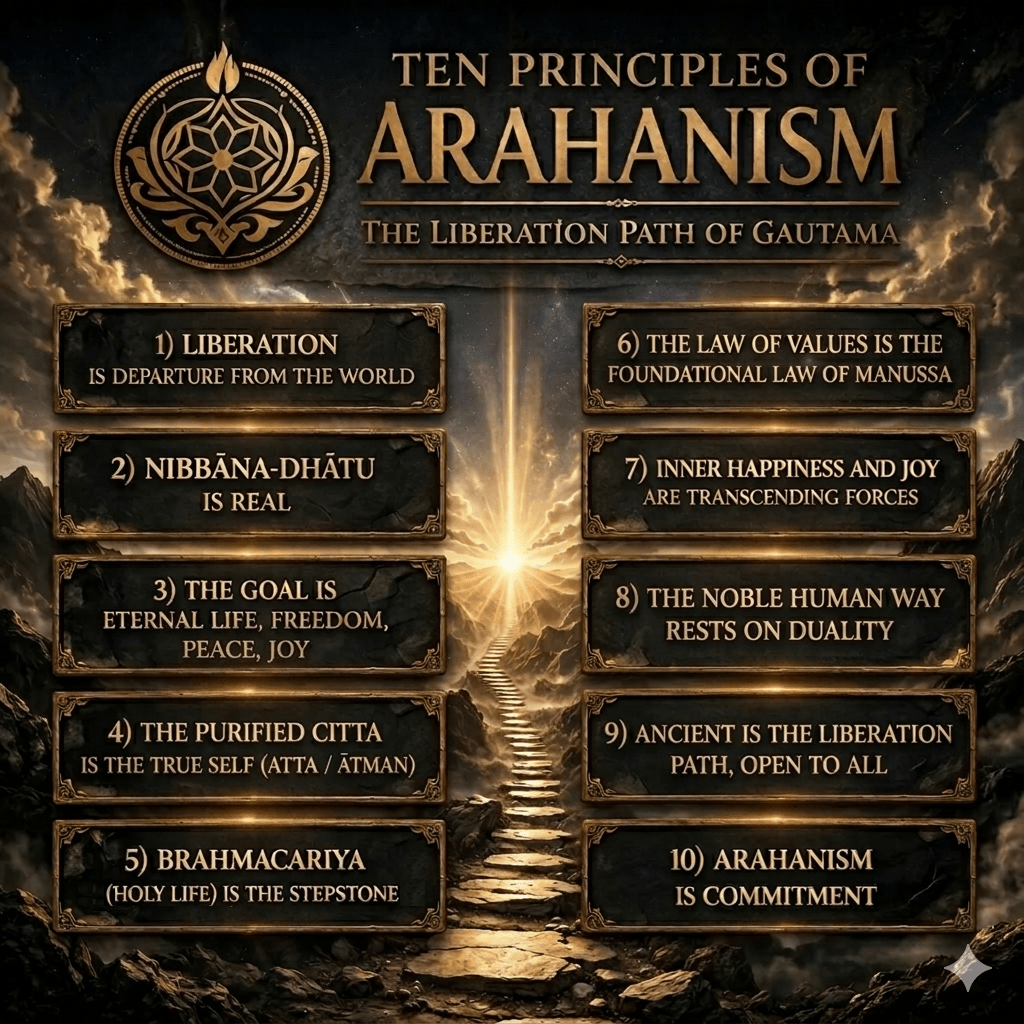
  • 1) Liberation is Departure from the World
  • 2) Nibbāna-Dhātu is Real
  • 3) The Goal is Eternal Life, Freedom, Peace, Joy
  • 4) The Purified Citta is the True Self (Atta / Ātman)
  • 5) Brahmacariya (Holy Life) is the stepstone
  • 6) The Law of Values is the Foundational law of Manussa
  • 7) Inner Happiness and Joy are Transcending Forces
  • 8) the Noble Human way rests on Duality
  • 9) Ancient is the Liberation Path, Open to All
  • 10) Arahanism is Commitment

pali chanting

A stone pathway made of irregular, smooth river stones gently ascending through a misty forest, symbolizing the Liberation Path. Each stone is engraved with one Pali term: Sīla, Samādhi, Paññā, and Nirodha, the words crisply carved and slightly darkened for contrast. Moss and delicate ferns frame the edges of the path, while tall, slender trees fade into soft fog in the distance. Early morning diffused light filters through the canopy, creating a peaceful, luminous atmosphere. Photographic realism with a low, forward-facing angle at ground level, the first stone in sharp focus and subsequent stones gradually softening into bokeh, giving a sense of progression, depth, and quiet determination.
A close-up photographic view of a single, perfectly still flame rising from a modest beeswax candle, its surface slightly textured and warm golden in tone, set against a deep, unfocused background. The candle rests on a low, dark stone slab with fine, natural striations, placed at the center of a simple, uncluttered meditation space. The only light source is the candle itself, casting soft, warm illumination and gentle, expanding shadows around it. The mood is intimate, silent, and profoundly focused, suggesting the refined clarity of samādhi and the glimpse of the deathless. Tight framing and shallow depth of field keep the flame in razor-sharp focus while the surroundings dissolve into a subtle, velvety darkness.
Buddha Vandanā • Ratanattay-anussati
Ratana Sutta Pali Chanting
Maha Mangala Sutta Pali Chanting

Newsletter

Receive new teachings, reflections, and practice resources in your inbox.